

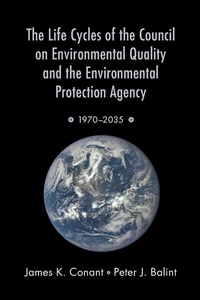
The Life Cycles of the Council on Environmental Quality and the Environmental Protection Agency
1970 - 2035
Published on 14. April 2016
Book
Paperback/Softback
216 pages
978-0-19-020371-9 (ISBN)
Description
During the middle and late 1960s, public concern about the environment grew rapidly, as did Congressional interest in addressing environmental problems. Then, in 1970, a dramatic series of bipartisan actions were taken to expand the national government's efforts to control the volume and types of substances that pollute the air, water, and land. In that year, President Richard Nixon signed into law the National Environmental Policy Act, which established for the first time a national policy on the environment and created the Council on Environmental Quality (CEQ). Additionally, President Nixon created, with Congressional support, the Environmental Protection Agency (EPA), and he signed into law the Clean Air Act of 1970, which had overwhelming bipartisan support in Congress. The strong bipartisan consensus on the need to protect environmental and human health began to erode, however, during the middle and late 1970s as other domestic and foreign policy problems rose to the top of the public and legislative agendas. Ronald Reagan's election to the Presidency in 1980 marked a dramatic shift in both environmental policymaking and administration. Over the thirty years that followed Reagan's election, environmental politics and administration became increasingly polarized.
In this book, James K. Conant and Peter J. Balint examine the trajectory of environmental policy and administration in the United States by looking at the development of the CEQ and EPA. They look at changes in budgetary and staffing resources over time as well as the role of quality of leadership as key indicators of capacity and vitality. As well, they make correlations between the agencies' fortunes and various social, political, and economic variables. Conant and Balint cautiously predict that both agencies are likely to survive over the next twenty years, but that they will both experience continuing volatility as their life histories unfold.
In this book, James K. Conant and Peter J. Balint examine the trajectory of environmental policy and administration in the United States by looking at the development of the CEQ and EPA. They look at changes in budgetary and staffing resources over time as well as the role of quality of leadership as key indicators of capacity and vitality. As well, they make correlations between the agencies' fortunes and various social, political, and economic variables. Conant and Balint cautiously predict that both agencies are likely to survive over the next twenty years, but that they will both experience continuing volatility as their life histories unfold.
Reviews / Votes
In this slim volume, Conant and Balint offer a comprehensive and rewarding history of the U.S. CEQ and the EPA. They ground their assessment in organizational lifecycle models and explore a variety of intriguing questions about the two agencies. Of particular importance is their rigorous analysis of EPA funding over time, which has major implications for the agency's effectiveness during periods of heightened political controversy over environmental policy. * Michael E. Kraft, co-author of Environmental Policy: New Directions for the Twenty-First Century * This book provides an invaluable perspective on the political economy of federal budgeting from the agency point of view. The insights generated by the authors on resource allocation and bureaucratic politics break new ground that hopefully may stimulate much needed new research on the politics of national budgeting. The authors do the great service to students and interested observers alike of demystifying the often obscure and specialized world of budgeting by clearly illustrating and demonstrating the broader policy and political consequences of budget choices and routines. * Paul L. Posner, Chairman, National Academy of Public Administration *More details
Language
English
Place of publication
New York
United States
Target group
College/higher education
Dimensions
Height: 234 mm
Width: 156 mm
Thickness: 12 mm
Weight
333 gr
ISBN-13
978-0-19-020371-9 (9780190203719)
Copyright in bibliographic data and cover images is held by Nielsen Book Services Limited or by the publishers or by their respective licensors: all rights reserved.
Schweitzer Classification
Other editions
Additional editions
James K. Conant | Peter J. Balint
The Life Cycles of the Council on Environmental Quality and the Environmental Protection Agency
1970 - 2035
Book
04/2016
Oxford University Press Inc
€210.20
Shipment within 15-20 days
James K. Conant | Peter J. Balint
The Life Cycles of the Council on Environmental Quality and the Environmental Protection Agency
1970 - 2035
E-Book
02/2016
1st Edition
OUP eBook
€15.49
Available for download
James K. Conant | Peter J. Balint
The Life Cycles of the Council on Environmental Quality and the Environmental Protection Agency
1970 - 2035
E-Book
02/2016
1st Edition
OUP eBook
€14.49
Available for download
Persons
James K. Conant is Professor in the School of Policy, Government, and International Affairs at George Mason University.
Peter J. Balint is Associate Professor in the School of Policy, Government, and International Affairs at George Mason University.
Peter J. Balint is Associate Professor in the School of Policy, Government, and International Affairs at George Mason University.
Content
Preface and Acknowledgments
Chapter 1: Environmental Politics, Policy, and Administration in the United States
Chapter 2: The National Environmental Policy Act of 1969, the Rise of Environmental Protection in the 1970s, and the Political Drama of the Next Three Decades
Chapter 3: Lifecycle Models of Organizations
Chapter 4: The Council on Environmental Quality: 1970-2010
Chapter 5: The Environmental Protection Agency: 1970-2010
Chapter 6: Comparing the Paths of the CEQ and the EPA and Assessing the Lifecycle Models
Chapter 7: The Future of the CEQ and the EPA: 2015-2035
Postscript
Appendix 1
Appendix 2
Notes
Bibliography
Index
Chapter 1: Environmental Politics, Policy, and Administration in the United States
Chapter 2: The National Environmental Policy Act of 1969, the Rise of Environmental Protection in the 1970s, and the Political Drama of the Next Three Decades
Chapter 3: Lifecycle Models of Organizations
Chapter 4: The Council on Environmental Quality: 1970-2010
Chapter 5: The Environmental Protection Agency: 1970-2010
Chapter 6: Comparing the Paths of the CEQ and the EPA and Assessing the Lifecycle Models
Chapter 7: The Future of the CEQ and the EPA: 2015-2035
Postscript
Appendix 1
Appendix 2
Notes
Bibliography
Index