

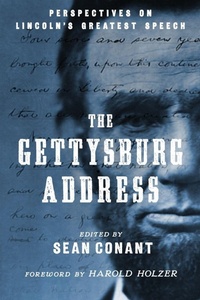
The Gettysburg Address
Perspectives on Lincoln's Greatest Speech
Published on 25. June 2015
Book
Paperback/Softback
368 pages
978-0-19-022745-6 (ISBN)
Description
It is the most famous speech Lincoln ever gave, and one of the most important orations in the history of the nation. Delivered on November 19, 1863, among the freshly dug graves of the Union dead, the Gettysburg Address defined the central meaning of the Civil War and gave cause for the nation's incredible suffering. The poetic language and moral sentiment inspired listeners at the time, and have continued to resonate powerfully with groups and individuals up to the present day. What gives this speech its enduring significance?
This collection of essays, from some of the best-known scholars in the field, answers that question. Placing the Address in complete historical and cultural context and approaching it from a number of fresh perspectives, the volume first identifies how Lincoln was influenced by great thinkers on his own path toward literary and oratory genius. Among others, Nicholas P. Cole draws parallels between the Address and classical texts of Antiquity and John Stauffer considers Lincoln's knowledge of the King James Bible and Shakespeare. The second half of the collection then examines the many ways in which the Gettysburg Address has been interpreted, perceived, and utilized in the past 150 years. Since 1863, African Americans, immigrants, women, gay rights activists, and international figures have invoked the speech's language and righteous sentiments on their respective paths toward freedom and equality. Essays include Louis P. Masur on the role the Address played in eventual emancipation; Jean H. Baker on the speech's importance to the women's rights movement; and Don H. Doyle on the Address's international legacy.
Lincoln spoke at Gettysburg in a defining moment for America, but as the essays in this collection attest, his message is universal and timeless. This work brings together the foremost experts in the field to illuminate the many ways in which that message continues to endure.
This collection of essays, from some of the best-known scholars in the field, answers that question. Placing the Address in complete historical and cultural context and approaching it from a number of fresh perspectives, the volume first identifies how Lincoln was influenced by great thinkers on his own path toward literary and oratory genius. Among others, Nicholas P. Cole draws parallels between the Address and classical texts of Antiquity and John Stauffer considers Lincoln's knowledge of the King James Bible and Shakespeare. The second half of the collection then examines the many ways in which the Gettysburg Address has been interpreted, perceived, and utilized in the past 150 years. Since 1863, African Americans, immigrants, women, gay rights activists, and international figures have invoked the speech's language and righteous sentiments on their respective paths toward freedom and equality. Essays include Louis P. Masur on the role the Address played in eventual emancipation; Jean H. Baker on the speech's importance to the women's rights movement; and Don H. Doyle on the Address's international legacy.
Lincoln spoke at Gettysburg in a defining moment for America, but as the essays in this collection attest, his message is universal and timeless. This work brings together the foremost experts in the field to illuminate the many ways in which that message continues to endure.
Reviews / Votes
Among the multitude of books that have emerged since the sesquicentennial of the Gettysburg Address, this collection edited by Conant emerges as one of the best ... Each essay in this excellent volume provides a useful insight on one of the country's greatest orations ... Essential. * S. J. Ramold, CHOICE *More details
Language
English
Place of publication
New York
United States
Target group
College/higher education
Professional and scholarly
Dimensions
Height: 234 mm
Width: 156 mm
Thickness: 20 mm
Weight
562 gr
ISBN-13
978-0-19-022745-6 (9780190227456)
Copyright in bibliographic data and cover images is held by Nielsen Book Services Limited or by the publishers or by their respective licensors: all rights reserved.
Schweitzer Classification
Other editions
Additional editions
Book
06/2015
Oxford University Press Inc
€150.70
Shipment within 15-20 days
E-Book
04/2015
1st Edition
OUP eBook
€13.49
Available for download
E-Book
04/2015
1st Edition
OUP eBook
€13.49
Available for download
Person
Sean Conant is a documentary filmmaker. He is the writer, producer, and director of the major documentary film "The Gettysburg Address", to be released in 2015.
Content
Preface ; SEAN CONANT ; Foreword ; JAMES M. McPHERSON ; Part I: Influences ; 1. Classical Democracy and the Gettysburg Address ; NICHOLAS P. COLE ; 2. Shakespeare, Religion, and the Gettysburg Address ; JOHN STAUFFER ; 3. "We Here Highly Resolve": The End of Compromise and the Return to Revolutionary Time ; ROBERT PIERCE FORBES ; 4. Democracy at Gettysburg ; SEAN WILENTZ ; 5. Daniel Webster, Abraham Lincoln, and the Gettysburg Address ; CRAIG L. SYMONDS ; 6. Theodore Parker, Transcendentalism, and the Gettysburg Address ; DEAN GRODZINS ; 7. Death and the Gettysburg Address ; MARK S. SCHANTZ ; 8. Shared Suffering and the Way to Gettysburg ; CHANDRA MANNING ; 9. Little Note, Long Remember: Lincoln and the Murk of Myth at Gettysburg ; ALLEN GUELZO ; Part II: Impacts ; 10. "A New Birth of Freedom": Emancipation and the Gettysburg Address ; LOUIS P. MASUR ; 11. "The Great Task Remaining Before Us": Lincoln and Reconstruction ; GEORGE RUTHERGLEN ; 12. Immigration and the Gettysburg Address: Nationalism and Equality at the Gates ; ALISON CLARK EFFORD ; 13. Engendering the Gettysburg Address: Its Meaning for Women ; JEAN H. BAKER ; 14. The Gettysburg Address and Civil Rights ; RAY ARSENAULT ; 15. Widely Noted and Long Remembered: The Gettysburg Address Around the World ; DON H. DOYLE ; 16. The Search for Meaning in Lincoln's Great Oration ; THOMAS A. DESJARDIN ; Afterword ; HAROLD HOLZER ; Appendix: The Five Copies of The Gettysburg Address ; Acknowledgments ; Contributors