

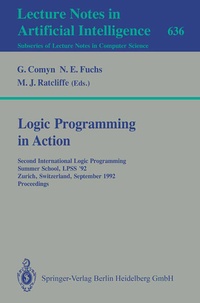
Logic Programming in Action
Second International Logic Programming Summer School, LPSS '92, Zurich, Switzerland, September 7-11, 1992. Proceedings
Published on 25. August 1992
Book
Paperback/Softback
CCCXL, 330 pages
978-3-540-55930-6 (ISBN)
Description
Logic programming enjoys a privileged position. It is firmly
rooted in mathematical logic, yet it is also immensely
practical, as a growing number of users in universities,
research institutes, and industry are realizing. Logic
programming languages, specifically Prolog, have turned out
to be ideal as prototyping and application development
languages.
This volume presents the proceedings of the Second Logic
Programming Summer School, LPSS'92. The First Logic
Programming Summer School, LPSS '90, addressed the
theoretical foundations of logic programming. This volume
focuses onthe relationship between theory and practice, and
on practical applications.
The introduction to the volume is by R. Kowalski, one of the
pioneers in the field. The following papers are organized
into sections on constraint logic programming, deductive
databases and expert systems, processing of natural and
formal languages, software engineering, and education.
More details
Series
Edition
1992 ed.
Language
English
Place of publication
Berlin
Germany
Publishing group
Springer Berlin
Target group
Professional and scholarly
Research
Illustrations
CCCXL, 330 p.
Dimensions
Height: 235 mm
Width: 155 mm
Thickness: 19 mm
Weight
517 gr
ISBN-13
978-3-540-55930-6 (9783540559306)
DOI
10.1007/3-540-55930-2
Schweitzer Classification
Content
Theory and practice in logic programming.- Constraint Logic Programming.- Scheduling and optimisation in the Automobile Industry.- Factory scheduling using finite domains.- The Prince project and its applications.- A (Gentle) introduction to deductive databases.- Knowledge based PPS applications in PROTOS-L.- The SECReTS banking expert system from phase 1 to phase 2.- Logic engineering and clinical dilemmas.- A knowledge-based approach to strategic planning.- Expert systems in mining.- Natural and formal language processing.- PUNDIT - Natural language interfaces.- The Esteam-316 dialogue manager.- Legislation as logic programs.- Knowledge representation for natural language processing.- A set of tools for VHDL design.- Tutorial notes: Reasoning about logic programs.- Software formal specification by logic programming: The example of standard Prolog.- The art of computer un-programming: Reverse engineering in Prolog.- Opium - An advanced debugging system.- Automatic theorem proving within the portable AI Lab.