

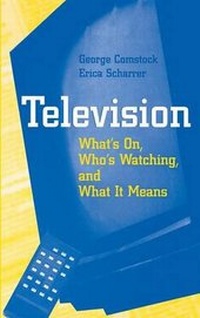
Television
What's on, Who's Watching, and What it Means
Published on 15. April 1999
Book
Hardback
388 pages
978-0-12-183580-4 (ISBN)
Description
Television: What's On, Who's Watching, and What It Means presents a comprehensive examination of the role of television in one's life. The emphasis is on data collected over the past two decades pointing to an increasing and in some instances a surprising influence of the medium. Television is not only watched but its messages are attended to and well understood. There is no shame in spending hours in front of the set, in fact, people over-estimate the time they spend viewing. Television advertising no longer persuades--it sells by creating a burst of emotional liking for the commercial. The emphases of television news determine not only what voters think about but also the presidential candidate they expect to support on election day. Children and teenagers who watch a great deal of television perform poorly on standardized achievement tests, and among the reasons are the usurpation of time spent learning to read and the discouragement of book reading. Television violence frightens some children and excites others, but its foremost effect is to increase aggressive behavior that sometimes spills over into seriously harmful antisocial behavior.
Reviews / Votes
"The renewed debate about media violence makes this comprehensive survey of empirical research on television viewers, content, and effect particularly timely...Highly recommended for all collections." --CHOICE, October 1999"This volume belongs on the bookshelf of all serious media researchers."--JOURNALISM AND MASS COMMUNICATION QUARTERLY
"George Comstock and his former graduate student, Erica Scharrer, examine an impressive array of studies (more than 1,100 are cited) in an attempt to describe the content of TV and to synthesize knowledge about people's uses of TV and the micro- and macroeffects of TV viewing. Comstock is the right person to take on this challenge. During the past quarter century, he has established himself as one of the leading scholars on the influence of TV in American life... the authors... make a significant contribution to an understanding of the role and impact of TV in our lives... the authors do a fine job of distilling and making sense out of the array of often conflicting studies about the content of TV and its effects... The book offers an excellent synthesis of social science research on TV: the essentials about TV--its content, uses, and effects. I recommend the book to all psychologists who are interested in the nature and effects of TV in contemporary America." --CONTEMPORARY PSYCHOLOGY, Vol. 45, 2000
More details
Language
English
Place of publication
San Diego
United States
Publishing group
Elsevier Science Publishing Co Inc
Target group
Professional and scholarly
University researchers and scholars in social psychology, communication, child development, sociology, advertising, marketing, and political science; graduate and senior undergraduate courses in mass media and communications.
Dimensions
Height: 229 mm
Width: 152 mm
Weight
660 gr
ISBN-13
978-0-12-183580-4 (9780121835804)
Copyright in bibliographic data and cover images is held by Nielsen Book Services Limited or by the publishers or by their respective licensors: all rights reserved.
Schweitzer Classification
Other editions
Additional editions
E-Book
04/1999
Academic Press
€83.95
Available for download
Persons
George Comstock earned his Ph.D. at Stanford University. He currently is the S.I. Newhouse Professor at the School of Public Communication, Syracuse University in the Television-Radio-Film Department. He is the author of Television and the American Child and was the senior author of the original Television and Human Behavior.Professor Comstock is a social psychologist and expert on the social effects of mass media. He is former science advisor and senior research coordinator of U.S. Surgeon General's Scientific Advisory Committee on Television and Social Behavior. Professor Comstock teaches classes insocial effects of television and communication research methods. Erica Scharrer is an Associate Professor in the Department of Communication at University of Massachusetts and studies media content, opinions about media, and media influence.
Content
The Industry and the Audience
Three Eras. The Main Means. Assembled to Monitor
Manufacturing the World
Decisions, Stories, and Viewers
The Political Medium
Public Thought and Action
Of Time and Content
Scholastic Performance
Antisocial Behavior
Three Eras. The Main Means. Assembled to Monitor
Manufacturing the World
Decisions, Stories, and Viewers
The Political Medium
Public Thought and Action
Of Time and Content
Scholastic Performance
Antisocial Behavior