

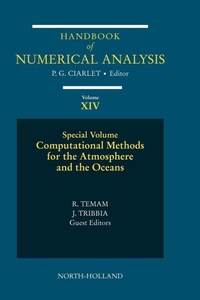
Computational Methods for the Atmosphere and the Oceans: Volume 14
Special Volume
Elsevier (Publisher)
Published on 28. November 2008
Book
Hardback
784 pages
978-0-444-51893-4 (ISBN)
Description
This book provides a survey of the frontiers of research in the numerical modeling and mathematical analysis used in the study of the atmosphere and oceans. The details of the current practices in global atmospheric and ocean models, the assimilation of observational data into such models and the numerical techniques used in theoretical analysis of the atmosphere and ocean are among the topics covered.
Reviews / Votes
"Since the IXth volume in the series 'Handbook of Numerical Analysis', volumes are devoted to a single specific application and are for this reason called 'Special Volumes'. This XIVth volume focuses on Computational Methods of the Atmosphere and the Ocean and serves to bring useful and important geophysical problems to the attention of mathematicians as well as to present useful tools developed by mathematicians. As such, it addresses a wide audience of researchers and is most useful to those which have some previous knowledge of the subject... All chapters of the book are self-contained, include references and, if applicable, mostly gray-scale plots. 31 color-plates are collected at the end of the book." --Zentralblatt MATH 1226-1More details
Series
Language
English
Place of publication
Oxford
United Kingdom
Publishing group
Elsevier Science & Technology
Target group
Professional and scholarly
College/higher education
This compilation is ideal for graduate students and researchers alike: Physical Sciences and Engineering, Numerical Methods in Engineering, Numerical Analysis, Applied Mathematics.
Product notice
Laminated cover
Dimensions
Height: 241 mm
Width: 168 mm
Thickness: 41 mm
Weight
1474 gr
ISBN-13
978-0-444-51893-4 (9780444518934)
Copyright in bibliographic data and cover images is held by Nielsen Book Services Limited or by the publishers or by their respective licensors: all rights reserved.
Schweitzer Classification
Other editions
Additional editions
Computational Methods for the Atmosphere and the Oceans
Special Volume
E-Book
06/2009
Elsevier
€180.00
Available for download
Persons
Content
Part 1. Modeling
1.) Finite-Volume Methods in Meteorology
2.) Computational Kernel Algorithms for Fine-Scale, Multi-Process, Long-Time Oceanic Simulations
Part 2. Nonlinear Methods
3.) Bifurcation analysis of ocean, atmosphere and climate models
4.) Time-Periodic Flows in Geophysical and Classical Fluid Dynamics
5.) Discrete momentum maps for lattice EPDiff
6.) Numerical generation of stochastic differential equations in climate models
Part 3. Turbulence
7.) Large-eddy simulations for geophysical fluid dynamics
8.) Two examples from geophysical and astrophysical turbulence on modeling disparate scale interactions
Part 4. Data Assimilation
9.) Data Assimilation for Geophysical Fluids
10.) Continuum and Discrete Covariance Propagation for Advective Dynamics
Part 5. Analysis
11.) The 3D Primitive Equations in the absence of viscosity: Boundary Conditions and well-posedness in the linearized case
12.) Some Mathematical Problems in Geophysical Fluid Dynamics
1.) Finite-Volume Methods in Meteorology
2.) Computational Kernel Algorithms for Fine-Scale, Multi-Process, Long-Time Oceanic Simulations
Part 2. Nonlinear Methods
3.) Bifurcation analysis of ocean, atmosphere and climate models
4.) Time-Periodic Flows in Geophysical and Classical Fluid Dynamics
5.) Discrete momentum maps for lattice EPDiff
6.) Numerical generation of stochastic differential equations in climate models
Part 3. Turbulence
7.) Large-eddy simulations for geophysical fluid dynamics
8.) Two examples from geophysical and astrophysical turbulence on modeling disparate scale interactions
Part 4. Data Assimilation
9.) Data Assimilation for Geophysical Fluids
10.) Continuum and Discrete Covariance Propagation for Advective Dynamics
Part 5. Analysis
11.) The 3D Primitive Equations in the absence of viscosity: Boundary Conditions and well-posedness in the linearized case
12.) Some Mathematical Problems in Geophysical Fluid Dynamics