

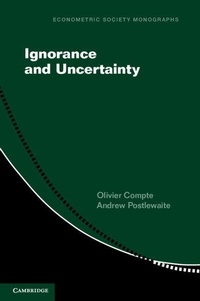
Ignorance and Uncertainty
Published on 13. December 2018
Book
Paperback/Softback
300 pages
978-1-108-43449-2 (ISBN)
Description
Born of a belief that economic insights should not require much mathematical sophistication, this book proposes novel and parsimonious methods to incorporate ignorance and uncertainty into economic modeling, without complex mathematics. Economics has made great strides over the past several decades in modeling agents' decisions when they are incompletely informed, but many economists believe that there are aspects of these models that are less than satisfactory. Among the concerns are that ignorance is not captured well in most models, that agents' presumed cognitive ability is implausible, and that derived optimal behavior is sometimes driven by the fine details of the model rather than the underlying economics. Compte and Postlewaite lay out a tractable way to address these concerns, and to incorporate plausible limitations on agents' sophistication. A central aspect of the proposed methodology is to restrict the strategies assumed available to agents.
Reviews / Votes
'This book provides a refreshing and thought-provoking examination of the standard Bayesian foundations of economic analysis. Anyone who reads it will find themselves thinking differently about economic models and economics. The discipline of economics will be all the richer if the book is regularly read and discussed, by economists and others.' Larry Samuelson, A. Douglas Melamed Professor of Economics, Yale University, Connecticut 'We are in the midst of an era of confusion about what we are trying to accomplish in economic theory. In this book, two insightful economic theorists weigh in on the meaning of economic theory's basic concepts and models. Their comments, even when critical, are given in a spirit of devotion and love for economic theory.' Ariel Rubinstein, Tel Aviv University and New York University 'This is an important book, by two world-leaders in economic theory. It not only provides new insights into longstanding problems, but will also change the way we think about economic modeling and so change how we develop economic theory in the future.' Paul Klemperer, Edgeworth Professor of Economics, University of Oxford 'In this brilliant and path-breaking book, Compte and Postlewaite offer a new way of modeling agent reasoning in microeconomic theory, striking a balance between the demands of equilibrium analysis with 'perfect' rationality and the realities of human cognition. They do not focus on a particular anomaly while embracing the rest of the game-theoretical assumptions. Rather, they focus on plausible ways of reasoning for economic agents, allowing a distinction between the agents' and the modeler's world view. In doing so, Compte and Postlewaite provide a new language for modeling bounded rationality.' Itzhak Gilboa, Tel Aviv University and Ecole des hautes etudes commerciales de ParisMore details
Series
Language
English
Place of publication
Cambridge
United Kingdom
Target group
Professional and scholarly
Product notice
Paperback (trade)
Illustrations
Worked examples or Exercises; 54 Line drawings, black and white
Dimensions
Height: 229 mm
Width: 152 mm
Thickness: 17 mm
Weight
443 gr
ISBN-13
978-1-108-43449-2 (9781108434492)
Copyright in bibliographic data and cover images is held by Nielsen Book Services Limited or by the publishers or by their respective licensors: all rights reserved.
Schweitzer Classification
Other editions
Additional editions
Olivier Compte | Andrew Postlewaite
Ignorance and Uncertainty
E-Book
12/2018
Cambridge University Press
€33.99
Available for download
Olivier Compte | Andrew Postlewaite
Ignorance and Uncertainty
Book
12/2018
Cambridge University Press
€136.20
Shipment within 15-20 days
Persons
Olivier Compte is a Professor at the Paris School of Economics and Ecole des Ponts ParisTech. Andrew Postlewaite is the Harry P. Kamen Professor of Economics and a Professor of Finance at the University of Pennsylvania.
Content
Introduction; Part I. Modeling Challenges: 1. Action space; 2. Ignorance and uncertainty; 3. Observations, perceptions and strategies; 4. Strategies and strategy restrictions; 5. Knowledge and beliefs; Part II. Legends and Myths: 6. Information aggregation; 7. Mechanism design; 8. Surplus extraction; 9. Folk theorems; 10. Comparative statics; Part III. Applications: 11. Auctions; 12. Learning; 13. Reputation; 14. Cooperation; 15. Influence; 16. Information aggregation in markets; 17. Bargaining; 18. Attrition; 19. Reputation; 20. Coordination; 21. Ambiguity and other complexity related aversions; Miscellanea; Index.