

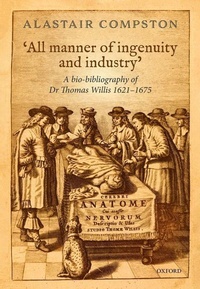
'All manner of ingenuity and industry'
A bio-bibliography of Thomas Willis 1621 - 1675
Published on 2. August 2021
Book
Hardback
824 pages
978-0-19-879539-1 (ISBN)
Description
This book celebrates the quatercentenary of the birth of Thomas Willis on 27 January 1621. As a physician in Oxford, Willis's work in the 1650s provides an example of rural medical practice in early modern England. As a member of the Oxford Philosophical Club that met from the 1640s, he was central to the move from classical scholasticism to accounts of anatomy and physiology based on observation and experiment. As Sedleian professor of natural philosophy in Oxford, the surviving records of his lectures from the 1660s provide an example of pedagogy in medicine at that time. And, after moving to London in 1667, Willis continued to interact with a community of scientists and physicians who transformed ideas on respiration, muscular movement and the nervous system.
Despite a busy clinical practice, Willis found time to write extensively on anatomy and physiology, clinical medicine and therapeutics. These contributions are recognized as wise, original and influential. Between 1659 and 1675, Willis published fourteen treatises. These appeared in six published works, one in two parts, written in Latin. Four of the titles contain engraved plates depicting the brain, muscle, lungs and stomach. The illustrators were Christopher Wren, Richard Lower, Edmund King and possibly Willis himself. Soon after his death, the treatises were published as collected works, also in Latin. Starting in 1679, his writings were translated into English and published as Dr Willis's practice of physic, eventually completed in 1684.
The eighteen chapters of this bio-bibliography are in four sections: chapter 1 is biographical; chapters 2 - 4 describe aspects of the history of the book and illustration relevant to Willis's printed works; chapters 5 - 14 provide bibliographical details of Willis's treatises contained in 102 copies printed in Latin, English, Dutch and French between 1659 and 1721; and chapters 15 - 18 summarise the content of Willis's works and their contribution to medical science.
Despite a busy clinical practice, Willis found time to write extensively on anatomy and physiology, clinical medicine and therapeutics. These contributions are recognized as wise, original and influential. Between 1659 and 1675, Willis published fourteen treatises. These appeared in six published works, one in two parts, written in Latin. Four of the titles contain engraved plates depicting the brain, muscle, lungs and stomach. The illustrators were Christopher Wren, Richard Lower, Edmund King and possibly Willis himself. Soon after his death, the treatises were published as collected works, also in Latin. Starting in 1679, his writings were translated into English and published as Dr Willis's practice of physic, eventually completed in 1684.
The eighteen chapters of this bio-bibliography are in four sections: chapter 1 is biographical; chapters 2 - 4 describe aspects of the history of the book and illustration relevant to Willis's printed works; chapters 5 - 14 provide bibliographical details of Willis's treatises contained in 102 copies printed in Latin, English, Dutch and French between 1659 and 1721; and chapters 15 - 18 summarise the content of Willis's works and their contribution to medical science.
Reviews / Votes
Compston's careful analysis places readers in Willis's presence, providing insights into the ways Willis communicated his learning. This is a work aimed at the most dedicated of Willis scholars but will also be an excellent reference for bibliophiles of medicine. * J. Rankin, CHOICE * This book is a superb work of scholarship and allows the reader to marvel at Willis's early contributions to medicine. The biographical sections are detailed and informative, the bibliography of work is encyclopedic in scope, and the accompanying analysis provides an excellent commentary and analysis of Willis's achievements. The references are detailed in the accompanying footnotes and will allow future researchers more source material for reading. The author has produced an outstanding scholarly contribution to the medical history literature. * Dr. Arpan K. Banerjee, Hektoen International *More details
Edition
1
Language
English
Place of publication
Oxford
United Kingdom
Target group
Professional and scholarly
Product notice
sewn/stitched
Cloth over boards
Dimensions
Height: 255 mm
Width: 182 mm
Thickness: 43 mm
Weight
1778 gr
ISBN-13
978-0-19-879539-1 (9780198795391)
Copyright in bibliographic data and cover images is held by Nielsen Book Services Limited or by the publishers or by their respective licensors: all rights reserved.
Schweitzer Classification
Other editions
Additional editions
Alastair Compston
'All manner of ingenuity and industry'
A bio-bibliography of Thomas Willis 1621 - 1675
E-Book
08/2021
1st Edition
OUP eBook
€88.49
Available for download
Person
Alastair Compston is professor emeritus of neurology in the University of Cambridge. He is a Fellow of Jesus College, Cambridge, and was formerly president of the European Neurological Society and the Association of British Neurologists, and editor of Brain, a journal of neurology. His research on the clinical science of human demyelinating disease has been recognised by several international prizes. He is a Fellow of the Royal Society and the Academy of Medical Sciences; and is elected as a foreign member of the National Academy of Sciences of Germany and the National Academy of Medicine of the USA. He has been appointed Commander of the British Empire. He has a longstanding interest in antiquarian books. His main activity in retirement is writing on the history of medicine
Content
Introduction
1: 'In the tents of the King as well as the Muses': the life and reputation of Thomas Willis
2: 'Setting down experiments of the sciences': printing and the works of Thomas Willis
3: 'To delineate with most skillful hands': illustration and the printed works of Thomas Willis
4: 'The mystery and school house of nature': bibliography and the works of Thomas Willis
5: 'Those first forgotten particles': Diatribae duae medico-philosophicae (1659 - 1687)
6: 'Addicted to the opening of heads': Cerebri anatome (1664 - 1683)
7: 'A certain physiologie and pathology of the brain and nervous stock': Pathologiae cerebri (1667 - 1678)
8: 'An Iliad of evils in the head': Affectionum quae dicuntur hystericae & hypochondriacae (1670 - 1678)
9: 'To understand all things but itself': De anima brutorum (1672 - 1674)
10: 'The happy curing of cephalick diseases': Pharmaceutice rationalis (1674 - 1679)
11: 'To be avoided as if they were sick': A plain and easie method for preserving those that are well from the plague (1691 - 1721)
12: 'The whole dowry of all nature': Opera omnia (1676 - 1720)
13: 'Satisfying a mind desirous of truth': Dr Willis's practice of physick (1679 - 1684)
14: 'Of drudgery in pursuit of lucre': The London practice of physick (1685 - 1695)
15: 'The hearths and altars for the vital fire': medical chemistry and disease
16: 'Neurologie: the doctrine of the nerves': the brain and nervous stock
17: 'A great and difficult thing, and full of hazards': the discourse of the soul
18: 'To practice medicine with a safe conscience': rational therapeutics
1: 'In the tents of the King as well as the Muses': the life and reputation of Thomas Willis
2: 'Setting down experiments of the sciences': printing and the works of Thomas Willis
3: 'To delineate with most skillful hands': illustration and the printed works of Thomas Willis
4: 'The mystery and school house of nature': bibliography and the works of Thomas Willis
5: 'Those first forgotten particles': Diatribae duae medico-philosophicae (1659 - 1687)
6: 'Addicted to the opening of heads': Cerebri anatome (1664 - 1683)
7: 'A certain physiologie and pathology of the brain and nervous stock': Pathologiae cerebri (1667 - 1678)
8: 'An Iliad of evils in the head': Affectionum quae dicuntur hystericae & hypochondriacae (1670 - 1678)
9: 'To understand all things but itself': De anima brutorum (1672 - 1674)
10: 'The happy curing of cephalick diseases': Pharmaceutice rationalis (1674 - 1679)
11: 'To be avoided as if they were sick': A plain and easie method for preserving those that are well from the plague (1691 - 1721)
12: 'The whole dowry of all nature': Opera omnia (1676 - 1720)
13: 'Satisfying a mind desirous of truth': Dr Willis's practice of physick (1679 - 1684)
14: 'Of drudgery in pursuit of lucre': The London practice of physick (1685 - 1695)
15: 'The hearths and altars for the vital fire': medical chemistry and disease
16: 'Neurologie: the doctrine of the nerves': the brain and nervous stock
17: 'A great and difficult thing, and full of hazards': the discourse of the soul
18: 'To practice medicine with a safe conscience': rational therapeutics