

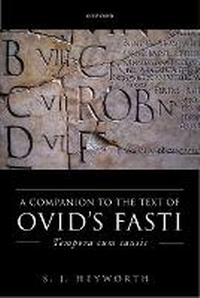
A Companion to Ovid's Fasti
Tempora cum causis
Oxford University Press
Will be published approx. on 14. September 2026
Book
Hardback
608 pages
978-0-19-894264-1 (ISBN)
Description
The Fasti is Ovid's six-book elegy on the first six months of the Roman calendar; it brings the ancient city to life in a way that few other texts achieve. Nevertheless there has been no previous Oxford Classical Text: this book serves as a companion to the OCT published simultaneously. It consists of four parts: (i) a detailed description of the manuscripts used; (ii) notes on the text, passage by passage, book by book; (iii) translations of the six books as printed in the OCT; (iv) a list of errors in the MSS, sorted by type.
Although published under Tiberius, the earliest copy of the Fasti belongs to the 10th century, and even that survives for just over four books. We are mainly dependent on the more than thirty copies dating from 1050 to 1250, a period when there was intense interest in the poem, spreading from the great Benedictine abbeys. The first section describes 26 manuscripts (including three from the 15th century), and explores their character, history, and interconnexions.
The notes are the core of the volume: they explain and justify the text printed in the OCT; and as an acknowledgement that no text is definitive, they attempt to contribute to ongoing debate about the correct readings and the meaning and significance of each couplet, and about the poet's style. Though the discussion in the notes is primarily textual, at times there is consideration of thorny questions of Roman topography, religion, history, and the calendar. Before each section, there are selective bibliographies, including items of importance for literary interpretation or textual criticism.
The volume culminates in an English translation of the text printed in the OCT, and a catalogue of mistakes made by the scribes, with a particular focus on categories such as anagrams, mistakes in the middle of words, contextual and semantic substitutions, interpolations, and intrusive glosses.
Although published under Tiberius, the earliest copy of the Fasti belongs to the 10th century, and even that survives for just over four books. We are mainly dependent on the more than thirty copies dating from 1050 to 1250, a period when there was intense interest in the poem, spreading from the great Benedictine abbeys. The first section describes 26 manuscripts (including three from the 15th century), and explores their character, history, and interconnexions.
The notes are the core of the volume: they explain and justify the text printed in the OCT; and as an acknowledgement that no text is definitive, they attempt to contribute to ongoing debate about the correct readings and the meaning and significance of each couplet, and about the poet's style. Though the discussion in the notes is primarily textual, at times there is consideration of thorny questions of Roman topography, religion, history, and the calendar. Before each section, there are selective bibliographies, including items of importance for literary interpretation or textual criticism.
The volume culminates in an English translation of the text printed in the OCT, and a catalogue of mistakes made by the scribes, with a particular focus on categories such as anagrams, mistakes in the middle of words, contextual and semantic substitutions, interpolations, and intrusive glosses.
More details
Language
English
Place of publication
Oxford
United Kingdom
Dimensions
Height: 234 mm
Width: 156 mm
ISBN-13
978-0-19-894264-1 (9780198942641)
Copyright in bibliographic data and cover images is held by Nielsen Book Services Limited or by the publishers or by their respective licensors: all rights reserved.
Schweitzer Classification
Person
S. J. Heyworth studied at Trinity College, Cambridge. Following that he taught at the Universities of Sheffield and Leeds before becoming Bowra Fellow and Tutor in Classics at Wadham College, Oxford in 1988. From 1993 to 1998 he was editor of Classical Quarterly. In 2007 he issued an Oxford Classical Text of Propertius together with a detailed textual commentary entitled Cynthia, and subsequently literary and grammatical commentaries on Propertius 3 and Aeneid 3 (both in collaboration with James Morwood), and on Ovid, Fasti 3 in 2019. He has published textual notes on Catullus, Vergil, Horace, the Tibullian corpus, and Seneca.
Content
- Preface
- Sigla
- Descriptions of MSS used
- Textual notes
- Translation
- Catalogue of illustrative errors in manuscripts of Ovid's Fasti
- Abbreviations and Bibliography
- Indices
- Sigla
- Descriptions of MSS used
- Textual notes
- Translation
- Catalogue of illustrative errors in manuscripts of Ovid's Fasti
- Abbreviations and Bibliography
- Indices