

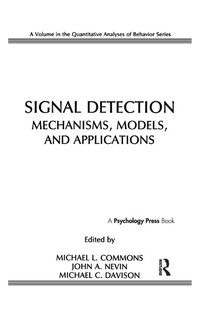
Signal Detection
Mechanisms, Models, and Applications
Published on 1. April 1991
Book
Hardback
310 pages
978-0-8058-0823-0 (ISBN)
Description
This volume is based on the 10th annual Harvard Symposium for the Quantitative Analysis of Behavior. The first Harvard Symposium was devoted to signal-detection analyses of reinforcement and choice behavior. The present volume reprises the original signal- detection theme, incorporating additional insights based on experimental and theoretical analyses undertaken during the years separating the two conferences.
This collection illustrates how signal-detection theory, first advanced to account for performance in threshold-level sensory discrimination, has broadened to encompass a variety of psychological problems involving discriminations between confusable stimuli. The approach is quantitative in its emphasis on estimation of independent parameters of the discrimination process, and analytical in its efforts to separate the determiners of discriminability and bias and to identify the mechanisms of their operation. Above all, the book is broadly integrative in its approach to diverse problems. This volume is based on the 10th annual Harvard Symposium for the Quantitative Analysis of Behavior. The first Harvard Symposium was devoted to signal-detection analyses of reinforcement and choice behavior. The present volume reprises the original signal- detection theme, incorporating additional insights based on experimental and theoretical analyses undertaken during the years separating the two conferences.
This collection illustrates how signal-detection theory, first advanced to account for performance in threshold-level sensory discrimination, has broadened to encompass a variety of psychological problems involving discriminations between confusable stimuli. The approach is quantitative in its emphasis on estimation of independent parameters of the discrimination process, and analytical in its efforts to separate the determiners of discriminability and bias and to identify the mechanisms of their operation. Above all, the book is broadly integrative in its approach to diverse problems. This volume is based on the 10th annual Harvard Symposium for the Quantitative Analysis of Behavior. The first Harvard Symposium was devoted to signal-detection analyses of reinforcement and choice behavior. The present volume reprises the original signal- detection theme, incorporating additional insights based on experimental and theoretical analyses undertaken during the years separating the two conferences.
Reviews / Votes
"This volume is one of the series' most successful in attaining the goal of quantification. Each of the chapters in this book successfully uses a quantitative method inspired by the theory of signal detectability."-Contemporary Psychology
More details
Series
Language
English
Place of publication
Philadelphia
United States
Publishing group
Taylor & Francis Inc
Target group
College/higher education
Professional and scholarly
Dimensions
Height: 235 mm
Width: 157 mm
Thickness: 21 mm
Weight
602 gr
ISBN-13
978-0-8058-0823-0 (9780805808230)
Copyright in bibliographic data and cover images is held by Nielsen Book Services Limited or by the publishers or by their respective licensors: all rights reserved.
Schweitzer Classification
Other editions
Additional editions
Michael L. Commons | John A. Nevin | Michael C. Davison
Signal Detection
Mechanisms, Models, and Applications
Book
07/2015
1st Edition
Psychology Press Ltd
€86.00
Shipment within 10-20 days
Michael L. Commons | John A. Nevin | Michael C. Davison
Signal Detection
Mechanisms, Models, and Applications
E-Book
09/2013
1st Edition
Psychology Press Ltd
€78.99
Available for download
Michael L. Commons | John A. Nevin | Michael C. Davison
Signal Detection
Mechanisms, Models, and Applications
E-Book
09/2013
1st Edition
Psychology Press Ltd
€78.99
Available for download
Persons
Michael L. Commons, John A. Nevin, Michael C. Davison
Content
Contents: M.L. Commons, Preface. J.A. Nevin, M.C. Davison, M.L. Commons, An Introduction to Mechanisms, Models, and Applications of Signal Detection. Part IMechanisms.W.J. McGill, M.C. Teich, Auditory Signal Detection and Amplification in a Neural Transmission Network. B. Alsop, Behavioral Models of Detection and Detection Models of Choice. M. Davison, Stimulus Discriminability, Contingency Discriminability, and Complex Stimulus Control. Part II:Models.J.G. Fetterman, Discrimination of Temporal Same-Different Relations by Pigeons. W.K. Honig, Discriminability and Distinctiveness in Complex Arrays of Simple Elements. S. Chase, E.J. Heinemann, Memory Limitations in Human and Animal Signal Detection. M.L. Commons, M. Woodford, E.J. Trudeau, How Each Reinforcer Contributes to Value: "Noise" Must Reduce Reinforcer Value Hyperbolically. A.W. Logue, M.L. Rodriguez, Signal Detection and Matching: Analyzing Choice on Concurrent Schedules. A.A. Wright, A Detection and Decision Process Model of Matching to Sample. Part IIIApplications.K.G. White, Psychophysics of Direct Remembering. D.C. McCarthy, Behavioral Detection Theory: Some Implications for Applied Human Research. J.A. Nevin, Signal Detection Analysis of Illusions and Heuristics.