

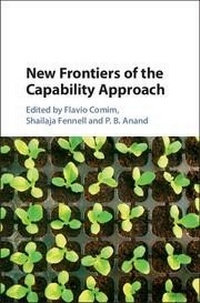
New Frontiers of the Capability Approach
Published on 25. October 2018
Book
Hardback
670 pages
978-1-108-42780-7 (ISBN)
Description
For over three decades, the capability approach proposed and developed by Amartya Sen and Martha Nussbaum has had a distinct impact on development theories and approaches because it goes beyond an economic conception of development and engages with the normative aspects of development. This book explores the new frontiers of the capability approach and its links to human development in three main areas. First, it delves into the philosophical foundations of the approach, re-examining its links to concepts of common good, collective agency and epistemic diversity. Secondly, it addresses its 'operational frontier', aiming to give inclusive explanations of some of the most advanced methods available for capability researchers. Thirdly, it offers a wide range of the applications of this approach, as carried out by a mix of renowned capability scholars and researchers from different disciplines. This broad interdisciplinary range includes the areas of human and sustainable development, inequalities, labour markets, education, special needs, cities, urban planning, housing, social capital and happiness studies, among others.
Reviews / Votes
'Because of its breadth and depth, this book does not explore just the frontiers of the Capability Approach but also the frontiers of social and economic studies in well-being, freedom and justice. Building bridges between disciplines and tackling diverse topical issues, it represents a real challenge to conventional perspectives on development and quality of life. It is also a great resource for scholars of the capability approaches, both for the fascinating reconstruction by Gay Meeks of the evolution of Amartya Sen's thought and for the other excellent chapters that push the boundaries of the framework.' Pasquale De Muro, Universita degli Studi Roma Tre 'The capabilities approach (CA), and its associated insistence on understanding poverty as a multidimensional phenomenon, is now an established field of scholarship and practice in international development. By simultaneously striving to fortify its theoretical foundations, methodological instruments and policy applications, those extending the pioneering contributions of CA's famous founders now preside over a sophisticated, mature and fruitful body of work. This volume amply showcases both the breadth and depth of these efforts, manifest in an array of countries and sectors.' Michael Woolcock, World Bank and Harvard University, MassachusettsMore details
Language
English
Place of publication
Cambridge
United Kingdom
Target group
Professional and scholarly
Edition type
Large type / large print edition
Product notice
sewn/stitched
Cloth over boards
Illustrations
Worked examples or Exercises
Dimensions
Height: 236 mm
Width: 191 mm
Thickness: 30 mm
Weight
1134 gr
ISBN-13
978-1-108-42780-7 (9781108427807)
Copyright in bibliographic data and cover images is held by Nielsen Book Services Limited or by the publishers or by their respective licensors: all rights reserved.
Schweitzer Classification
Other editions
Additional editions
Flavio Comim | Shailaja Fennell | P. B. Anand
New Frontiers of the Capability Approach
Book
06/2021
Cambridge University Press
€71.00
Shipment within 15-20 days
Flavio Comim
New Frontiers of the Capability Approach
E-Book
10/2018
Cambridge University Press
€31.99
Available for download
Flavio Comim | Shailaja Fennell | P. B. Anand
New Frontiers of the Capability Approach
E-Book
10/2018
Cambridge University Press
€112.99
Available for download
Persons
Flavio Comim is an associate professor at the University Ramon Llull/IQS in Spain and an affiliated lecturer at the Centre of Development Studies, University of Cambridge. He has been a consultant for UNESCO, UNEP, FAO, WHO and UNDP. He co-edited the books The Capability Approach: Concepts, Measures and Applications (Cambridge, 2008), with Mozaffar Qizilbash and Sabina Alkire and Capabilities, Gender, Equality (Cambridge, 2014), with Martha Nussbaum. Shailaja Fennell is Lecturer in Development Studies at the University of Cambridge. Her previous publications include Rules, Rubrics and Riches: The Interrelations between Legal Reform and International Development (2010) and Gender Education and Equality in a Global Context: Conceptual Frameworks and Policy Perspectives (ed with M. Arnot, 2008). P. B. Anand is Reader in Environmental Economics and Public Policy at the University of Bradford where he has been teaching since 1998. His previous works include his book Scarcity, Entitlements and the Economics of Water in Developing Countries (2007) and papers on applying the capability approach to issues related to access to water and sustainability.
Content
Introduction Flavio Comim, Shailaja Fennell and P. B. Anand; 1. Key-note chapter: on Sen on the capability of capabilities: the story of a not-for-profit enterprise J. G. Meeks; Part I. The Need for New Foundations: 2. Capabilities and the common good Jonathan Warner; 3. Measuring the meta-capability of agency: theoretical basis for creating a responsibility indicator Mathias Nebel and Maria-Teresa Herrera-Nebel; 4. Equal liberty, reflective equilibrium and education: defending Rawls from Sen's criticisms Caroline Souza and Gabriel Goldmeier; 5. On epistemic diversity, ontologies and assumptions in capability approaches Josh Platzky Miller; 6. Collective agency capability: how capabilities can emerge in a social moment Razia Shariff; Part II. The Operationalisation Frontier: 7. Sen's capability approach, social choice theory and the use of rankings Flavio Comim; 8. Selecting capabilities for development: an evaluation of proposed methods Morten Byskov; 9. From resources to functioning: rethinking and measuring conversion rates Enrica Chiappero, Paola Salardi and Francesco Scervini; 10. Demystifying the use of simultaneous equation models for operationalising the capability approach Jaya Krishnakumar and Ricardo Nogales; Part III. The Application Frontier: 11. Human development in India - comparing Sen and his competitors Des Gasper; 12. Sustainable human development measurement issues: a new proposal Mario Biggeri and Vicenzo Mauro; 13. Inequality and capabilities: a multidimensional empirical exploration in Chile Macarena Orchard and Martina Yopo; 14. Living wages in international supply chains and the capability approach: towards a conceptual framework Stephanie Schrage and Kristin Huber; 15. For a happy human development Tadashi Hirai; 16. Capability of capabilities and aspirations of the middle classes in India Meera Tiwari; 17. The value individual and community social resources Paul Anand; Part IV. The Housing and Urban Frontier: 18. Tracking the transition from 'basic needs' to 'capabilities' for human-centred development: the role of housing in urban inclusion Shailaja Fennell, Jaime Royo-Olid and Matthew Barac; 19. Building regulations through the capability lens: for safer and inclusive built environment? Prachi Acharya; 20. Cities and the capability approach P. B. Anand; Part V. The Education Frontier: 21. Formal education, well-being and aspirations; a capability based analysis on high school pupils from France Robin Vos and Jerome Ballet; 22. Other people's adaptations: teaching children with special educational needs to adapt and to aspire Cristina Devecchi and Michael Watts; 23. Expanding children's capabilities at the writers' workshop Helena Kiff; Education and 'the capability approach Caroline Hart.