

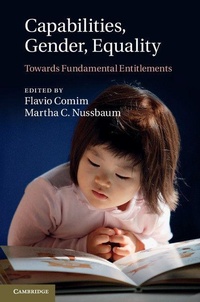
Capabilities, Gender, Equality
Towards Fundamental Entitlements
Published on 17. April 2014
Book
Hardback
484 pages
978-1-107-01569-2 (ISBN)
Description
Questions of gender, injustice and equality pervade all our lives, and as such, the capabilities or 'human development' approach to understanding well-being and basic political entitlements continues to be debated. In this thought-provoking book, a range of authors provide unique reflections on the capabilities approach and, specifically, Martha C. Nussbaum's contributions to issues of gender, equality and political liberalism. Moreover, the authors tackle a broad range of development issues, including those of religion, ecological and environmental justice, social justice, child care, disability and poverty. This is the first book to examine Nussbaum's work in political philosophy in such depth, bringing together a group of distinguished experts with diverse disciplinary perspectives. It also features a unique contribution from Nussbaum herself, in which she offers reactions to the discussion and her latest thoughts on the capabilities approach. Capabilities, Gender, Equality will interest a wide range of readers and policymakers interested in new human development policies.
Reviews / Votes
'This wonderful collection of essays provides an intellectual feast. The authors engage deeply with Nussbaum's capability approach (as distinct from Amartya Sen's capability approach) from a wide range of perspectives - political philosophy, gender, environment, poverty, justice - revealing both Nussbaum's originality and their own insights. You wish yourself immediately in the same room, conversing.' Bina Agarwal 'A thought-provoking interdisciplinary collection of contributions by leading scholars on the theoretical foundations of the capabilities approach, on gender and on equality issues, taking off from Martha C. Nussbaum's pioneering work on these topics. This book is a tribute to Nussbaum's impressive scientific output, a reflection on core aspects of the capabilities approach and an important addition to the literature on human capabilities.' Enrica Chiappero-Martinetti, University of Pavia 'It is important to explore alternative approaches to the interpretation and use of the idea of capabilities, and this wide-ranging collection of essays makes a significant contribution to the on-going debates on the subject. It is a very welcome addition to the literature.' Amartya Sen, Nobel Laureate, Economics 1998More details
Language
English
Place of publication
Cambridge
United Kingdom
Target group
Professional and scholarly
Illustrations
11 Tables, black and white; 5 Halftones, unspecified; 5 Halftones, black and white
Dimensions
Height: 235 mm
Width: 157 mm
Thickness: 30 mm
Weight
845 gr
ISBN-13
978-1-107-01569-2 (9781107015692)
Copyright in bibliographic data and cover images is held by Nielsen Book Services Limited or by the publishers or by their respective licensors: all rights reserved.
Schweitzer Classification
Other editions
Additional editions
Book
08/2018
Cambridge University Press
€54.00
Shipment within 15-20 days
E-Book
04/2014
Cambridge University Press
€26.99
Available for download
E-Book
03/2014
1st Edition
Cambridge University Press
€32.49
Available for download
Persons
Flavio Comim is an Affiliated Lecturer for the Department of Land Economy and the Centre of Development Studies at the University of Cambridge, and he also lectures at the Federal University of Rio Grande do Sul, Brazil. He has published widely in areas such as history of economic thought, economic methodology, development ethics and the capability approach. Martha C. Nussbaum is the Ernst Freund Distinguished Service Professor of Law and Ethics at the University of Chicago, appointed in the Law School and the Philosophy Department. Over the years, Nussbaum has extended and developed the capabilities approach, and she has received numerous awards for her work.
Content
Preface; Introduction: capabilities, challenges, and the omnipresence of political liberalism Martha C. Nussbaum; Part I. The Capabilities Approach: 1. Perfectionist liberalism and political liberalism Martha C. Nussbaum; 2. Rawlsian social-contract theory and the severely disabled Henry S. Richardson; 3. Logos, pathos and ethos in Martha C. Nussbaum's capabilities approach to human development Des Gasper; 4. Building capabilities: a new paradigm for human development Flavio Comim; 5. Capabilities or functionings? Anatomy of a debate Marc Fleurbaey; 6. From humans to all of life: Nussbaum's transformation of dignity Jeremy Bendik-Keymer; Part II. Gender: 7. Questioning the gender-based division of labour: the contribution of the capabilities approach to feminist economics Ulrike Knoblock; 8. Primary goods, capabilities, and the millennium development target for gender equity in education Elaine Unterhalter and Harry Brighouse; 9. The weight of institutions on women's capabilities: how far can microfinance help? Muriel Gilardone, Isabelle Guerin and Jane Palier; 10. The capabilities of women: towards an alternative framework for development Santosh Mehrotra; 11. Applying the capabilities approach to disability, poverty, and gender Patricia Welch Saleeby; 12. Educational transformation, gender justice and Nussbaum's capabilities Melanie Walker; 13. The social contract, unpaid child care and women's income capability Hilde Bojer; Part III. Equality: 14. Lists and thresholds: comparing the Doyal-Gough theory of human need with Nussbaum's capabilities approach Ian Gough; 15. Nussbaum, Rawls, and the ecological limits of justice: using capability ceilings to resolve capability conflicts Breena Holland; 16. Social justice and Nussbaum's concept of the person John M. Alexander; 17. God and Martha C. Nussbaum: towards a Reformed Christian view of capabilities Jonathan Warner; Index.