

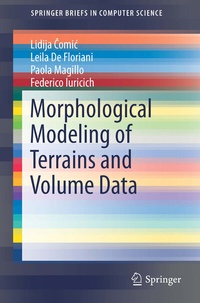
Morphological Modeling of Terrains and Volume Data
Published on 28. October 2014
Book
Paperback/Softback
XI, 116 pages
978-1-4939-2148-5 (ISBN)
Description
This book describes the mathematical background behind discrete approaches to morphological analysis of scalar fields, with a focus on Morse theory and on the discrete theories due to Banchoff and Forman. The algorithms and data structures presented are used for terrain modeling and analysis, molecular shape analysis, and for analysis or visualization of sensor and simulation 3D data sets. It covers a variety of application domains including geography, geology, environmental sciences, medicine and biology. The authors classify the different approaches to morphological analysis which are all based on the construction of Morse or Morse-Smale decompositions. They describe algorithms for computing such decompositions for both 2D and 3D scalar fields, including those based on the discrete watershed transform. Also addressed are recent developments in the research on morphological shape analysis, such as simplification operators for Morse and Morse-Smale complexes and their multi-resolution representation. Designed for professionals and researchers involved with modeling and algorithm analysis, Morphological Modeling of Terrains and Volume Data is a valuable resource. Advanced-level students of computer science, mathematics and geography will also find the content very helpful.
More details
Series
Language
English
Place of publication
New York
United States
Target group
Professional and scholarly
Research
Illustrations
58 s/w Abbildungen
XI, 116 p. 58 illus.
Dimensions
Height: 235 mm
Width: 155 mm
Thickness: 8 mm
Weight
207 gr
ISBN-13
978-1-4939-2148-5 (9781493921485)
DOI
10.1007/978-1-4939-2149-2
Schweitzer Classification
Other editions
Additional editions
Lidija Comic | Leila de Floriani | Paola Magillo
Morphological Modeling of Terrains and Volume Data
E-Book
10/2014
1st Edition
Springer New York
€53.49
Available for download
Content
Background.- Morphology Computation Algorithms: Generalities.- Boundary-Based and Region-Growing Algorithms.- Watershed Algorithms.- A Combinatorial Approach Based on Forman Theory.- Simplification and Multi-Resolution Representations.- Experimental Analysis and Comparisons.