

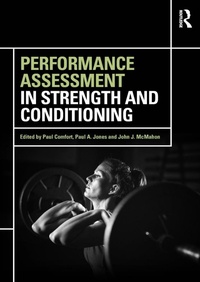
Performance Assessment in Strength and Conditioning
1st Edition
Published on 22. October 2018
Book
Paperback/Softback
382 pages
978-0-415-78938-7 (ISBN)
Description
It is an essential skill for any strength and conditioning coach to be able to reliably assess the physical performance of their athletes and communicate the results and their implications to performers and coaches, alike. Performance Assessment in Strength and Conditioning is the first textbook to clearly and coherently suggest the most appropriate and reliable methods for assessing and monitoring athletes' performance, as well as including detailed sections on testing considerations and the interpretation and application of results.
The book explores the full range of considerations required to reliably assess performance, including questions of ethics and safety, reliability and validity, and standardised testing, before going on to recommend (through a comparison of field- and laboratory-based techniques) the optimal methods for testing all aspects of physical performance, including:
injury risk
jump performance
sprint performance
change of direction and agility
strength
power
aerobic performance
body composition
Closing with a section on interpreting, presenting and applying results to practice, and illustrated with real-life case study data throughout, Performance Assessment in Strength and Conditioning offers the most useful guide to monitoring athlete performance available. It is an essential text for upper-level strength and conditioning students and practitioners alike.
The book explores the full range of considerations required to reliably assess performance, including questions of ethics and safety, reliability and validity, and standardised testing, before going on to recommend (through a comparison of field- and laboratory-based techniques) the optimal methods for testing all aspects of physical performance, including:
injury risk
jump performance
sprint performance
change of direction and agility
strength
power
aerobic performance
body composition
Closing with a section on interpreting, presenting and applying results to practice, and illustrated with real-life case study data throughout, Performance Assessment in Strength and Conditioning offers the most useful guide to monitoring athlete performance available. It is an essential text for upper-level strength and conditioning students and practitioners alike.
More details
Language
English
Place of publication
London
United Kingdom
Publishing group
Taylor & Francis Ltd
Target group
College/higher education
Professional and scholarly
Further/Vocational Education, Postgraduate, Professional, and Undergraduate
Illustrations
31 s/w Zeichnungen, 46 s/w Tabellen, 74 s/w Abbildungen
46 Tables, black and white; 31 Line drawings, black and white; 74 Illustrations, black and white
Dimensions
Height: 246 mm
Width: 174 mm
Thickness: 21 mm
Weight
682 gr
ISBN-13
978-0-415-78938-7 (9780415789387)
Copyright in bibliographic data and cover images is held by Nielsen Book Services Limited or by the publishers or by their respective licensors: all rights reserved.
Schweitzer Classification
Other editions
New editions
Paul Comfort | Paul A. Jones
Performance Assessment in Strength and Conditioning
Book
approx. 04/2026
2nd Edition
Routledge
€115.30
Not yet published
Additional editions
Paul Comfort | Paul A. Jones | John J. McMahon
Performance Assessment in Strength and Conditioning
Book
10/2018
1st Edition
Routledge
€207.40
Shipment within 15-20 days
Paul Comfort | Paul A. Jones | John J. McMahon
Performance Assessment in Strength and Conditioning
E-Book
10/2018
1st Edition
Routledge
€65.99
Available for download
Paul Comfort | Paul A. Jones | John J. McMahon
Performance Assessment in Strength and Conditioning
E-Book
10/2018
Routledge
€65.99
Available for download
Persons
Paul Comfort, PhD, CSCS*D, ASCC, is a Reader in Strength and Conditioning and Programme Leader for the MSc Strength and Conditioning at the University of Salford, UK.
Paul A. Jones, PhD, MSc, BSc (Hons), CSCS*D, BASES Accred. CSci., is a Lecturer in Sports Biomechanics and Strength and Conditioning at the University of Salford, UK.
John J. McMahon, PhD, CSCS, ASCC, is a Lecturer in Sports Biomechanics and Strength and Conditioning (S&C) at the University of Salford, UK.
Paul A. Jones, PhD, MSc, BSc (Hons), CSCS*D, BASES Accred. CSci., is a Lecturer in Sports Biomechanics and Strength and Conditioning at the University of Salford, UK.
John J. McMahon, PhD, CSCS, ASCC, is a Lecturer in Sports Biomechanics and Strength and Conditioning (S&C) at the University of Salford, UK.
Content
Introduction: The Role of Assessing and Monitoring Performance
Part 1: Testing Considerations
1. Ethical and Health and Safety Issues
2. Psychological Issues during Assessment of Performance
3. Reliability, Validity and Measurement Error
4. Standardisation of Testing
5. Structured Testing vs. Continual Monitoring
Part 2: Assessment Methods
6. Assessment of Factors Associated with Injury Risk
7. Vertical Jump Testing
8. Sprint Testing
9. Change of Direction and Agility
10. Strength - Isometric and Dynamic Testing
11. Assessment of Power
12. Aerobic Performance Assessment
13. Body Composition Assessment
14. Combined Assessment Methods
Part 3: Interpretation and Application
15. Interpretation of Results
16. Presentation and Communication of Results
17. Application to Training
Part 1: Testing Considerations
1. Ethical and Health and Safety Issues
2. Psychological Issues during Assessment of Performance
3. Reliability, Validity and Measurement Error
4. Standardisation of Testing
5. Structured Testing vs. Continual Monitoring
Part 2: Assessment Methods
6. Assessment of Factors Associated with Injury Risk
7. Vertical Jump Testing
8. Sprint Testing
9. Change of Direction and Agility
10. Strength - Isometric and Dynamic Testing
11. Assessment of Power
12. Aerobic Performance Assessment
13. Body Composition Assessment
14. Combined Assessment Methods
Part 3: Interpretation and Application
15. Interpretation of Results
16. Presentation and Communication of Results
17. Application to Training