

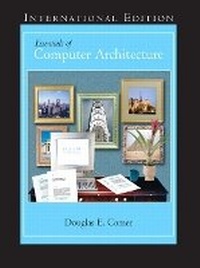
Essentials of Computer Architecture
International Edition
Published on 16. September 2004
Book
Paperback/Softback
400 pages
978-0-13-196426-6 (ISBN)
Description
Essentials of Computer Architecture is ideal for undergraduate courses in computer architecture and organization.
Douglas Comer takes a clear, concise approach to computer architecture that readers love. By exploring the fundamental concepts from a programmer 's perspective and explaining programming consequences, this unique text covers exactly the material students need to understand and construct efficient and correct programs for modern hardware.
Douglas Comer takes a clear, concise approach to computer architecture that readers love. By exploring the fundamental concepts from a programmer 's perspective and explaining programming consequences, this unique text covers exactly the material students need to understand and construct efficient and correct programs for modern hardware.
More details
Language
English
Place of publication
United States
Publishing group
Pearson Education (US)
Target group
Professional and scholarly
Dimensions
Height: 235 mm
Width: 178 mm
Thickness: 20 mm
Weight
591 gr
ISBN-13
978-0-13-196426-6 (9780131964266)
Copyright in bibliographic data and cover images is held by Nielsen Book Services Limited or by the publishers or by their respective licensors: all rights reserved.
Schweitzer Classification
Other editions
Previous edition
Book
09/2004
Pearson
€134.77
Article exhausted; check for reprint
Person
Douglas E. Comer is a Distinguished Professor of Computer Science at Purdue University and a Fellow of the ACM. Comer has experience with both hardware and software. He has created many low-level software systems including TCP/IP protocol software, compilers, device drivers, and an operating system. At Bell Labs, he built a VLSI chip. As a member of the IAB, he participated in the formation of the Internet, and he is considered a leading authority on computer-related topics. A pioneer in the development of curriculum and laboratories for research and education, his popular books have been translated into 16 languages. Comer consults for industry, and has lectured to thousands of professional engineers and students around the world. He is editor-in-chief of the journal Software: Practice and Experience.
Content
(NOTE: All chapters begin with an Introduction and end with a Summary.)
1. Introduction And Overview.
PART I. BASICS.
2. Fundamentals of Digital Logic.
3. Data and Program Representation.
PART II. PROCESSORS.
4. The Variety of Processors and Computational.
5. Processor Types and Instruction Sets.
6. Operand Addressing and Instruction Representation.
7. CPUs: Microcode, Protection, and Processor Modes.
8. Assembly Languages and Programming Paradigm.
PART III. MEMORIES.
9. Memory and Storage.
10. Physical Memory and Physical Addressing.
11. Virtual Memory Technologies and Virtual.
12. Caches and Caching.
PART IV. I/O.
13. Input / Output Concepts and Terminology.
14. Buses and Bus Architectures.
15. Programmed and Interrupt-Driven I/O.
16. A Programmers View of Devices, I/O, and Buffering.
PART V. ADVANCED TOPICS.
17. Parallelism.
18. Pipelining.
19. Assessing Performance.
20. Architecture Examples and Hierarchy.
Appendix 1. Lab Exercises For a Computer Architecture Course.
Bibliography.
Index.
1. Introduction And Overview.
PART I. BASICS.
2. Fundamentals of Digital Logic.
3. Data and Program Representation.
PART II. PROCESSORS.
4. The Variety of Processors and Computational.
5. Processor Types and Instruction Sets.
6. Operand Addressing and Instruction Representation.
7. CPUs: Microcode, Protection, and Processor Modes.
8. Assembly Languages and Programming Paradigm.
PART III. MEMORIES.
9. Memory and Storage.
10. Physical Memory and Physical Addressing.
11. Virtual Memory Technologies and Virtual.
12. Caches and Caching.
PART IV. I/O.
13. Input / Output Concepts and Terminology.
14. Buses and Bus Architectures.
15. Programmed and Interrupt-Driven I/O.
16. A Programmers View of Devices, I/O, and Buffering.
PART V. ADVANCED TOPICS.
17. Parallelism.
18. Pipelining.
19. Assessing Performance.
20. Architecture Examples and Hierarchy.
Appendix 1. Lab Exercises For a Computer Architecture Course.
Bibliography.
Index.