

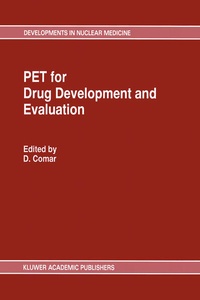
PET for Drug Development and Evaluation
Published on 30. November 1995
Book
Hardback
VIII, 360 pages
978-0-7923-3716-4 (ISBN)
Description
Can drug development and evaluation be improved by the use of positron emission tomography (PET)? PET is now well established and many PET centres participate in networks that warrant the quality of their research. PET allows one to follow the effect of a drug on a variety of patients' metabolic parameters. In addition, PET may be used to follow the fate in vivo of a compound, allowing visualisation of its binding to specific receptors and a direct study of the mechanism of drug action in normal and pathological situations.
The book shows the fields in which PET offers new and unique information for the development of drugs (conception, toxicity, pharmacokinetics and metabolism, clinical research, and relations between clinical and biological effects) and evaluates fields in which PET may shorten the development time of drugs.
Audience: Professionals in the pharmaceutical industry in all areas of drug discovery and pharmacology, pre-clinical testing, pharmacokinetics and metabolism, clinical evaluation, registration and regulatory affairs. Government health authority representatives who assess data and documentation on new drug development and radiopharmaceuticals. Academic experts concerned with any of these areas.
The book shows the fields in which PET offers new and unique information for the development of drugs (conception, toxicity, pharmacokinetics and metabolism, clinical research, and relations between clinical and biological effects) and evaluates fields in which PET may shorten the development time of drugs.
Audience: Professionals in the pharmaceutical industry in all areas of drug discovery and pharmacology, pre-clinical testing, pharmacokinetics and metabolism, clinical evaluation, registration and regulatory affairs. Government health authority representatives who assess data and documentation on new drug development and radiopharmaceuticals. Academic experts concerned with any of these areas.
More details
Series
Edition
1995 ed.
Language
English
Place of publication
Dordrecht
Netherlands
Target group
Professional and scholarly
Research
Illustrations
VIII, 360 p.
Dimensions
Height: 260 mm
Width: 183 mm
Thickness: 28 mm
Weight
980 gr
ISBN-13
978-0-7923-3716-4 (9780792337164)
DOI
10.1007/978-94-011-0429-6
Schweitzer Classification
Other editions
Additional editions
E-Book
12/2012
Springer
€149.79
Available for download
Book
10/2012
Springer
€160.49
Shipment within 15-20 days
Content
one: Introduction.- 1. Drug development and positron emission tomography.- 2. Positron emission tomography: Basic principles and potential interest for pharmacological studies.- 3. Is PET a tool for drug evaluation?.- two: Psychiatry.- 4. PET in neuropsychiatric drug development.- 5. Radioligand disposition and metabolism - Key information in early drug development.- 6. PET studies in the early clinical development of a new antipsychotic.- 7. PET in the development of Dopamine D1 antagonists as new potential antipsychotic drugs.- 8. Is the 5-HT2-receptor a target for antipsychotic drug action? PET studies on dopamine (D2) and serotonin (5-HT2) receptor occupancy in patients and healthy subjects.- 9. Preclinical development of a radioligand for the study of central 5-HT1A receptors with PET-[11C]WAY-100635.- 10. Comparative in vivo and in vitro selectivity of zolpidem for ? (Benzodiazepine) modulatory site subtypes.- 11. Do the effects of muscarinic receptor blockade on brain glucose consumption mimic the cortical and subcortical metabolic pattern of Alzheimer's disease in normal volunteers?.- three: Neurology.- 12. PET evaluation of drug treatment in ischemic stroke and Alzheimer's disease.- 13. PET imaging of cerebral perfusion and oxygen metabolism in acute ischemic stroke: Implications for management and therapy.- 14. Pharmacokinetics: Kinetic modelling of MAO inhibitors and D2 antagonists.- 15. Brain activation under drug treatment.- 16. Modifying the progression of Parkinson's disease.- 17. COMT inhibition: Pharmacology of tolcapone and 6-[18F]-Fluoro-L-Dopa (FDOPA) PET results.- 18. Interaction of Lisuride with dopaminergic receptors.- 19. Lisuride and [C-ll]-raclopride interaction at the D2 receptor site.- four: Cardiology.- 20. Drug design in cardiology:The pharmaceutical industry point of view.- 21. Myocardial receptors and their interaction with cardiovascular drugs.- 22. The pathophysiological background of cardiovascular diseases and its impact on diagnosis and treatment.- 23. Effect of cardiotonic drugs on myocardial oxygen consumption and efficiencyas assessed by 11C-acetate and PET.- 24. Integration of new and classical techniques in drug development. PET application to Propionyl-L-carnitine pharmacokinetic study.- five: Oncology.- 25. The view of the EORTC new drug development office on PET in (pre)clinical trials of anticancer drugs.- 26. Bottlenecks in anticancer drug discovery and development: In vivo pharmacokinetic and pharmacodynamic issues and the potential role of PET.- 27. Radiolabeled anticancer drugs for in vivo pharmacokinetic studies by PET.- 28. The use of radiolabeled anticancer drugs in phase I/II clinical trials and the assessment of therapeutic efficacy of new agents using PET.- 29. Kinetics and applications of F-18-fluorouracil in colorectal tumors.- six: Miscellaneous.- 30. The disposition of a new drug propellant (HFA 134a) in humans studied by fluorine-18 labelling and whole-body ?-counting.- 31. Preclinical characterisation of radiolabeled idoxifene.