

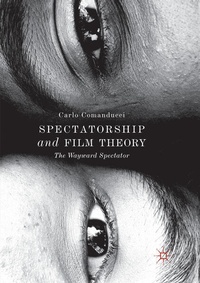
Spectatorship and Film Theory
The Wayward Spectator
Published on 3. January 2019
Book
Paperback/Softback
VII, 208 pages
978-3-030-07240-7 (ISBN)
Description
This book interrogates the relation between film spectatorship and film theory in order to criticise some of the disciplinary and authoritarian assumptions of 1970s apparatus theory, without dismissing its core political concerns. Theory, in this perspective, should not be seen as a practice distinct from spectatorship but rather as an integral aspect of the spectator's gaze. Combining Jacques Rancière's emancipated spectator with Judith Butler's queer theory of subjectivity,
Spectatorship and Film Theory
foregrounds the contingent, embodied and dialogic aspects of our experience of film. Erratic and always a step beyond the grasp of disciplinary discourse, this singular work rejects the notion of the spectator as a fixed position, and instead presents it as a field of tensions-a "wayward" history of encounters.
More details
Edition
Softcover Reprint of the Original 1st 2018 ed.
Language
English
Place of publication
Cham
Switzerland
Publishing group
Springer International Publishing
Target group
Professional and scholarly
Illustrations
VII, 208 p.
Dimensions
Height: 210 mm
Width: 148 mm
Thickness: 12 mm
Weight
286 gr
ISBN-13
978-3-030-07240-7 (9783030072407)
DOI
10.1007/978-3-319-96743-1
Schweitzer Classification
Other editions
Additional editions
Book
09/2018
Palgrave Macmillan
€80.24
Shipment within 10-15 days
Person
Carlo Comanducci
teaches at Vistula University, Warsaw, Poland. He writes on cinema and spectatorship, psychoanalytic theory, anarchy and the politics of aesthetics.
Content
1. Introduction: Film theory, a divided passion?.- 2. The heteronomy of subjectivity and the spectator's emancipation.- 3. Everyday film theory.- 4. Situatedness and contingency of film experience.- 5. The process of free association and film as an evocative object.- 6. The indeterminacy of embodiment.- 7. The spectator as a history of encounters.