

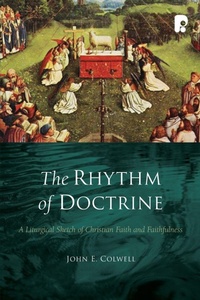
The Rhythm of Doctrine
A Liturgical Sketch of Christian Faith and Faithfulness
Published on 1. April 2007
Book
Paperback/Softback
216 pages
978-1-84227-498-9 (ISBN)
Description
Traditionally, Systematic Theology has been structured around the articles of the Creed: the doctrine of God, the doctrine of Christ, the doctrine of the Spirit, the doctrine of the Church, and so on. Whilst this approach has its benefits it is not without flaws. One weakness is that the roots and context of theology in Christian worship can be lost sight of and discussions can become abstract and disconnected from the life of faith. But there is another way to structure Systematic Theology, an approach more explicitly and self-consciously rooted the pattern of liturgy followed by most Christians for most of the Church's history.
Reviews / Votes
'The Rhythm of Doctrine represents the cutting edge of work being done in worship and theology' Robert Webber, Professor of Ministry, Northern Seminary, Lombard, USA, and President of the Institute for Worship Studies.More details
Language
English
Place of publication
Cumbria
United Kingdom
Publishing group
Send The Light
Dimensions
Height: 229 mm
Width: 152 mm
Thickness: 9 mm
Weight
228 gr
ISBN-13
978-1-84227-498-9 (9781842274989)
Copyright in bibliographic data and cover images is held by Nielsen Book Services Limited or by the publishers or by their respective licensors: all rights reserved.
Schweitzer Classification
Person
John E. Colwell (Ph.D., Kings College, University of London) is Director of post-graduate studies and tutor in Christian Doctrine and Ethics at Spurgeons College. He has published numerous articles and books including Living the Christian Story: The Distinctiveness of Christian Ethics (London, T & T Clark, 2002); Promise and Presence: an exploration of sacramental theology (Milton Keynes: Paternoster Press, 2005); Rhythm of Doctrine: A Liturgical Sketch of Christian Faith and Faithfulness (Milton Keynes: Paternoster Press, 2007) and Why Have You Forsaken Me? A Personal Reflection on the Experience of Desolation (Paternoster, 2009)
- Editorial Review.
- Editorial Review.