

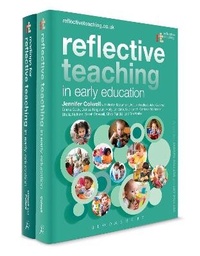
Reflective Teaching in Early Education Pack
Published on 26. February 2015
Book
978-1-4725-9501-0 (ISBN)
Description
Reflective Teaching in Early Education supports both undergraduate and postgraduate students and extended career-long professionalism for early years practitioners working in pre-schools, child care settings and the first years of primary schools. This innovative book offers comprehensive, evidence-based guidance on key issues in early years practice and evidence-informed 'principles' and 'concepts' to encourage a deeper understanding of teaching practices in early childhood education and care.
Readings for Reflective Teaching in Early Education is a unique portable library of exceptional readings, drawing together seminal extracts and contemporary literature, to support both initial study and extended career-long professionalism for early years practitioners. The associated website, reflectiveteaching.co.uk, offers an enormous range of supplementary resources including reflective activities, research briefings, advice on further reading and up-to-date policy and curriculum documents.
Reflective Teaching in Early Education links directly to the companion text, Readings for Reflective Teaching in Early Education, and to the website, reflectiveteaching.co.uk, offering a fully integrated and complementary range of resources.
Readings for Reflective Teaching in Early Education is a unique portable library of exceptional readings, drawing together seminal extracts and contemporary literature, to support both initial study and extended career-long professionalism for early years practitioners. The associated website, reflectiveteaching.co.uk, offers an enormous range of supplementary resources including reflective activities, research briefings, advice on further reading and up-to-date policy and curriculum documents.
Reflective Teaching in Early Education links directly to the companion text, Readings for Reflective Teaching in Early Education, and to the website, reflectiveteaching.co.uk, offering a fully integrated and complementary range of resources.
Reviews / Votes
A very useful and thought-provoking pack. * Elise Alexander, Oxford Brookes University, UK *More details
Series
Language
English
Place of publication
London
United Kingdom
Publishing group
Bloomsbury Publishing PLC
Target group
College/higher education
ISBN-13
978-1-4725-9501-0 (9781472595010)
Copyright in bibliographic data and cover images is held by Nielsen Book Services Limited or by the publishers or by their respective licensors: all rights reserved.
Schweitzer Classification
Persons
Jennifer Colwell is Research Fellow in the Education Research Centre at the University of Brighton, UK.
Andrew Pollard is Professor of Education and supports educational research at the Institute of Education, University of London, UK, and the University of Bristol, UK.
The team includes:
Early Years Educationalists: Helen Beaumont, Helen Bradford, Julie Canavan, Denise Kingston, Holly Linklater, Sue Lynch, Catriona McDonald, Sheila Nutkins and Tim Waller.
Early Years Practitioners: Emma Cook, Sara Ottwell and Chris Randall with staff from One World Nursery and Phoenix Nursery.
Andrew Pollard is Professor of Education and supports educational research at the Institute of Education, University of London, UK, and the University of Bristol, UK.
The team includes:
Early Years Educationalists: Helen Beaumont, Helen Bradford, Julie Canavan, Denise Kingston, Holly Linklater, Sue Lynch, Catriona McDonald, Sheila Nutkins and Tim Waller.
Early Years Practitioners: Emma Cook, Sara Ottwell and Chris Randall with staff from One World Nursery and Phoenix Nursery.
Content
Both volumes within this pack follow the same structure:
Introduction-
Part I: Becoming a Reflective Professional
1. Identity. Who are we, and what do we stand for?
2. Learning. How can we understand learner development?
3. Reflection. How can we develop the quality of our teaching?
4. Principles. What are the foundations of effective teaching and learning?
Part II: Creating Conditions for Learning
5. Contexts. What is, and what might be?
6. Relationships. How are we getting on together?
7. Engagement. How are we managing behaviour?
8. Spaces. How are we creating environments for learning?
Part III: Teaching for Learning
9. Curriculum. What is to be taught and learned?
10. Planning. How are we implementing the curriculum?
11. Pedagogy. How can we develop effective strategies?
12. Communication. How does use of language support learning?
13. Assessment. How can assessment enhance learning?
Part IV: Reflecting on Consequences
14. Outcomes. How do we monitor student learning achievements?
15. Inclusion. How are we enabling learning opportunities?
Part V: Deepening Understanding
16. Expertise. Conceptual tools for career-long fascination?
17. Professionalism. How does reflective teaching contribute to society?
List of case-studies, checklists, figures and research briefings
Bibliography
Acknowledgements
Index
Introduction-
Part I: Becoming a Reflective Professional
1. Identity. Who are we, and what do we stand for?
2. Learning. How can we understand learner development?
3. Reflection. How can we develop the quality of our teaching?
4. Principles. What are the foundations of effective teaching and learning?
Part II: Creating Conditions for Learning
5. Contexts. What is, and what might be?
6. Relationships. How are we getting on together?
7. Engagement. How are we managing behaviour?
8. Spaces. How are we creating environments for learning?
Part III: Teaching for Learning
9. Curriculum. What is to be taught and learned?
10. Planning. How are we implementing the curriculum?
11. Pedagogy. How can we develop effective strategies?
12. Communication. How does use of language support learning?
13. Assessment. How can assessment enhance learning?
Part IV: Reflecting on Consequences
14. Outcomes. How do we monitor student learning achievements?
15. Inclusion. How are we enabling learning opportunities?
Part V: Deepening Understanding
16. Expertise. Conceptual tools for career-long fascination?
17. Professionalism. How does reflective teaching contribute to society?
List of case-studies, checklists, figures and research briefings
Bibliography
Acknowledgements
Index