

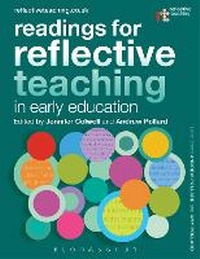
Readings for Reflective Teaching in Early Education
Published on 26. February 2015
Book
Paperback/Softback
416 pages
978-1-4725-1264-2 (ISBN)
Description
Readings for Reflective Teaching in Early Education is a unique portable library of exceptional readings drawing together seminal extracts and contemporary literature from international sources from books and journals to support both initial study and extended career-long professionalism for early years practitioners. Introductions to each reading highlight the key issues explored and explain the status of classic works.
This book, along with the core text and associated website, draw upon the work of Andrew Pollard, former Director of the TLRP, and the work of many years of accumulated understanding of generations of early years practitioners, primary school teachers and educationalists.
Readings for Reflective Teaching in Early Education, the core text, Reflective Teaching in Early Education, and the website, provide a fully integrated set of resources promoting the expertise of early years professionals.
The associated website, www.reflectiveteaching.co.uk offers supplementary resources including reflective activities, research briefings and advice on further readings. It also features a glossary of educational terms, links to useful websites and showcases examples of excellent research and practice. This book forms part of the Reflective Teaching series, edited by Andrew Pollard and Amy Pollard, offering support for reflective practice in early, primary, secondary, further, vocational, university and adult sectors of education.
This book, along with the core text and associated website, draw upon the work of Andrew Pollard, former Director of the TLRP, and the work of many years of accumulated understanding of generations of early years practitioners, primary school teachers and educationalists.
Readings for Reflective Teaching in Early Education, the core text, Reflective Teaching in Early Education, and the website, provide a fully integrated set of resources promoting the expertise of early years professionals.
The associated website, www.reflectiveteaching.co.uk offers supplementary resources including reflective activities, research briefings and advice on further readings. It also features a glossary of educational terms, links to useful websites and showcases examples of excellent research and practice. This book forms part of the Reflective Teaching series, edited by Andrew Pollard and Amy Pollard, offering support for reflective practice in early, primary, secondary, further, vocational, university and adult sectors of education.
Reviews / Votes
Readings for Reflective Teaching in Early Education would support any early years professional, from early years educators to those engaged in teacher training. It will be useful in attempting to access learning in our contemporary world of blended approaches, where face to face contact with more knowledgeable others is limited, and yet the desire to be able to apply theory to practice remains a driving force in the pursuit of clarity regarding, in particular, the nature of the role of the adult in young children's learning. * Heather Davies, Lecturer (Early Years) and Programme Director (Early Years Teacher UG and PG routes), University of Hull, UK * Readings for Reflective Teaching in Early Education offers a wide range of selected readings from a variety of sources, which will be very useful to busy students and teachers whose time is precious. It provides examples of high quality teaching and learning aimed to inspire and motivate educational professionals. Many of these papers will be a starting point for ongoing reflection and references provide follow up material. I am sure student teachers will dip into this many times following their initial education to refresh and develop their ongoing pedagogical practice. * Anne Robertson, Lecturer in Education, Department of Early Years and Primary Education, Institute of Education, University College London, UK * This invaluable insightful collection of reflections on teaching and learning in the early years, focusses on current thinking, research, policy and practice, and offers those working in the early years an opportunity to reflect upon their own developing philosophy. I would wholeheartedly recommend Readings for Reflective Teaching in Early Education to students and practitioners alike. * Lynne Mckenna, Director of Initial Teacher Education Programmes, Northumbria University, UK *More details
Series
Language
English
Place of publication
London
United Kingdom
Publishing group
Bloomsbury Publishing PLC
Target group
College/higher education
Professional and scholarly
Dimensions
Height: 200 mm
Width: 150 mm
Thickness: 20 mm
Weight
829 gr
ISBN-13
978-1-4725-1264-2 (9781472512642)
DOI
CBID179808
Copyright in bibliographic data and cover images is held by Nielsen Book Services Limited or by the publishers or by their respective licensors: all rights reserved.
Schweitzer Classification
Other editions
Additional editions
Jennifer Colwell | Andrew Pollard
Readings for Reflective Teaching in Early Education
E-Book
02/2015
2nd Edition
Bloomsbury Academic
€36.49
Available for download
Jennifer Colwell | Andrew Pollard
Readings for Reflective Teaching in Early Education
E-Book
02/2015
2nd Edition
Bloomsbury Academic
€36.49
Available for download
Persons
Jennifer Colwell is an Educational Consultant and Research Fellow in the Education Research Centre at the University of Brighton, UK.
Andrew Pollard is Professor of Education and supports educational research at IOE, UCL's Faculty of Education and Society, University College London, UK, and the University of Bristol, UK. He was Director of the UK-wide Teaching and Learning Research Programme (TLRP) and advised the government on the National Curriculum Review.
Andrew Pollard is Professor of Education and supports educational research at IOE, UCL's Faculty of Education and Society, University College London, UK, and the University of Bristol, UK. He was Director of the UK-wide Teaching and Learning Research Programme (TLRP) and advised the government on the National Curriculum Review.
Content
Introduction
Part I: Becoming a Reflective Professional
1. Identity. Who are we and what do we stand for?
2. Learning. How can we understand learner development?
3. Reflection. How can we develop the quality of our teaching?
4. Principles. What are the foundations of effective teaching and learning?
Part II: Creating Conditions for Learning
5. Contexts. What is, and what might be?
6. Relationships. How are we getting on together?
7. Engagement. How are we managing behaviour?
8. Spaces. How are we creating environments for learning?
Part III: Teaching for Learning
9. Curriculum. What is taught in the early years?
10. Planning. How are we implementing the curriculum?
11. Pedagogy. How can we develop effective strategies?
12. Communication. How does language support learning?
13. Assessment. How can assessment enhance learning?
Part IV: Reflecting on Consequences
14. Outcomes. How do we capture learning achievements?
15. Inclusion. How are we enabling learning opportunities?
Part V: Deepening Understanding
16. Expertise. Conceptual tools for career-long fascination?
17. Professionalism. How does reflective teaching contribute to society?
List of case-studies, checklists, figures and research briefings
Bibliography
Acknowledgements
Index
Part I: Becoming a Reflective Professional
1. Identity. Who are we and what do we stand for?
2. Learning. How can we understand learner development?
3. Reflection. How can we develop the quality of our teaching?
4. Principles. What are the foundations of effective teaching and learning?
Part II: Creating Conditions for Learning
5. Contexts. What is, and what might be?
6. Relationships. How are we getting on together?
7. Engagement. How are we managing behaviour?
8. Spaces. How are we creating environments for learning?
Part III: Teaching for Learning
9. Curriculum. What is taught in the early years?
10. Planning. How are we implementing the curriculum?
11. Pedagogy. How can we develop effective strategies?
12. Communication. How does language support learning?
13. Assessment. How can assessment enhance learning?
Part IV: Reflecting on Consequences
14. Outcomes. How do we capture learning achievements?
15. Inclusion. How are we enabling learning opportunities?
Part V: Deepening Understanding
16. Expertise. Conceptual tools for career-long fascination?
17. Professionalism. How does reflective teaching contribute to society?
List of case-studies, checklists, figures and research briefings
Bibliography
Acknowledgements
Index