

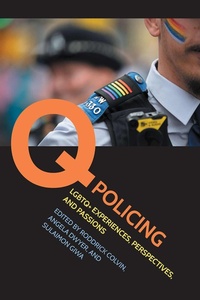
Q Policing
LGBTQ Experiences, Perspectives, and Passions
Will be published approx. on 23. December 2024
Book
Paperback/Softback
264 pages
978-0-8093-3956-3 (ISBN)
Description
Global perspectives on policing within LGBTQ communities Relationships between law enforcement and lesbian, gay, bisexual, transgender, and queer (LGBTQ ) communities have always been varied and complex. On one hand, history is filled with incidents of police harassment: raids that sparked famous uprisings and rebellions; shoddy police investigations into the murders of LGBTQ community members; a corrosive organizational culture marked by heteronormativity and misogyny. Yet positive changes are being made, such as the creation of LGBTQ police associations, participation by police officers in Pride Parades around the world, and formal apologies for past actions. To some LGBTQ community members, police are the physical manifestations of state-sanctioned oppression and abuse. To others, they are guardians who have become partners in public safety. Q Policing features eighteen contributors from around the world who explore the nature of the relationship between LGBTQ communities and the police. Part 1 of the book offers insights on policing and racial and ethnic constructions, including efforts to build collaborative models of community-building within groups and with law enforcement. Part 2 highlights the experiences of individuals who may be marginalized due to various social constructions such as transgender, unhoused, southern, or kink-involved. Finally, Part 3 shares perspectives of queer folks inside policing. The contributors-scholars, social workers, police officers, and other community leaders-cover diverse topics, including queer experiences of policing in southern India, clinical implications for mental health professionals working with Latinx LGBTQ people, transgender and nonbinary peoples' presentation management during encounters with law enforcement, discriminatory policies in place in the southern United States, the pathologization of kink, and more. Essays analyze interviews with the "Pride Defenders" in Hamilton, Canada, as well as British and American police officers transitioning while in uniform. They explore the experiences of gay, lesbian, and genderqueer police officers, map principal findings and central concerns that structure extant scholarship on gay police officers in the UK, use queer theory to explore the effectiveness of LGBTQ liaisons, and more. The volume editors adopt an inclusive global perspective to account for contextually located experiences of queer people within and outside of the United States. The book incorporates a variety of voices, data sources, and methodologies, but contributors share an intentional focus on race, age, sex, gender, and other identities that helps explain and contextualize queer people's experiences around and in policing. The diverse, international group of contributors-whose voices are not often heard in traditional outlets and mainstream media-demonstrates that despite discrimination, harassment, and violence, LGBTQ communities continue to thrive.
Reviews / Votes
"Q Policing is the first volume to fully explore the rich and complex intersections between sexuality, gender diversity, and policing. International in its scope and intersectional in its approach, the authors canvass a wide array of original topics spanning from the policing of queer lives, protest, and kink, to organizational analyses of police bodies, and even to the experiences of queer people serving as police officers. No volume to date has unpacked these threads in such detail or with such nuance. Q Policing is a very welcome addition to queer studies in criminology and criminal justice, and a necessary read."-Matthew Ball, author of Criminology and Queer Theory: Dangerous Bedfellows? "Q Policing covers the diverse LGBTQ experiences with law enforcement systems over the last five decades, from abolition to reform to employment. This interdisciplinary collection provides a contemporary analysis that highlights growing sexuality and gender identities. Their category 'criminal processing system' pushes criminology to acknowledge the limited role of 'justice' in these institutions across the world."-Andrew R. Spieldenner, editor of A Pill for Promiscuity: Gay Sex in an Age of Pharmaceuticals "Readers of this volume will come away with a clear understanding of the challenges, changes, and progress that are occurring between LGBTQ communities and law enforcement. The book is a must-read for all individuals trying to understand the complexities that have plagued the police community and LGBTQ community from working together over the decades."-Richard Greggory Johnson III, coeditor of Unheard Voices: A Collection of Narratives by Black, Gay and Bisexual Men "Q Policing is a welcome addition to queer criminological literature. Colvin, Dwyer, and Giwa have brought together an impressive cadre of scholars, offering a unique and global collection of essays that explore the intersectional experiences of queer people who have come into contact with law enforcement and/or who work as police officers themselves."-Emily Lenning, coauthor of Queer CriminologyMore details
Series
Language
English
Place of publication
Carbondale
United States
Target group
Professional and scholarly
Product notice
Paperback (trade)
Unsewn / adhesive bound
Illustrations
2 images
Dimensions
Height: 226 mm
Width: 152 mm
Thickness: 20 mm
Weight
454 gr
ISBN-13
978-0-8093-3956-3 (9780809339563)
Copyright in bibliographic data and cover images is held by Nielsen Book Services Limited or by the publishers or by their respective licensors: all rights reserved.
Schweitzer Classification
Persons
Roddrick Colvin is professor of public administration and director of the School of Public Affairs at San Diego State University. His research has appeared in the Review of Public Personnel Administration, Police Quarterly, and Women and Criminal Justice. He is the author of Gay and Lesbian Cops: Diversity and Effective Policing.
Angela Dwyer is associate professor in policing and emergency management at the University of Tasmania. Her research on LGBTQ-police relations helped found the queer criminology discipline and she was awarded the Richard Tewksbury Award by the Western Society of Criminology 2022-2023 for this work. She is the lead editor of Queering Criminology.
Sulaimon Giwa is associate professor of social work and police studies, as well as the interim dean of the School of Social Work at Memorial University of Newfoundland and Labrador. He is the coauthor of the second edition of Transforming Community Policing: Mobilization, Engagement, and Collaboration.
Contributions by Roberto L. Abreu, Dhanya Babu, Koree S. Badio, Kwan-Lamar Blount-Hill, Alexa DeGagne, Nicole Elias, Tyson Marlow, Julio A. Martin, Sean A. McCandless, Seth J. Meyer, Paige L. Moore, Lauren Moton, Max Osborn, Heather Panter, Leah Rouse, Nick Rumens, Mitchell D. Sellers, and Emma L. Turley.
Angela Dwyer is associate professor in policing and emergency management at the University of Tasmania. Her research on LGBTQ-police relations helped found the queer criminology discipline and she was awarded the Richard Tewksbury Award by the Western Society of Criminology 2022-2023 for this work. She is the lead editor of Queering Criminology.
Sulaimon Giwa is associate professor of social work and police studies, as well as the interim dean of the School of Social Work at Memorial University of Newfoundland and Labrador. He is the coauthor of the second edition of Transforming Community Policing: Mobilization, Engagement, and Collaboration.
Contributions by Roberto L. Abreu, Dhanya Babu, Koree S. Badio, Kwan-Lamar Blount-Hill, Alexa DeGagne, Nicole Elias, Tyson Marlow, Julio A. Martin, Sean A. McCandless, Seth J. Meyer, Paige L. Moore, Lauren Moton, Max Osborn, Heather Panter, Leah Rouse, Nick Rumens, Mitchell D. Sellers, and Emma L. Turley.
Content
Introduction-Roddrick Colvin, Angela Dwyer, and Sulaimon Giwa Part 1: Intersections with Cultural Diversity 1. Inclusive criminology: A note on queer experiences of police in India-Dhanya Babu and Kwan-Lamar Blount-Hill 2. Latinx LGBTQ communities and law enforcement personnel: Oppression, violence and reform-Julio A. Martin, Koree S. Badio, Tyson Marlow, and Roberto L. Abreu 3. Defending queer space against white supremacists and police in Hamilton-Alexa DeGagne Part 2: Intersections with Marginality 4. Transgender and nonbinary people's presentation management during encounters with police-Max Osborn 5. Inequities among LGBTQ young people: Organizational roles in police departments-Sean A. McCandless 6. LGBTQ policing in the South: A look at protections and police reforms-Mitchell D. Sellers 7. Policing queer kink: Misconceptions, preconceptions, and confusion-Emma L. Turley Part 3: Intersections in Uniform 8. Transitioning in uniform: Identity and conflict within policing-Heather Panter 9. Existence as resistance: The case of lesbian police officers-Lauren Moton 10. Gay police officers in the United Kingdom: Current scholarly research-Nick Rumens 11. Applying Queer Theory to the Role of LGBTQ Police Liaisons-Seth J. Meyer, Nicole Elias and Paige L. Moore 12. Blurring the binaries: the experiences of genderqueer police officers-Angela Dwyer, Leah M. Rouse, and Heather Panter Conclusion References