

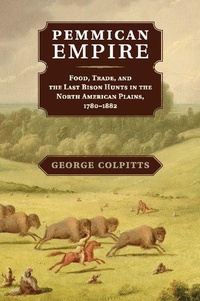
Pemmican Empire
Food, Trade, and the Last Bison Hunts in the North American Plains, 1780-1882
Published on 15. March 2018
Book
Paperback/Softback
318 pages
978-1-107-62289-0 (ISBN)
Description
In the British territories of the North American Great Plains, food figured as a key trading commodity after 1780, when British and Canadian fur companies purchased ever-larger quantities of bison meats and fats (pemmican) from plains hunters to support their commercial expansion across the continent. Pemmican Empire traces the history of the unsustainable food-market hunt on the plains, which, once established, created distinctive trade relations between the newcomers and the native peoples. It resulted in the near annihilation of the Canadian bison herds north of the Missouri River. Drawing on fur company records and a broad range of Native American history accounts, Colpitts offers new perspectives on the market economy of the western prairie that was established during this time, one that created asymmetric power among traders and informed the bioregional history of the West where the North American bison became a food commodity hunted to nearly the last animal.
Reviews / Votes
'At last we have the sweeping story of the destruction of the buffalo herds of North America, not as a subject of natural history but as an inquiry into man's depredations - from the first employment of the mammal's flesh and fat for the making of pemmican, which was the fuel of the fur traders that enabled the spanning of the continent to the Columbia Country, right through to the savage and debilitating corporate wars and rivalries across the forty-ninth parallel. Thoroughly researched and finely written, this distinguished contribution to historical studies tells the tragic story of a world we have lost as individuals, corporations, tribes, and Metis all sought to maximize their benefits in the profligate search for food and for hides. It is a story of universal importance.' Barry Gough, Wilfrid Laurier University 'George Colpitts has given us an utterly fresh and revealing look at the oft-studied story of the plains bison, its exploitation, and its near demise, and he has set that story in its full fascinating natural and economic context. This is a splendid work of environmental history.' Elliott West, University of Arkansas 'Colpitts absolutely provides invaluable insight into the role of the pemmican empire in shaping an economic history of nourishment - physical, but also intellectual and social - in the buffalo commons ...' Brenda Macdougall, Environmental History 'Herein lies the greatest strength of Colpitts' work, and the aspect of his scholarship which may prove most influential. Pemmican is understood here not merely as a product, but as a process - the name comes from the Cree pemmican or pemigan, meaning 'he makes grease.' This draws our attention to the work involved in making pemmican, and to the work which its amazing caloric capacity facilitated. It also highlights pemmican as more than just a combination of meat and fat: it was the result of human decision-making, a tangible expression of the producer's relationships with the animals, people, and economies around them.' Scott P. Stephen, British Colombian QuarterlyMore details
Series
Language
English
Place of publication
Cambridge
United Kingdom
Target group
Professional and scholarly
Product notice
Paperback (trade)
Illustrations
7 Maps; 6 Halftones, unspecified; 6 Halftones, black and white; 19 Line drawings, black and white
Dimensions
Height: 229 mm
Width: 152 mm
Thickness: 19 mm
Weight
518 gr
ISBN-13
978-1-107-62289-0 (9781107622890)
Copyright in bibliographic data and cover images is held by Nielsen Book Services Limited or by the publishers or by their respective licensors: all rights reserved.
Schweitzer Classification
Other editions
Additional editions
George Colpitts
Pemmican Empire
Food, Trade, and the Last Bison Hunts in the North American Plains, 1780-1882
Book
10/2014
Cambridge University Press
€125.70
Shipment within 15-20 days
Person
George Colpitts is Associate Professor of History at the University of Calgary.
Content
Introduction; 1. Changing food-energy regimes in the northern fur trade, 1760-90; 2. The pemmican bioregion, 1790-1810; 3. Food fights and pemmican wars, 1790-1816; 4. Selling bison flesh in the British market after 1821; 5. Commercial war zones in the bison commons, 1835-50; 6. Ending the pemmican era; Conclusion.