

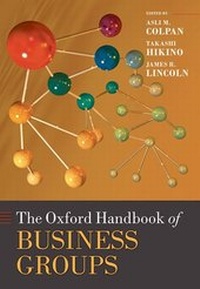
The Oxford Handbook of Business Groups
Published on 5. August 2010
Book
Hardback
828 pages
978-0-19-955286-3 (ISBN)
Description
Business groups - large, diversified, often family-controlled organizations with pyramidal ownership structure, such as the Japanese zaibatsu, the Korean chaebol and the grupos economicos in Latin America - have played a significant role in national economic growth, especially in emerging economies. Earlier variants can also be found in the trading companies, often set up in Britain, which operated in Asia, Africa, and Latin America.
Business groups are often criticized as premodern forms of economic organization, and occasionally as symptomatic of corrupt 'crony capitalism', but many have shown remarkable resilience, navigating and adjusting to economic and political turbulence, international competition, and technological change.
This Handbook provides a comprehensive analysis of business groups around the world. It examines the adaptive and competitive capabilities of business groups, and their evolutionary dynamics. 16 individual country chapters deal with business groups from Asia to Africa, the Middle East to Latin America, while overarching chapters consider the historical and theoretical context of business groups. With contributions from leading experts, The Oxford Handbook of business groups provides a comprehensive, empirically and theoretically rich guide for scholars and policy-makers.
Business groups are often criticized as premodern forms of economic organization, and occasionally as symptomatic of corrupt 'crony capitalism', but many have shown remarkable resilience, navigating and adjusting to economic and political turbulence, international competition, and technological change.
This Handbook provides a comprehensive analysis of business groups around the world. It examines the adaptive and competitive capabilities of business groups, and their evolutionary dynamics. 16 individual country chapters deal with business groups from Asia to Africa, the Middle East to Latin America, while overarching chapters consider the historical and theoretical context of business groups. With contributions from leading experts, The Oxford Handbook of business groups provides a comprehensive, empirically and theoretically rich guide for scholars and policy-makers.
Reviews / Votes
an important new study * Geoffrey Owen, Financial Times *More details
Series
Language
English
Place of publication
Oxford
United Kingdom
Target group
College/higher education
Dimensions
Height: 250 mm
Width: 177 mm
Thickness: 52 mm
Weight
1574 gr
ISBN-13
978-0-19-955286-3 (9780199552863)
Copyright in bibliographic data and cover images is held by Nielsen Book Services Limited or by the publishers or by their respective licensors: all rights reserved.
Schweitzer Classification
Other editions
Additional editions
Asli M. Colpan | Takashi Hikino | James R. Lincoln
The Oxford Handbook of Business Groups
Book
07/2012
Oxford University Press
€53.22
Shipment within 15-20 days
Asli M. Colpan | Takashi Hikino | James R. Lincoln
The Oxford Handbook of Business Groups
E-Book
08/2010
OUP eBook
€39.49
Available for download
Asli M. Colpan | Takashi Hikino | James R. Lincoln
The Oxford Handbook of Business Groups
E-Book
08/2010
OUP eBook
€39.49
Available for download
Persons
Asli M. Colpan is Associate Professor and Mizuho Securities Chair in Strategy and International Business at the Graduate School of Management, Kyoto University. She is also Adjunct Associate Professor of the Kyoto Consortium for Japanese Studies at Colombia University. Her research interests include corporate strategy, corporate governance, and especially the evolution of large enterprises in industrial and emerging economies. Her work has been published in Industrial and Corporate Change, Asia Pacific Journal of Management, and Asian Business and Management.
Takashi Hikino is Associate Professor of Business and Industrial Organization at the Graduate School of Economics and the Graduate School of Management at Kyoto University. His recent publications include Big Business and Wealth of Nations, Cambridge University Press, 1997 (co-edited with Alfred D. Chandler and Franco Amatori), Competing Policies for Competitiveness: Microeconomic Policies During the Golden Age of Capitalism, Oxford University Press, 1998 (co-edited with Hideaki Miyajima and Takeo Kikkawa), and The Global Chemical Industry in the Age of the Petrochemical Revolution, Cambridge University Press, 2006 (co-edited with Louis Galambos and Vera Zamagni).
James R. Lincoln is Mitsubishi Professor of International Business and Finance in the Walter A. Haas School of Business, University of California at Berkeley. His primary research interests include organizational design and innovation, Japanese management, and inter-organizational networks. He is the author of Culture, Control and Commitment: A Study of Work Organization and Work Attitudes in the U.S. and Japan, (with Arne L. Kalleberg), Cambridge University Press, 1990, and Japan's Network Economy: Structure, Persistence and Change, Cambridge University Press, 2004 (with Michael L. Gerlach).
Takashi Hikino is Associate Professor of Business and Industrial Organization at the Graduate School of Economics and the Graduate School of Management at Kyoto University. His recent publications include Big Business and Wealth of Nations, Cambridge University Press, 1997 (co-edited with Alfred D. Chandler and Franco Amatori), Competing Policies for Competitiveness: Microeconomic Policies During the Golden Age of Capitalism, Oxford University Press, 1998 (co-edited with Hideaki Miyajima and Takeo Kikkawa), and The Global Chemical Industry in the Age of the Petrochemical Revolution, Cambridge University Press, 2006 (co-edited with Louis Galambos and Vera Zamagni).
James R. Lincoln is Mitsubishi Professor of International Business and Finance in the Walter A. Haas School of Business, University of California at Berkeley. His primary research interests include organizational design and innovation, Japanese management, and inter-organizational networks. He is the author of Culture, Control and Commitment: A Study of Work Organization and Work Attitudes in the U.S. and Japan, (with Arne L. Kalleberg), Cambridge University Press, 1990, and Japan's Network Economy: Structure, Persistence and Change, Cambridge University Press, 2004 (with Michael L. Gerlach).
Content
PART I: OVERVIEW; 4. BUSINESS GROUPS IN PREWAR JAPAN: HISTORICAL FORMATION AND LEGACY; GROUP 1: ASIA; GROUP 2: LATIN AMERICA; GROUP 3: MIDDLE EAST, EASTERN EUROPE, AND AFRICA; PART III: ECONOMIC, SOCIO-POLITICAL, AND MANAGERIAL UNDERPINNINGS OF BUSINESS GROUPS