

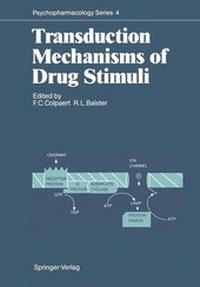
Transduction Mechanisms of Drug Stimuli
1st Edition
Published on 22. April 1988
Book
Hardback
IX, 236 pages
978-3-540-18617-5 (ISBN)
Description
In this book the latest data available on transduction mechanisms of drug stimuli are presented. A common theme underlying the chapter in this volume is the recognition that drugs can act as stimuli, in much the same manner as external events do. Accordingly, the papers focus on the mechanisms by which these stimuli are transduced at different levels of analysis, such as the behavioral, pharmacological, and molecular levels. Some chapters discuss the mechanisms of transduction of the discriminative effects of several important classes of drugs, while others deal with the methods and research strategies by which these mechanisms can be analyzed. Collectively, the papers in this volume reflect the current status of knowledge in the rapidly expanding field of behavioral pharmacology.
More details
Other editions
Additional editions
Francis C. Colpaert | Robert L. Balster
Transduction Mechanisms of Drug Stimuli
E-Book
12/2012
Springer
€96.29
Available for download
Francis C. Colpaert | Robert L. Balster
Transduction Mechanisms of Drug Stimuli
Book
12/2011
Springer
€106.99
Shipment within 7-9 days
Content
Transduction.- Drugs as Chemical Stimuli.- Molecular Mechanisms.- Site-Selective Serotonin Agonists as Discriminative Stimuli.- Discriminative Stimulus Effects of Cholinergic Agonists and the Actions of Their Antagonists.- Stimulus Properties of Dopaminergic Drugs: Comparisons Involving Selective Agonists and Antagonists.- Central Nervous System Stimulants: Neuropharmacological Mechanisms.- Discriminative Stimulus Properties of Anxiolytic and Sedative Drugs: Pharmacological Specificity.- Comparison of Discriminative Stimuli Produced by Full and Partial Benzodiazepine Agonists: Pharmacological Specificity.- Receptor Mechanisms of Opioid Drug Discrimination.- Discriminative and Analgesic Effects of Mu and Kappa Opioids: In Vivo pA2 Analysis.- Receptor Mediation of the Discriminative Stimulus Properties of Phencyclidine and Sigma-Opioid Agonists.- Theory, Concepts, and Research Strategies.- Neural Mechanisms of Drug Stimuli: Experimental Approaches.- Intrinsic Activity and Discriminative Effects of Drugs.- Relationship Between the Discriminative Stimulus Properties and Subjective Effects of Drugs.- Similarities and Differences Between Behavioral Control by Drug-Produced Stimuli and by Sensory Stimuli.- Discrimination Strategies in Animal Psychophysics and Their Role in Understanding Sensory Receptor Function.- Molecular Transduction Mechanisms in ACTH-Induced Grooming.