

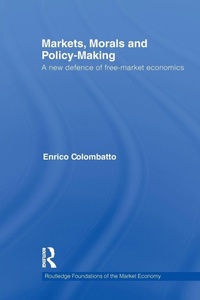
Markets, Morals, and Policy-Making
A New Defense of Free-Market Economics
1st Edition
Published on 8. August 2013
Book
Paperback/Softback
296 pages
978-0-415-71069-5 (ISBN)
Description
Free-market economics has attempted to combine efficiency and freedom by emphasizing the need for neutral rules and meta-rules. These efforts have only been partly successful, for they have failed to address the deeper, normative arguments justifying - and limiting - coercion. This failure has thus left most advocates of free-market vulnerable to formulae which either emphasize expediency or which rely upon optimal social engineering to foster different notions of the common will and of the common good. This book offers the reader a new perspective on free-market economics, one in which the defense of markets is no longer based upon the utilitarian claim that free markets are more efficient; rather, the defense of markets rests upon the moral argument that top-down coercive policy-making is necessarily in tension with the rights-based notion of justice typical of the Western tradition.
In arguing for a consistent moral basis for the free-market view, we depart from both the Austrian and neoclassical traditions by acknowledging that rationality is not a satisfactory starting point. This rejection of rationality as the complete motivator for human economic behaviour throws constitutional economics and the law-and-economics tradition into new relief, revealing these approaches as governed by considerations derived by various notions of social efficiency, rather than by principles consistent with individual freedom, including freedom to choose.
This book shows that the solution is in fact a better understanding of the lessons taught by the Scottish Enlightenment: the role of the political context is to ensure that the individual can pursue his own ends, free from coercion. This also implies individual responsibility, respect for somebody else's preferences and for his entrepreneurial instincts. Social virtue is not absent from this understanding of politics, but rather than being defined through the priorities of policy-makers, it emerges as the outcome of interaction among self-determining individuals. The strongest and most consistent case for free-market economics, therefore, rests on moral philosophy, not on some version of static-efficiency theorizing.
This book should be of interest to students and researchers focussing on economic theory, political economics and the philosophy of economic thought, but is also written in a non-technical style making it accessible to an audience of non-economists.
In arguing for a consistent moral basis for the free-market view, we depart from both the Austrian and neoclassical traditions by acknowledging that rationality is not a satisfactory starting point. This rejection of rationality as the complete motivator for human economic behaviour throws constitutional economics and the law-and-economics tradition into new relief, revealing these approaches as governed by considerations derived by various notions of social efficiency, rather than by principles consistent with individual freedom, including freedom to choose.
This book shows that the solution is in fact a better understanding of the lessons taught by the Scottish Enlightenment: the role of the political context is to ensure that the individual can pursue his own ends, free from coercion. This also implies individual responsibility, respect for somebody else's preferences and for his entrepreneurial instincts. Social virtue is not absent from this understanding of politics, but rather than being defined through the priorities of policy-makers, it emerges as the outcome of interaction among self-determining individuals. The strongest and most consistent case for free-market economics, therefore, rests on moral philosophy, not on some version of static-efficiency theorizing.
This book should be of interest to students and researchers focussing on economic theory, political economics and the philosophy of economic thought, but is also written in a non-technical style making it accessible to an audience of non-economists.
Reviews / Votes
"Economic theory emerged out of the Scottish Enlightenment as a social science with relevance for public issues. Over the past century or so, however, economics retreated into the vapid mechanics of optimization. In this imaginative and creative book, Enrico Colombatto presents a wide-ranging restatement of the moral and social foundations of economics as a publicly-relevant discipline."Richard Wagner, George Mason University, USA
More details
Series
Language
English
Place of publication
London
United Kingdom
Publishing group
Taylor & Francis Ltd
Target group
College/higher education
Dimensions
Height: 234 mm
Width: 156 mm
Thickness: 16 mm
Weight
453 gr
ISBN-13
978-0-415-71069-5 (9780415710695)
Copyright in bibliographic data and cover images is held by Nielsen Book Services Limited or by the publishers or by their respective licensors: all rights reserved.
Schweitzer Classification
Other editions
Additional editions
E-Book
03/2012
1st Edition
Routledge
€55.49
Available for download
E-Book
03/2012
1st Edition
Routledge
€55.49
Available for download
Book
06/2011
1st Edition
Routledge
€232.10
Shipment within 15-20 days
Person
Enrico Colombatto is Professor of Economics at the University of Turin (Italy) and Director of the International Centre for Economic Research.
Content
1. Introduction 2. On the Nature and Scope of Economic Reasoning 3. Time, Rationality, Cooperation 4. Institutions 5. Social Contracts and Historical Rules 6. Legitimacy and Efficiency: An Introduction to Transaction Costs and Law and Economics 7. The Normative Agendas of the Law and Economics Approach 8. Growth and Crises Reconsidered 9. Poverty and Transition 10. Final Remarks on the Economic Way of Thinking