

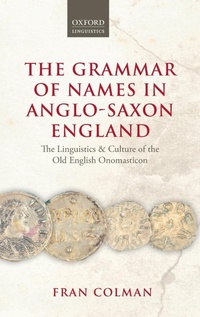
The Grammar of Names in Anglo-Saxon England
The Linguistics and Culture of the Old English Onomasticon
Published on 24. July 2014
Book
Hardback
324 pages
978-0-19-870167-5 (ISBN)
Description
This book examines personal names, including given and acquired (or nick-) names, and how they were used in Anglo-Saxon England. It discusses their etymologies, semantics, and grammatical behaviour, and considers their evolving place in Anglo-Saxon history and culture. From that culture survive thousands of names on coins, in manuscripts, on stone and other inscriptions. Names are important and their absence a stigma (Grendel's parents have no names); they may have particular functions in ritual and magic; they mark individuals, generally people but also beings with close human contact such as dogs, cats, birds, and horses; and they may provide indications of rank and gender.
Dr Colman explores the place of names within the structure of Old English, their derivation, formation, and other linguistic behaviour, and compares them with the products of other Germanic (e.g., Present-day German) and non-Germanic (e.g., Ancient and Present-day Greek) naming systems. Old English personal names typically followed the Germanic system of elements based on common words like leof (adjective 'beloved') and wulf (noun 'wolf'), which give Leofa and Wulf, and often combined as in Wulfraed, (raed noun, 'advice, counsel') or as in Leofing (with the diminutive suffix -ing). The author looks at the combinatorial and sequencing possibilities of these elements in name formation, and assesses the extent to which, in origin, names may be selected to express qualities manifested by, or expected in, an individual. She examines their different modes of inflection and the variable behaviour of names classified as masculine or feminine. The results of her wide-ranging investigation are provocative and stimulating.
Dr Colman explores the place of names within the structure of Old English, their derivation, formation, and other linguistic behaviour, and compares them with the products of other Germanic (e.g., Present-day German) and non-Germanic (e.g., Ancient and Present-day Greek) naming systems. Old English personal names typically followed the Germanic system of elements based on common words like leof (adjective 'beloved') and wulf (noun 'wolf'), which give Leofa and Wulf, and often combined as in Wulfraed, (raed noun, 'advice, counsel') or as in Leofing (with the diminutive suffix -ing). The author looks at the combinatorial and sequencing possibilities of these elements in name formation, and assesses the extent to which, in origin, names may be selected to express qualities manifested by, or expected in, an individual. She examines their different modes of inflection and the variable behaviour of names classified as masculine or feminine. The results of her wide-ranging investigation are provocative and stimulating.
More details
Language
English
Place of publication
Oxford
United Kingdom
Target group
College/higher education
Professional and scholarly
Dimensions
Height: 240 mm
Width: 161 mm
Thickness: 22 mm
Weight
652 gr
ISBN-13
978-0-19-870167-5 (9780198701675)
Copyright in bibliographic data and cover images is held by Nielsen Book Services Limited or by the publishers or by their respective licensors: all rights reserved.
Schweitzer Classification
Other editions
Additional editions
Fran Colman
The Grammar of Names in Anglo-Saxon England
The Linguistics and Culture of the Old English Onomasticon
E-Book
07/2014
1st Edition
OUP eBook
€77.49
Available for download
Person
Retired as Reader in English Language at the University of Edinburgh in 2002, Fran Colman continues to research and lecture on the structure and history of the English language, notably on the names and coinage of Anglo-Saxon England. She has been an invited lecturer at universities and learned societies in Australia, England, Finland, France, Germany, Greece, Poland, Scotland, Spain. Her previous publications include Money Talks: Reconstructing Old English (de Gruyter Mouton, 1992), Sylloge of Coins of the British Isles: Royal Coin Cabinet Stockholm. Part V: Anglo-Saxon Coins: Edward the Confessor and Harold II, 1042-1066 (published for the British Academy by OUP and Spink and Son Ltd., 2007) and, as editor, Evidence for Old English (John Donald, 1992).
Content
PART I: ON NAMES; PART II: TOWARDS THE OLD ENGLISH ONOMASTICON