

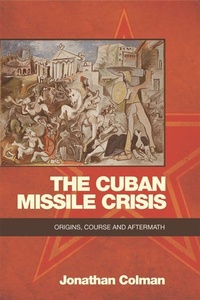
The Cuban Missile Crisis
Origins, Course and Aftermath
Published on 15. February 2016
Book
Paperback/Softback
304 pages
978-0-7486-9630-7 (ISBN)
Description
October 1962, The Cuban Missile Crisis: the confrontation that brought the world closer to nuclear catastrophe than ever before or since. Both John F. Kennedy and Nikita Khrushchev were determined to avoid nuclear war, but events could easily have spiraled out of control with cataclysmic results. Drawing on an extensive body of research, including primary sources released only in the last few years, this work places the crisis in a broader international and chronological context than previously possible. Discover how America was responsible for causing the conflict and Cuba's role as an important actor rather than a superpower pawn.
Reviews / Votes
Despite the Cuban Missile Crisis being one of the most studied episodes of Cold War confrontation, Colman's book is a welcome addition. It provides an excellent overview and will be useful for those unfamiliar with the crisis or looking for an accessible introduction. It will be particularly expedient for undergraduate students as, in addition to the discerning analysis, the appendices provide a chronology of events, short biographies of the major players and a selection of 16 key documents, which elucidate aspects of the main arguments. It will also be welcomed by experts in American foreign policy and the international history of the Cold War more broadly, through an engagement with the most recent research and scholarship on the crisis. Colman's Cuban Missile Crisis is an accessible and eminently readable book for anyone with an interest in the global perspective of one of the most important international events during the Cold War era. -- Conor Tobin, University College Dublin * History: The Journal of the Historical Association * Drawing on both historical documents and state-of-the-art research, this is a valuable introduction to a seminal and timeless event in conflict resolution and political decision-making. -- Associate Professor in War Studies, Swedish National Defence University * J.J. Widen *More details
Language
English
Place of publication
Edinburgh
United Kingdom
Target group
College/higher education
Product notice
Paperback (trade)
Unsewn / adhesive bound
Dimensions
Height: 233 mm
Width: 156 mm
Thickness: 20 mm
Weight
476 gr
ISBN-13
978-0-7486-9630-7 (9780748696307)
Copyright in bibliographic data and cover images is held by Nielsen Book Services Limited or by the publishers or by their respective licensors: all rights reserved.
Schweitzer Classification
Other editions
Additional editions
E-Book
02/2016
1st Edition
Edinburgh University Press
€0.00
Available for download
E-Book
02/2016
1st Edition
Edinburgh University Press
€29.49
Available for download
Person
Jonathan Colman teaches international and US history at the University of Central Lancashire, Preston, England. He is the author of A 'Special Relationship'? Harold Wilson, Lyndon B. Johnson and Anglo-American Relations 'at the Summit', 1964-68 (2004), and The Foreign Policy of Lyndon B. Johnson: The United States and the World, 1963-69 (2010). He has also published numerous articles in leading peer-reviewed journals.
Content
Introduction
1. The United States, the Cuban Revolution and the Cold War, 1959-61
2. The Decision to Base Nuclear Missiles in Cuba, Spring-Summer 1962
3. Discovering the Missile Bases, 14-22 October 1962
4. Confrontation, 22-25 October 1962
5. A World Crisis, 22-28 October 1962
6. Nadir and Resolution, 26-28 October 1962
7. Aftermath I, November-December 1962
8. Aftermath II, 1963-70
Conclusion
Appendix 1: List of Persons
Appendix 2: Chronology
Appendix 3: Biographies
Appendix 4: Documents
1. The United States, the Cuban Revolution and the Cold War, 1959-61
2. The Decision to Base Nuclear Missiles in Cuba, Spring-Summer 1962
3. Discovering the Missile Bases, 14-22 October 1962
4. Confrontation, 22-25 October 1962
5. A World Crisis, 22-28 October 1962
6. Nadir and Resolution, 26-28 October 1962
7. Aftermath I, November-December 1962
8. Aftermath II, 1963-70
Conclusion
Appendix 1: List of Persons
Appendix 2: Chronology
Appendix 3: Biographies
Appendix 4: Documents