

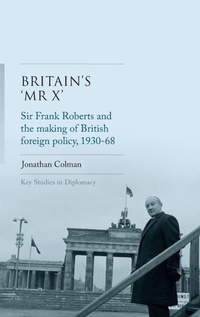
Britain'S 'Mr X'
Sir Frank Roberts and the Making of British Foreign Policy, 1930-68
Published on 29. April 2025
Book
Hardback
248 pages
978-1-5261-8096-4 (ISBN)
Description
Over four decades as a diplomat, Sir Frank Roberts dealt with headline issues, including policy towards Germany during the years of appeasement, the Second World War alliance with the Soviet Union, the origins of the Cold War, NATO affairs, the Berlin and Cuban Missile Crises, European integration, and relations with the Federal Republic of Germany. Collaborating with the renowned American diplomat, George F. Kennan (the cryptonymous author 'X' of an influential 1947 article), his despatches from Moscow in 1946 shaped Britain's Cold War strategy. In 1954 he played an integral part in the diplomacy behind the rearmament of the Federal Republic and her incorporation into NATO, helping to build an enduring structure of transatlantic security. Roberts' career sheds new light on British foreign policy across an era in which Britain slipped from global pre-eminence to regional power status. -- .
Reviews / Votes
Contemporary verdicts about Frank Roberts'The most supremely competent of all the professional diplomatists I have known.'
George F. Kennan
'A sharp-witted and capable person.'
Stalin
'A superlative operator.'
Lord Thomas Brimelow
Reviews of Britain's 'Mr X'
'Frank Roberts was one of the foremost British diplomats of the Cold War. He held senior posts in major European capitals and did much to shape Britain's relations with West Germany, Yugoslavia, NATO and the Soviet Union. A man possessed of a formidable intellect and work ethic, he was widely seen by his contemporaries as the diplomats' diplomat. Dr Colman's book, although focussing primarily on Roberts' diplomatic career, is also very strongly biographical, casting fascinating insights into his subject's formative years, including his cherished Lancashire roots. Dr Colman is a leading British historian of the Cold War in Europe and North America, and this book benefits enormously from the depth of insight that he is thus able to bring to the material. Anyone interested in twentieth century British foreign policy, especially in the period after the Second World War, should read this book.'
Gaynor Johnson, Professor Emerita in International History, University of Kent
'A powerful reminder that international relations are shaped by people and that there are many, like Frank Roberts, who play a key role without becoming household names.'
Allen Packwood, Director, Churchill Archives Centre, University of Cambridge
'Jonathan Colman's latest book is a welcome addition to the literature on twentieth century British foreign policy, focusing as it does on one of the country's leading diplomats, Sir Frank Roberts, who rose to become ambassador to Yugoslavia (1954-57), NATO (1957-60), the USSR (1960-62) and West Germany (1963-68). As well as allowing us to see diplomacy from the viewpoint of a consummate insider and throwing new light on key episodes, like the Cuban Missile Crisis, Colman's exhaustive study of Roberts' career, based on meticulous transatlantic research, is especially useful for highlighting distinctively British approaches to global issues. This is especially clear in 1946, when Roberts' belief that Britain, though firmness and patience, could find a way to work with the Kremlin, had both similarities to and differences from the view of his American colleague, George F. Kennan.'
John W. Young, Professor Emeritus in History, University of Nottingham. -- .
More details
Series
Language
English
Place of publication
Manchester
United Kingdom
Target group
College/higher education
Professional and scholarly
Dimensions
Height: 240 mm
Width: 161 mm
Thickness: 18 mm
Weight
540 gr
ISBN-13
978-1-5261-8096-4 (9781526180964)
Copyright in bibliographic data and cover images is held by Nielsen Book Services Limited or by the publishers or by their respective licensors: all rights reserved.
Schweitzer Classification
Other editions
Additional editions
E-Book
04/2025
Manchester University Press
€124.99
Available for download
Person
Jonathan Colman is Senior Lecturer in International History at the University of Lancashire. A former By-Fellow at the Churchill Archives Centre, Churchill College, Cambridge, he has published widely on British and American foreign policies and diplomatic representation. -- .
Content
Introduction: Britain's 'Mr X'
Prelude
1. Approaching war, 1930-39
2. The 'Ancient Alliance': Portugal, 1943
3. Upholding allied unity: The Polish question, 1941-45
4. The beginning of the Cold War: Moscow, 1945-47
5. Negotiating with Stalin and Molotov: Principal Private Secretary to Bevin, 1947-49
6. 'Great power' in the Foreign Office: German affairs, 1951-54
7. Contending with Tito: Belgrade, 1954-57
8. Defending British defence policy: The NATO Atlantic Council, 1957-60
9. Two crises in Moscow, 1960-62
10. Between vetoes: Bonn, 1963-68
Conclusion: Britain's 'Mr X' -- .
Prelude
1. Approaching war, 1930-39
2. The 'Ancient Alliance': Portugal, 1943
3. Upholding allied unity: The Polish question, 1941-45
4. The beginning of the Cold War: Moscow, 1945-47
5. Negotiating with Stalin and Molotov: Principal Private Secretary to Bevin, 1947-49
6. 'Great power' in the Foreign Office: German affairs, 1951-54
7. Contending with Tito: Belgrade, 1954-57
8. Defending British defence policy: The NATO Atlantic Council, 1957-60
9. Two crises in Moscow, 1960-62
10. Between vetoes: Bonn, 1963-68
Conclusion: Britain's 'Mr X' -- .