

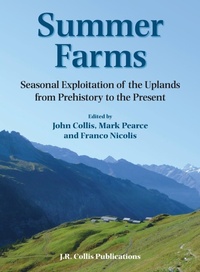
Summer Farms
Seasonal Exploitation of the Uplands from Prehistory to the Present
1st Edition
Will be published approx. on 31. August 2017
Book
Paperback/Softback
262 pages
978-0-906090-56-5 (ISBN)
Description
Summer farms occur throughout the world where there are rich pastures that can only be utilised for part of the year, mainly because they are under snow and ice during the winter. In Europe transhumance is often a major event when the cattle and other livestock leave their home villages and move up into the mountains, and likewise on their return. The best known sites in Europe are perhaps those found in the Alpine areas, but they occur everywhere where there are suitable highland areas to exploit, even on small islands such as the Isle of Man. Traditionally they have been the subject of the studies of ethnographers and anthropologists, especially in the second half of the 20th century when technological and economic changes led to the gradual abandonment of the farms and to other ways of exploiting the highlands. The farmers of the last generation that lived on these farms is gradually disappearing and with them the oral records and memories, and now it is archaeologists who are leading the studies both to record the last famers and more specifically looking at the history of such farming which can stretch back into prehistory, and certainly to at least the Bronze Age with the rise in importance of 'Secondary Products' such as cheese which could be stored for use over winter. Much of the evidence can only be gathered by surface survey and by excavation, though in some cases there are good written sources which have yet to be fully exploited. This was the topic of two sessions at meetings of the European Association of Archaeologists, at Oslo in 2011 and Helsinki in 2012, and this volume publishes a dozen case studies, as well as brief summaries of other projects in Europe, extending from the Black Sea in the east to northern Spain and Iceland in the west, though with a concentration on the Alpine area.
One thing that emerges is the very varied nature of these sites, both in their chronology, who the people were who went to the farms, the distances travelled, and the other activities associated with transhumance such as mining. In some cases the products were primarily for the subsistence of the agricultural population, but in other cases they were traded and could produce a large amount of profit. This is the first overview of these sites in Europe written from an archaeological point of view.
More details
Series
Language
English
Place of publication
London
United Kingdom
Target group
College/higher education
Illustrations
172 colour and black and white figures
Dimensions
Height: 276 mm
Width: 203 mm
Thickness: 17 mm
Weight
913 gr
ISBN-13
978-0-906090-56-5 (9780906090565)
Copyright in bibliographic data and cover images is held by Nielsen Book Services Limited or by the publishers or by their respective licensors: all rights reserved.
Schweitzer Classification
Persons
John Collis is Professor Emeritus in the Department of Archaeology, University of Sheffield. Mark Pearce is Professor of Mediterranean Prehistory, University of Nottingham. Franco Nicolis is Director of the Office of Archaeological Heritage in Trentino, northern Italy.
Content
1: Summer Farms: An Introduction John Collis 2: Pastoral Exploitation of the Caspian and Don Steppes and the North Caucasus during the Bronze Age: Seasonality and Isotopes N.I. Shishlina, Russian State Historical Museum, and Y.O. Larionova, Russian Academy of Sciences 3: `Salas': Summer Farming and Transhumance in the Czech Republic from a (Pre)historic and Environmental Perspective Dagmar Dreslerova, Czech Academy of Sciences 4: Hard Cheese: Upland Pastoralism in the Italian Bronze and Iron Ages Mark Pearce, University of Nottingham 5: Shepherds and Miners through Time in the Veneto Highlands: Ethnoarchaeology and Archaeology Mara Migliavacca, University of Padua 6: Seasonal Settlements and Husbandry Resources in the Ligurian Apennines (17th-20th centuries) Anna Maria Stagno, University of Genoa/University of the Basque Country 7: The `Invisible' Shepherd and the `Visible' Dairyman: Ethnoarchaeology of Alpine Pastoral Sites in the Val di Fiemme (Eastern Italian Alps) Francesco Carrer, University of York 8: Going up the Mountain! Exploitation of the Trentino Highlands as Summer Farms during the Bronze Age: The Dosso Rotondo Site at Storo (Northern Italy) Franco Nicolis, Elisabetta Mottes, Provincia autonoma di Trento, Michele Bassetti, Cora Societa Archeologica, Elisabetta Castiglioni, Musei Civici di Como, Mauro Rottoli, Musei Civici di Como and Sara Ziggiotti 9: Pastoral Land Use and Climate between the 17th and 19th Century in the Italian Southern Alps (Pasubio Massif, Trento): A Preliminary Report Marco Avanzini and Isabella Salvador, Museo delle Scienze, Trento 10: Alpine Huts, Livestock and Cheese in the Oberhasli Region (Switzerland): Medieval and Early Modern Building Remains and their Historical Context Brigitte Andres, Independent Scholar 11: Driving Forces and Variability in the Exploitation of a High-altitude Landscape from the Neolithic to Medieval Periods in the Southern French Alps Kevin Walsh, University of York, and Florence Mocci, Aix-Marseille Universite 12: An Archaeological Approach to the Branas: Summer Farms in the Pastures of the Cantabrian Mountains (Northern Spain) David Gonzalez Alvarez, Universidad Complutense de Madrid, Margarita Fernandez Mier, Universidad de Leon, and Pablo Lopez Gomez, Universidad de Granada 13: Elusive Sel Sites: The Geoarchaeological Quest for Icelandic Shielings and the Case of THorvaldsstadasel, in Northeast Iceland Patrycja Kupiec, University of Aberdeen, Karen Milek, University of Aberdeen, Gudrun Alda Gisladottir and James Woollett, Universite Laval