

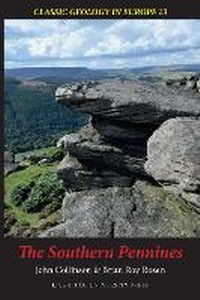
The Southern Pennines
Published on 28. October 2021
Book
Paperback/Softback
256 pages
978-1-78046-100-7 (ISBN)
Description
This guide is a starting point for exploring the geology of the Pennines between the southern Yorkshire Dales and Nidderdale in the north and the southern part of the Derbyshire Peak District in the south. The book concentrates on the main Pennine range, but also takes in higher ground to the west, including Rossendale, the Forest of Bowland and the Staffordshire Moorlands. While the guide is aimed primarily at undergraduate level, it is written and illustrated to also appeal to visitors to the area.
The greater part of the guide deals with sedimentary rocks of Carboniferous age (360-300 Ma). It discusses the changing tectonic regime and its influence on the development of sedimentary basins and their sedimentation. It describes the depositional environments, the subsequent tectonic deformation of the sediments and the controls on present-day outcrop patterns. The older visible geology consists mostly of limestones, deposited in a tropical setting during the Dinantian (360-330 Ma) on shallow-water carbonate platforms, on ramps and in deeper settings. Mound-shaped reef-like structures, that occur in many limestone areas, consist mostly of carbonate mudstone and formed under the influence of micro-organisms. On the Derbyshire Platform, carbonate deposition was disrupted by basaltic magma around several volcanic centres. Limestone deposition was followed by accumulation of a complex series of sandstones and mudstones comprising the Millstone Grit, deposited throughout the Namurian (330-318 Ma), when the Dinantian sea-floor topography was eliminated by the advance of large deltas, creating a vast plain across which Westphalian (318-308 Ma) Coal Measures were deposited.
Introductory chapters explain the tectonic, stratigraphic and sedimentological factors that governed deposition, later deformation and mineralisation. The interaction of fluctuating sea-level in response to southern hemisphere glaciation and ongoing tectonic activity are emphasised. The field guide proper is in six chapters, each devoted to a particular area, where individual localities are described and illustrated. While some itineraries are suggested, the format allows users to plan trips to match their interests. An extensive glossary should help non-geologists with technical terms.
The greater part of the guide deals with sedimentary rocks of Carboniferous age (360-300 Ma). It discusses the changing tectonic regime and its influence on the development of sedimentary basins and their sedimentation. It describes the depositional environments, the subsequent tectonic deformation of the sediments and the controls on present-day outcrop patterns. The older visible geology consists mostly of limestones, deposited in a tropical setting during the Dinantian (360-330 Ma) on shallow-water carbonate platforms, on ramps and in deeper settings. Mound-shaped reef-like structures, that occur in many limestone areas, consist mostly of carbonate mudstone and formed under the influence of micro-organisms. On the Derbyshire Platform, carbonate deposition was disrupted by basaltic magma around several volcanic centres. Limestone deposition was followed by accumulation of a complex series of sandstones and mudstones comprising the Millstone Grit, deposited throughout the Namurian (330-318 Ma), when the Dinantian sea-floor topography was eliminated by the advance of large deltas, creating a vast plain across which Westphalian (318-308 Ma) Coal Measures were deposited.
Introductory chapters explain the tectonic, stratigraphic and sedimentological factors that governed deposition, later deformation and mineralisation. The interaction of fluctuating sea-level in response to southern hemisphere glaciation and ongoing tectonic activity are emphasised. The field guide proper is in six chapters, each devoted to a particular area, where individual localities are described and illustrated. While some itineraries are suggested, the format allows users to plan trips to match their interests. An extensive glossary should help non-geologists with technical terms.
Reviews / Votes
'A fantastic book about local geology and a valuable addition to the Classic Geology in Europe series. The authors are to be commended for sharing their extensive knowledge of the South Pennine rocks.' Dr. Christine Arkwright, Proceedings of the Open University Geological SocietyMore details
Series
Edition
New edition
Language
English
Place of publication
Edinburgh
United Kingdom
Publishing group
Liverpool University Press
Target group
College/higher education
Edition type
New edition
Illustrations
colour illustrations throughout
Dimensions
Height: 216 mm
Width: 139 mm
Thickness: 24 mm
Weight
704 gr
ISBN-13
978-1-78046-100-7 (9781780461007)
Copyright in bibliographic data and cover images is held by Nielsen Book Services Limited or by the publishers or by their respective licensors: all rights reserved.
Schweitzer Classification
Persons
John Collinson was Senior Lecturer at Keele University and Professor of Sedimentology at Bergen University and then a consultant on the
sedimentology of hydrocarbon reservoirs. He has published extensively on Namurian sedimentology and stratigraphy. Brian Roy Rosen is a specialist on living and fossil corals and reefs, and has held research positions at the universities of Newcastle-upon-
Tyne and Aberystwyth before taking a research position at the Natural History Museum. His work ranges from Silurian to living examples, on
four continents and three tropical oceans.
sedimentology of hydrocarbon reservoirs. He has published extensively on Namurian sedimentology and stratigraphy. Brian Roy Rosen is a specialist on living and fossil corals and reefs, and has held research positions at the universities of Newcastle-upon-
Tyne and Aberystwyth before taking a research position at the Natural History Museum. His work ranges from Silurian to living examples, on
four continents and three tropical oceans.