

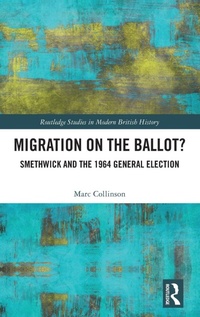
Migration on the Ballot?
Smethwick and the 1964 General Election
1st Edition
Published on 6. March 2026
Book
Hardback
208 pages
978-0-367-76661-0 (ISBN)
Description
Migration on the Ballot? re-examines the 1964 election contest at Smethwick. It considers the impact of deindustrialisation, urban redevelopment, and migration on the town, alongside the candidates and parties who stood, and how commentators have shaped our understanding of the result.
The 1964 election was supposed to be a success for Labour Leader Harold Wilson. Yet, while his party returned to power after thirteen years in opposition, the defeat of Shadow Cabinet Minister Patrick Gordon Walker by the Conservative Peter Griffiths at Smethwick overshadowed Labour's victory. In a town affected by economic, urban, and demographic change, Griffiths ran a campaign most remembered for its anti-migrant rhetoric. A 'safe' Labour seat in the West Midlands not only voted Conservative but also became a metonym for 'racial politics', influencing national debates about migration and impacting the new Labour Government's agenda. However, despite its continued notoriety, the campaign remains under-interrogated, with scholarly attention notable either for its obsolescence or brevity. This study seeks to understand how far these Conservative appeals actually determined the outcome, or whether a more complicated story lies beneath.
This book will be of interest to scholars, students, and those interested in modern British political history, elections, and their outcomes.
The 1964 election was supposed to be a success for Labour Leader Harold Wilson. Yet, while his party returned to power after thirteen years in opposition, the defeat of Shadow Cabinet Minister Patrick Gordon Walker by the Conservative Peter Griffiths at Smethwick overshadowed Labour's victory. In a town affected by economic, urban, and demographic change, Griffiths ran a campaign most remembered for its anti-migrant rhetoric. A 'safe' Labour seat in the West Midlands not only voted Conservative but also became a metonym for 'racial politics', influencing national debates about migration and impacting the new Labour Government's agenda. However, despite its continued notoriety, the campaign remains under-interrogated, with scholarly attention notable either for its obsolescence or brevity. This study seeks to understand how far these Conservative appeals actually determined the outcome, or whether a more complicated story lies beneath.
This book will be of interest to scholars, students, and those interested in modern British political history, elections, and their outcomes.
More details
Series
Language
English
Place of publication
London
United Kingdom
Publishing group
Taylor & Francis Ltd
Target group
College/higher education
Postgraduate
Illustrations
1 s/w Photographie bzw. Rasterbild, 3 s/w Tabellen, 1 s/w Abbildung
3 Tables, black and white; 1 Halftones, black and white; 1 Illustrations, black and white
Dimensions
Height: 240 mm
Width: 161 mm
Thickness: 17 mm
Weight
499 gr
ISBN-13
978-0-367-76661-0 (9780367766610)
Copyright in bibliographic data and cover images is held by Nielsen Book Services Limited or by the publishers or by their respective licensors: all rights reserved.
Schweitzer Classification
Other editions
Additional editions
E-Book
03/2026
Routledge
€60.49
Available for download
E-Book
03/2026
Routledge
€60.49
Available for download
Person
Marc Collinson is Lecturer in Political History at Bangor University. His research focuses on elections, place, and governance in post-war British politics. Recent publications have explored Eton and Slough during the 1964 election and the 1965 Leyton by-election (both 2024).
Content
Introduction 1. 'Smethwick...will forever be changing': Place, continuity, and change in a Black Country town 2. Smethwick's changing electorate: Municipal policies, demographic movement, and changing boundaries 3. Cultivating local xenophobia: Migration, activism, and Smethwick politics before 1964 4. The Lie of the Land: Smethwick and the political dynamics of the West Midlands 5. Cyphers or Agents?: Smethwick Candidates in the 'three-way fight' of 1964 6. Political momentum?: Reconsidering 1964, Smethwick's year of elections 7. A Smethwick 'effect'? Impacts and aftermath, 1964-1974 8. Interpreting Smethwick: An intellectual history. Conclusion: Smethwick as political history