

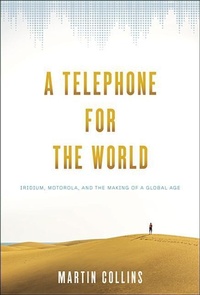
A Telephone for the World
Iridium, Motorola, and the Making of a Global Age
Will be published approx. on 28. May 2018
Book
Hardback
280 pages
978-1-4214-2483-5 (ISBN)
Description
In a post-Cold War world, the Iridium satellite network revealed a new age of globalization.
Winner of the William and Joyce Middleton Electrical Engineering History Award by the IEEE
In June 1990, Motorola publicly announced an ambitious business venture called Iridium. The project's signature feature was a constellation of 77 satellites in low-Earth orbit which served as the equivalent of cellular towers, connecting to mobile customers below using wireless hand-held phones. As one of the founding engineers noted, the constellation "bathed the planet in radiation," enabling a completely global communications system.
Focusing on the Iridium venture, this book explores the story of globalization at a crucial period in US and international history. As the Cold War waned, corporations and nations reoriented toward a new global order in which markets, neoliberal ideology, and the ideal of a borderless world predominated. As a planetary-scale technological system, the project became emblematic of this shift and of the role of the United States as geopolitical superpower. In its ambition, scope, challenges, and organizing ideas, the rise of Iridium provides telling insight into how this new global condition stimulated a re-thinking of corporate practices-on the factory floor, in culture and knowledge, and in international relations.
Combining oral history interviews with research in corporate records, Martin Collins opens up new angles on what global meant in the years just before and after the end of the Cold War. The first book to tell the story of Iridium in this context, A Telephone for the World is a fascinating look at how people, nations, and corporations across the world grappled in different ways with the meaning of a new historical era.
Winner of the William and Joyce Middleton Electrical Engineering History Award by the IEEE
In June 1990, Motorola publicly announced an ambitious business venture called Iridium. The project's signature feature was a constellation of 77 satellites in low-Earth orbit which served as the equivalent of cellular towers, connecting to mobile customers below using wireless hand-held phones. As one of the founding engineers noted, the constellation "bathed the planet in radiation," enabling a completely global communications system.
Focusing on the Iridium venture, this book explores the story of globalization at a crucial period in US and international history. As the Cold War waned, corporations and nations reoriented toward a new global order in which markets, neoliberal ideology, and the ideal of a borderless world predominated. As a planetary-scale technological system, the project became emblematic of this shift and of the role of the United States as geopolitical superpower. In its ambition, scope, challenges, and organizing ideas, the rise of Iridium provides telling insight into how this new global condition stimulated a re-thinking of corporate practices-on the factory floor, in culture and knowledge, and in international relations.
Combining oral history interviews with research in corporate records, Martin Collins opens up new angles on what global meant in the years just before and after the end of the Cold War. The first book to tell the story of Iridium in this context, A Telephone for the World is a fascinating look at how people, nations, and corporations across the world grappled in different ways with the meaning of a new historical era.
Reviews / Votes
Collins examines the historical development of Motorola's Iridium global telecommunications project, which sought to provide cellular voice service to any point on Earth using a network of 77 low-orbiting satellites... Iridium's Apollo-like saga will capture the interest of general readers in engineering, science, history, sociology, and business, and will serve as an excellent capstone case study. Technical discussions are easy to understand, and the extensive endnotes and bibliography will satisfy the most rigorous scholar.-R. Dupont, Louisiana State University Alexandria, Choice This is an ambitious book that connects technology, capitalism, and globalization. It is all that more audacious because it uses a failed communications platform and business model to make these connections . . . Although Iridium was a business failure, its legacy continues to be a set of cultural, social, and political expectations about global flows of information and capital. As Collins forcefully reminds us, globalization is not a given, but was (and continues to be) "actively fashioned" by those who seek "to project market values, power, and control over the totality of the planet."
-David Hochfelder, University at Albany, Journal of American History Engaging, informative, and thought provoking, A Telephone for the World should prove to be of particular interest to business and economic historians skeptical of neoliberal pieties about innovation, to media and communications historians intrigued by the evolution of spectrum management, and to cultural and political historians fascinated by the zeitgeist of the 1990s.
-Richard R. John, Columbia University, American Historical Review
More details
Language
English
Place of publication
Baltimore, MD
United States
Target group
Professional and scholarly
Illustrations
18 s/w Abbildungen, 5 s/w Zeichnungen
5 Line drawings, black and white; 18 Illustrations, black and white
Dimensions
Height: 160 mm
Width: 236 mm
Thickness: 22 mm
Weight
498 gr
ISBN-13
978-1-4214-2483-5 (9781421424835)
DOI
10.1353/book.59133
Copyright in bibliographic data and cover images is held by Nielsen Book Services Limited or by the publishers or by their respective licensors: all rights reserved.
Schweitzer Classification
Other editions
Additional editions
E-Book
05/2018
Johns Hopkins University Press
€34.49
Available for download
Person
Martin Collins is a curator at the Smithsonian National Air and Space Museum. He is the author of Cold War Laboratory: RAND, the Air Force, and the American State, 1945-1950.
Content
Preface
Introduction
1. Iridium and the Global Age
2. The Global and the Engineers
3. The Global and Iridium the Business
4. "Freedom to Communicate"
5. From "It's a bird, it's a phone" to "Edsels in the sky"
Conclusion
Notes
Bibliography
Index
Introduction
1. Iridium and the Global Age
2. The Global and the Engineers
3. The Global and Iridium the Business
4. "Freedom to Communicate"
5. From "It's a bird, it's a phone" to "Edsels in the sky"
Conclusion
Notes
Bibliography
Index