

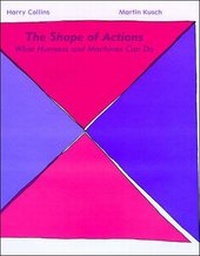
The Shape of Actions
What Humans and Machines Can Do
Published on 5. January 1999
Book
Hardback
224 pages
978-0-262-03257-5 (ISBN)
Description
What can humans do? What can machines do? How do humans delegate actions to machines?
In this book, Harry Collins and Martin Kusch combine insights from sociology and philosophy to
provide a novel answer to these increasingly important questions.The authors begin by distinguishing
between two basic types of intentional behavior, which they call polimorphic actions and
mimeomorphic actions. Polimorphic actions (such as writing a love letter) are ones that community
members expect to vary with social context. Mimeomorphic actions (such a swinging a golf club) do
not vary. Although machines cannot act, they can mimic mimeomorphic actions. Mimeomorphic actions
are thus the crucial link between what humans can do and what machines can
do.
Following a presentation of their detailed categorization of actions, the
authors apply their approach to a broad range of human-machine interactions and to learning. Key
examples include bicycle riding and the many varieties of writing machines. They also show how their
theory can be used to explain the operation of organizations such as restaurants and armies.
Finally, they look at a historical case -- the technological development of the air pump -- applying
their categorization of actions to the processes of mechanization and automation. Automation, they
argue, can occur only where what we want to bring about can be brought about through mimeomorphic
action.
In this book, Harry Collins and Martin Kusch combine insights from sociology and philosophy to
provide a novel answer to these increasingly important questions.The authors begin by distinguishing
between two basic types of intentional behavior, which they call polimorphic actions and
mimeomorphic actions. Polimorphic actions (such as writing a love letter) are ones that community
members expect to vary with social context. Mimeomorphic actions (such a swinging a golf club) do
not vary. Although machines cannot act, they can mimic mimeomorphic actions. Mimeomorphic actions
are thus the crucial link between what humans can do and what machines can
do.
Following a presentation of their detailed categorization of actions, the
authors apply their approach to a broad range of human-machine interactions and to learning. Key
examples include bicycle riding and the many varieties of writing machines. They also show how their
theory can be used to explain the operation of organizations such as restaurants and armies.
Finally, they look at a historical case -- the technological development of the air pump -- applying
their categorization of actions to the processes of mechanization and automation. Automation, they
argue, can occur only where what we want to bring about can be brought about through mimeomorphic
action.
More details
Language
English
Place of publication
Cambridge, Mass.
United States
Publishing group
MIT Press Ltd
Target group
College/higher education
Professional and scholarly
US School Grade: College Graduate Student and over
Illustrations
31
Dimensions
Height: 229 mm
Width: 152 mm
Thickness: 0 mm
Weight
454 gr
ISBN-13
978-0-262-03257-5 (9780262032575)
Copyright in bibliographic data and cover images is held by Nielsen Book Services Limited or by the publishers or by their respective licensors: all rights reserved.
Schweitzer Classification
Other editions
Additional editions
Book
01/1999
MIT Press
€27.70
Article exhausted; check different version
E-Book
01/1999
MIT Press
€29.49
Available for download