

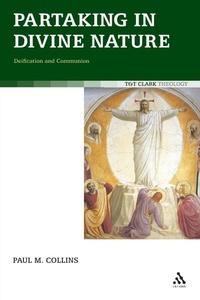
Partaking in Divine Nature
Deification and Communion
Published on 22. December 2011
Book
Paperback/Softback
240 pages
978-0-567-26296-7 (ISBN)
Description
Discussion of theosis is mainly undertaken within Byzantine Orthodoxy and is usually structured around an examination of patristic and medieval sources. This work builds upon such discussions and broadens the basis by including Western sources (Catholic and Protestant) in contemporary debates about salvation. In seeking to explore a relational understanding of salvation, the construal of the doctrine of deification is examined in terms of the divine nature understood as communion. This is related in particular of the theological project of Zizioulas, and other exponents of communion ontology. The book is an investigation of how understandings of theosis in the Christian Tradition have related to understandings of divine nature in terms of koinonia. It further suggests a relational paradigm for conceptualising how theosis may be understood today, drawing out implications for the Christian community and discipleship.
Reviews / Votes
'In this dearly written and informative book, Paul Collins dispels two myths that surround the notion of deification: that it is the properly of Eastern Orthodox Christians and that it is inherently individualistic. Collins demonstrates definitively that the metaphor of deification has structured the Christian imagination of the entire Christian tradition, East' and 'West', and that it is necessarily a communal and relational reality with cultural and political implications. He advances the discussion on deification in a way that will impact how Churches understand and relate to each other and to the world.' - Aristotle Papanikolaou, Fordham University, New York, NY, USA. 'Paul Collins does a wonderful job of presenting a florilegia of authors and traditions towards elucidating a modem appropriation of a theology of theosis. He creatively builds upon a complementarily of approaches, of what it means to become holy and transfigured by divine grace, by drawing upon early church traditions, Eastern Orthodoxy and Western Christianity, and their rootedness in the Scriptures, with a view to showing how deification is at once personal, yet ecclesial and cosmic.' - Jaroslav Z. Skira, Regis College, University of Toronto, ON, Canada Jaroslav Skira ... Paul Collins has opened up exciting new directions for us. This is a well-conceived and carefully researched work, which will, in connection with other works on deification, spur further research in this field. Theology Vol 114 No. 4More details
Language
English
Place of publication
Edinburgh
United Kingdom
Publishing group
Bloomsbury Publishing PLC
Target group
College/higher education
Dimensions
Height: 234 mm
Width: 156 mm
Thickness: 13 mm
Weight
357 gr
ISBN-13
978-0-567-26296-7 (9780567262967)
Copyright in bibliographic data and cover images is held by Nielsen Book Services Limited or by the publishers or by their respective licensors: all rights reserved.
Schweitzer Classification
Other editions
Additional editions
E-Book
05/2010
1st Edition
T.& T.Clark Ltd
€42.99
Available for download
Person
Revd Dr Paul M. Collins, formerly Reader in Theology at the University of Chichester, Parish Priest on Holy Island, Northumberland, England.
Content
Introduction to the thesis of the book and its contents
Deification in pre-Christian traditions
including Greek and Indian traditions; assessment of the influence of these upon Christian understandings of incarnation and salvation.
Deification in Eastern Orthodox Tradition
including discussion of salvation in terms of recapitulation; understandings of 'the Cross'; an examination of the development of theosis in patristic and medieval authors: e.g. Origen, Athanasius, the Cappadocian fathers, Ps-Dionysius, Maximus the Confessor, Symeon the Theologian, Gregory Palamas; and modern authors such as Bulgakov and Staniloae. This will also include and examination of how divine nature is understood in relation to theosis.
Deification in Western Traditions
including Thomas Aquinas, Martin Luther, the Caroline Divines and the Wesleys; as well as recent authors both Catholic and Protestant e.g. Karl Rahner, Catherine Mowry LaCugna, Lars Thunberg, Norman Russell; as well as an assessment of the place of 'deification' alongside other models and understandings of salvation in the West.
Deification and Relationality: imago trinitatis
discussion of divine nature understood in terms of koinonia i.e. in terms of a hermeneutic of relationality; discussion of this hermeneutic in the works of Zizioulas, Barth, Torrance, Gunton, Hardy, Schwoebel; discussion of Rahner's place in & contribution to this debate; discussion of dialectical understandings of difference and repetition (inc. Deleuze) and how these concepts inform a relational understanding of theosis.
Deification: Transformation and Community
[a] discussion of the implications and applications of these findings in relation to Christian community (Church) and Christian life (discipleship). [b] theosis and the body 'garments of skin': asceticism, materiality and sexuality; [c] theosis and the Virtues: imitation of Christ; participating in the sacraments; [d] Christological focus of transformation: the Hypostatic Union and the Transfiguration: application for the Church? Church community as the locus of formation for partaking in the relationality of the divine: discipleship and deification.
Conclusion / Summary of findings
Deification in pre-Christian traditions
including Greek and Indian traditions; assessment of the influence of these upon Christian understandings of incarnation and salvation.
Deification in Eastern Orthodox Tradition
including discussion of salvation in terms of recapitulation; understandings of 'the Cross'; an examination of the development of theosis in patristic and medieval authors: e.g. Origen, Athanasius, the Cappadocian fathers, Ps-Dionysius, Maximus the Confessor, Symeon the Theologian, Gregory Palamas; and modern authors such as Bulgakov and Staniloae. This will also include and examination of how divine nature is understood in relation to theosis.
Deification in Western Traditions
including Thomas Aquinas, Martin Luther, the Caroline Divines and the Wesleys; as well as recent authors both Catholic and Protestant e.g. Karl Rahner, Catherine Mowry LaCugna, Lars Thunberg, Norman Russell; as well as an assessment of the place of 'deification' alongside other models and understandings of salvation in the West.
Deification and Relationality: imago trinitatis
discussion of divine nature understood in terms of koinonia i.e. in terms of a hermeneutic of relationality; discussion of this hermeneutic in the works of Zizioulas, Barth, Torrance, Gunton, Hardy, Schwoebel; discussion of Rahner's place in & contribution to this debate; discussion of dialectical understandings of difference and repetition (inc. Deleuze) and how these concepts inform a relational understanding of theosis.
Deification: Transformation and Community
[a] discussion of the implications and applications of these findings in relation to Christian community (Church) and Christian life (discipleship). [b] theosis and the body 'garments of skin': asceticism, materiality and sexuality; [c] theosis and the Virtues: imitation of Christ; participating in the sacraments; [d] Christological focus of transformation: the Hypostatic Union and the Transfiguration: application for the Church? Church community as the locus of formation for partaking in the relationality of the divine: discipleship and deification.
Conclusion / Summary of findings