

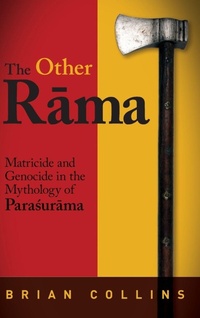
The Other Rama
Matricide and Genocide in the Mythology of Parasurama
Published on 1. October 2020
Book
Hardback
333 pages
978-1-4384-8039-8 (ISBN)
Description
A systematic analysis of the myth cycle of Parasurama ("Rama with the Axe"), an avatara of Vi??u with a much darker reputation.
The Other Rama presents a systematic analysis of the myth cycle of Parasurama ("Rama with the Axe"), an avatara of Vi??u best known for decapitating his own mother and annihilating twenty-one generations of the Katriya warrior caste in an extermination campaign frequently referred to as "genocide" by modern scholars. Compared to Rama and Ka, the other human forms of Vi??u, Parasurama has a much darker reputation, with few temples devoted to him and scant worshippers. He has also attracted far less scholarly attention. But dozens of important castes and clans across the subcontinent claim Parasurama as the originator of their bloodline, and his mother, Reuka, is worshipped in the form of a severed head throughout South India.
Using the tools of comparative mythology and psychoanalysis, Brian Collins identifies three major motifs in the mythology of Parasurama: his hybrid status as a Brahmin warrior, his act of matricide, and his bloody one-man war to cleanse the earth of Katriyas. Collins considers a wide variety of representations of the myth, from its origins in the Mahabharata to contemporary debates online. He also examines Parasurama alongside the Wandering Jew of European legend and Psycho's matricidal serial killer Norman Bates. He examines why mythmakers once elevated this transgressive and antisocial figure to the level of an avatara and why he still holds such fascination for a world that continues to grapple with mass killings and violence against women.
The Other Rama presents a systematic analysis of the myth cycle of Parasurama ("Rama with the Axe"), an avatara of Vi??u best known for decapitating his own mother and annihilating twenty-one generations of the Katriya warrior caste in an extermination campaign frequently referred to as "genocide" by modern scholars. Compared to Rama and Ka, the other human forms of Vi??u, Parasurama has a much darker reputation, with few temples devoted to him and scant worshippers. He has also attracted far less scholarly attention. But dozens of important castes and clans across the subcontinent claim Parasurama as the originator of their bloodline, and his mother, Reuka, is worshipped in the form of a severed head throughout South India.
Using the tools of comparative mythology and psychoanalysis, Brian Collins identifies three major motifs in the mythology of Parasurama: his hybrid status as a Brahmin warrior, his act of matricide, and his bloody one-man war to cleanse the earth of Katriyas. Collins considers a wide variety of representations of the myth, from its origins in the Mahabharata to contemporary debates online. He also examines Parasurama alongside the Wandering Jew of European legend and Psycho's matricidal serial killer Norman Bates. He examines why mythmakers once elevated this transgressive and antisocial figure to the level of an avatara and why he still holds such fascination for a world that continues to grapple with mass killings and violence against women.
Reviews / Votes
"Collins is admirably meticulous and thorough in his argument, navigating between the macro and micro levels of mythic analysis, balancing broader psychological significance of the stories with gritty political realities. Throughout, he guides the reader with erudite ease, creating prose that is clear, entertaining, and witty while never losing a tone of seriousness and respect for the material at hand. In all, Collins' book represents a great contribution on several levels." - Religion"...The Other Rama will also speak meaningfully to those engaged in the study of the Sanskrit epics and Pura?as (ancient legends and myths), and more broadly to those seeking to apply psychological theory to the study of Hindu mythology ... readers who follow the book's layered psycho-synthetic argumentation through to the end will be rewarded with a suitably complex understanding of what drives this dark and elusive character of Hindu mythology." - Reading Religion
"Collins provides a lively and delightfully written study of the Parasurama myth, an exploration filtered through psychoanalytical theory. For readers interested in this particular tradition of analysis and other types of comparison, this book will be a welcomed inquiry into the possible meanings of this perennial Indian mythic figure." - Christian Novetzke, author of Religion and Public Memory: A Cultural History of Saint Namdev in India
More details
Series
Language
English
Place of publication
Albany, NY
United States
Target group
Professional and scholarly
US School Grade: College Graduate Student and over
Illustrations
11 Tables, black and white; 1 Illustrations, black and white; 7 Figures
Dimensions
Height: 235 mm
Width: 157 mm
Thickness: 24 mm
Weight
694 gr
ISBN-13
978-1-4384-8039-8 (9781438480398)
Copyright in bibliographic data and cover images is held by Nielsen Book Services Limited or by the publishers or by their respective licensors: all rights reserved.
Schweitzer Classification
Other editions
Additional editions
E-Book
10/2020
1st Edition
De Gruyter
from
€88.99
Available for download
Person
Brian Collins is Drs. Ram and Sushila Gawande Chair in Indian Religion and Philosophy at Ohio University. He is the author of The Head beneath the Altar: Hindu Mythology and the Critique of Sacrifice.
Content
List of Figures
Abbreviations
Acknowledgments
Preface: The Other Rama
Introduction: God with an Axe
1. The Brahmin Warrior: Parasurama in Extremis
2. Matricide I: The Broken Pot
3. Matricide II: The Severed Head
4. Var?icide I: The Extermination of the K?atriyas and Its Aftermath
5. Var?icide II: Blood and Soil in Malabar and Maharashtra
Conclusion: Introducing Parasurama
Notes
Works Cited
Index
Abbreviations
Acknowledgments
Preface: The Other Rama
Introduction: God with an Axe
1. The Brahmin Warrior: Parasurama in Extremis
2. Matricide I: The Broken Pot
3. Matricide II: The Severed Head
4. Var?icide I: The Extermination of the K?atriyas and Its Aftermath
5. Var?icide II: Blood and Soil in Malabar and Maharashtra
Conclusion: Introducing Parasurama
Notes
Works Cited
Index