

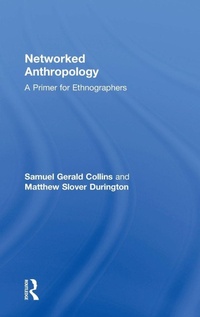
Networked Anthropology
A Primer for Ethnographers
1st Edition
Published on 22. August 2014
Book
Hardback
172 pages
978-0-415-82174-2 (ISBN)
Description
The advent of social media offers anthropologists exciting opportunities to extend their research to communities in fresh ways. At the same time, these technological developments open up anthropological fieldwork to different hazards. Networked Anthropology explores the increasing appropriation of diverse media platforms and social media into anthropological research and teaching. The chapters consider the possibilities and challenges of multimedia, how network ecologies work, the ethical dilemmas involved, and how to use multimedia methodologies. The book combines theoretical insights with case studies, methodological sketches and pedagogical notes. Drawing on recent ethnographic work, the authors provide practical guidance in creative ways of doing networked anthropology. They point to the future of ethnography, both inside and outside the classroom, and consider ways in which networked anthropology might develop.
Reviews / Votes
"Networked Anthropology is an essential roadmap for conducting engaged anthropology on a rapidly changing digital terrain. Collins and Durington detail how anthropologists can make use of social media to link classrooms to local communities in ways that span the corporeal and the digital. They also point out both the potential ethical pitfalls and the unexpected benefits of embracing social networks at every stage of the research process."- P. Kerim Friedman, National Dong Hwa University, Taiwan, and founding member of Savage Minds.
"Contemporary anthropologists share a networked world with research participants and other interlocutors -- a world in which we are all producing and consuming media throughout the ethnographic encounter. Collins and Durington examine how social media inexorably reshapes 'the field' in both senses (fieldsite and disciplinary practice) and can potentially generate a more nuanced, ethical, public anthropology premised on reciprocity, sharing, and dialogue with participants and audiences."
- Krista Harper, University of Massachusetts Amherst, USA
More details
Language
English
Place of publication
London
United Kingdom
Publishing group
Taylor & Francis Ltd
Target group
College/higher education
Illustrations
3 s/w Tabellen
3 Tables, black and white
Dimensions
Height: 240 mm
Width: 161 mm
Thickness: 15 mm
Weight
449 gr
ISBN-13
978-0-415-82174-2 (9780415821742)
Copyright in bibliographic data and cover images is held by Nielsen Book Services Limited or by the publishers or by their respective licensors: all rights reserved.
Schweitzer Classification
Other editions
Additional editions
E-Book
08/2014
1st Edition
Routledge
€55.49
Available for download
E-Book
08/2014
1st Edition
Routledge
€55.49
Available for download
Book
08/2014
1st Edition
Routledge
€62.90
Shipment within 15-20 days
Persons
Samuel Collins is a Professor in the Department of Sociology, Anthropology and Criminal Justice at Towson University.
Matthew S. Durington is an Associate Professor in the Department of Sociology, Anthropology and Criminal Justice at Towson University.
Matthew S. Durington is an Associate Professor in the Department of Sociology, Anthropology and Criminal Justice at Towson University.
Content
Introduction: What is Networked Anthropology? 1. Anthropology Confronts a Networked World 2. Networked Ecologies 3. Towards a Networked Ethics 4. Moving from Visual Anthropology to Networked Anthropology 5. Case Study 1: Sharp Leadenhall 6. Case Study 2: JACQUES Conclusion: Tomorrow's Networks ACTIVITIES (Pre-Field, The Networked Field, Recursive Analysis)