

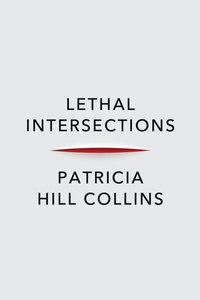
Lethal Intersections
Race, Gender, and Violence
1st Edition
Published on 20. October 2023
Book
Paperback/Softback
288 pages
978-1-5095-5316-7 (ISBN)
Description
School shootings, police misconduct, and sexual assault where people are injured and die dominate the news. But how are these incidents of violence and extreme harm connected?
In this new book, world-renowned sociologist Patricia Hill Collins explores how violence differentially affects people according to their class, sexuality, nationality and ethnicity. These invisible workings of overlapping power relations give rise to what she terms 'lethal intersections', where multiple forms of oppression converge to catalyze a set of violent practices that fall more heavily on particular groups. Drawing on a rich tapestry of cases from investigative journalism, feature films, documentaries and fiction, Collins challenges readers to reflect upon what counts as violence today and what can be done about it. Resisting violence offers a common thread that weaves together disparate anti-violence projects across the world. When parents of murdered children organize against gun violence, when Black citizens march against the excessive use of police force in their neighborhoods, and when women and girls report sexual abuse by employers, coaches, and community leaders, the ideas and actions of ordinary people lay a foundation for new ways of thinking about and combating violence.
Through its ground-breaking analysis Lethal Intersections aims to stimulate debate about violence as one of the most pressing social problems of our times.
School shootings, police misconduct, and sexual assault where people are injured and die dominate the news. But how are these incidents of violence and extreme harm connected?
In this new book, world-renowned sociologist Patricia Hill Collins explores how violence differentially affects people according to their class, sexuality, nationality and ethnicity. These invisible workings of overlapping power relations give rise to what she terms 'lethal intersections', where multiple forms of oppression converge to catalyze a set of violent practices that fall more heavily on particular groups. Drawing on a rich tapestry of cases from investigative journalism, feature films, documentaries and fiction, Collins challenges readers to reflect upon what counts as violence today and what can be done about it. Resisting violence offers a common thread that weaves together disparate anti-violence projects across the world. When parents of murdered children organize against gun violence, when Black citizens march against the excessive use of police force in their neighborhoods, and when women and girls report sexual abuse by employers, coaches, and community leaders, the ideas and actions of ordinary people lay a foundation for new ways of thinking about and combating violence.
Through its ground-breaking analysis <i>Lethal Intersections</i> aims to stimulate debate about violence as one of the most pressing social problems of our times.
In this new book, world-renowned sociologist Patricia Hill Collins explores how violence differentially affects people according to their class, sexuality, nationality and ethnicity. These invisible workings of overlapping power relations give rise to what she terms 'lethal intersections', where multiple forms of oppression converge to catalyze a set of violent practices that fall more heavily on particular groups. Drawing on a rich tapestry of cases from investigative journalism, feature films, documentaries and fiction, Collins challenges readers to reflect upon what counts as violence today and what can be done about it. Resisting violence offers a common thread that weaves together disparate anti-violence projects across the world. When parents of murdered children organize against gun violence, when Black citizens march against the excessive use of police force in their neighborhoods, and when women and girls report sexual abuse by employers, coaches, and community leaders, the ideas and actions of ordinary people lay a foundation for new ways of thinking about and combating violence.
Through its ground-breaking analysis Lethal Intersections aims to stimulate debate about violence as one of the most pressing social problems of our times.
School shootings, police misconduct, and sexual assault where people are injured and die dominate the news. But how are these incidents of violence and extreme harm connected?
In this new book, world-renowned sociologist Patricia Hill Collins explores how violence differentially affects people according to their class, sexuality, nationality and ethnicity. These invisible workings of overlapping power relations give rise to what she terms 'lethal intersections', where multiple forms of oppression converge to catalyze a set of violent practices that fall more heavily on particular groups. Drawing on a rich tapestry of cases from investigative journalism, feature films, documentaries and fiction, Collins challenges readers to reflect upon what counts as violence today and what can be done about it. Resisting violence offers a common thread that weaves together disparate anti-violence projects across the world. When parents of murdered children organize against gun violence, when Black citizens march against the excessive use of police force in their neighborhoods, and when women and girls report sexual abuse by employers, coaches, and community leaders, the ideas and actions of ordinary people lay a foundation for new ways of thinking about and combating violence.
Through its ground-breaking analysis <i>Lethal Intersections</i> aims to stimulate debate about violence as one of the most pressing social problems of our times.
Reviews / Votes
"A profoundly inviting and compelling account of intersectional violence. Collins leaves no one behind in this analysis, which makes the book an act of resistance in and of itself."Patrick R. Grzanka, The University of Tennessee, Knoxville
"A profoundly inviting and compelling account of intersectional violence. Collins leaves no one behind in this analysis, which makes the book an act of resistance in and of itself."
<b>Patrick R. Grzanka, The University of Tennessee, Knoxville</b>
More details
Language
English
Place of publication
Oxford
United Kingdom
Publishing group
John Wiley and Sons Ltd
Target group
College/higher education
Dimensions
Height: 225 mm
Width: 151 mm
Thickness: 23 mm
Weight
430 gr
ISBN-13
978-1-5095-5316-7 (9781509553167)
Copyright in bibliographic data is held by Nielsen Book Services Limited or its licensors: all rights reserved.
Schweitzer Classification
Other editions
Additional editions
Book
10/2023
1st Edition
Polity Press
€70.00
Shipment within 15-20 days
E-Book
10/2023
1st Edition
Wiley-Scrivener
€17.99
Available for download
Person
Content
Acknowledgements
Introduction
Chapter One. Lethal Intersections and Violence
Chapter Two. Violence and the Power of Ideas
Chapter Three. Violence and National Identity
Chapter Four. Invisible Violence
Chapter Five. Resisting Intersectional Violence
References
Notes
Introduction
Chapter One. Lethal Intersections and Violence
Chapter Two. Violence and the Power of Ideas
Chapter Three. Violence and National Identity
Chapter Four. Invisible Violence
Chapter Five. Resisting Intersectional Violence
References
Notes