

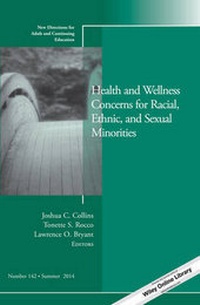
Health and Wellness Concerns for Racial, Ethnic, and Sexual Minorities
New Directions for Adult and Continuing Education, Number 142
Published on 23. June 2014
Book
Paperback/Softback
112 pages
978-1-118-91643-8 (ISBN)
Description
Minority status in the United States often accompanies diminished access to education, employment, and subsequently health care. This volume explores factors that have contributed to health disparities among racial, ethnic, and sexual minorities. Focused on developing strategies for understanding these disparities and promoting wellness in minority communities, the authors highlight social forces such as racism, ethnocentrism, sexism, and homophobia, which continue to influence not only access to and quality of care but also perception and trust of health care professionals. The authors identify several common themes, including the importance of communication, intentional and unintentional discriminatory structures, and perhaps most significantly, the role of culturally relevant learning sites. This is the 142nd volume of the Jossey Bass series New Directions for Adult and Continuing Education. Noted for its depth of coverage, it explores issues of common interest to instructors, administrators, counselors, and policymakers in a broad range of education settings, such as colleges and universities, extension programs, businesses, libraries, and museums.
More details
Series
Language
English
Place of publication
New York
United States
Target group
Professional and scholarly
Dimensions
Height: 232 mm
Width: 153 mm
Thickness: 7 mm
Weight
136 gr
ISBN-13
978-1-118-91643-8 (9781118916438)
Copyright in bibliographic data and cover images is held by Nielsen Book Services Limited or by the publishers or by their respective licensors: all rights reserved.
Schweitzer Classification
Persons
Volume Editors: Joshua C. Collins is a doctoral candidate in the program for adult education and human resource development at Florida International University.
Tonette S. Rocco is a professor and program leader in the adult education and human resource development graduate program in the Department of Leadership and Professional Studies, and the director of the Office of Academic Writing and Publication Support at Florida International University.
Lawrence O. Bryant is an assistant professor?at Georgia State University, Byrdine Lewis School of Nursing and Health Profession, Department of Respiratory Therapy.
Series Editors: Susan Imel is director of the Eric Clearinghouse on Adult, Career, and Vocatinoal Education, Ohio State University.
Jovita M. Ross-Gordon is an associate professor in the College of Education at Southwest?Texas?University, San Marcos.
Tonette S. Rocco is a professor and program leader in the adult education and human resource development graduate program in the Department of Leadership and Professional Studies, and the director of the Office of Academic Writing and Publication Support at Florida International University.
Lawrence O. Bryant is an assistant professor?at Georgia State University, Byrdine Lewis School of Nursing and Health Profession, Department of Respiratory Therapy.
Series Editors: Susan Imel is director of the Eric Clearinghouse on Adult, Career, and Vocatinoal Education, Ohio State University.
Jovita M. Ross-Gordon is an associate professor in the College of Education at Southwest?Texas?University, San Marcos.
Content
EDITORS NOTES 1 Joshua C. Collins, Tonette S. Rocco, Lawrence O. Bryant 1. Disparities in Healthcare for Racial, Ethnic, and Sexual Minorities 5 Joshua C. Collins, Tonette S. Rocco This chapter situates healthcare as a concern for the field of adult education through a critique of disparities in access to healthcare, quality of care received, and caregiver services for racial, ethnic, and sexual minorities. 2. The Black Church: Promoting Health, Fighting Disparities 15 Michael L. Rowland, E. Paulette Isaac-Savage This chapter illustrates the role of the Black church in promoting health awareness and healthy behaviors, and in fighting health disparities. 3. Literacy and Health Disparities 25 Esther Prins, Angela Mooney This chapter explores the relationship between literacy and health disparities, focusing on the concept of health literacy. Recommendations are provided for ways to bridge the health literacy gap for learners in adult basic education and family literacy programs. 4. Injection Drug Users, Aboriginality, and HIV: A Postcolonial Glance From a Strong Ally 37 John P. Egan This chapter describes the intersection of colonization, disease, and community engagement, including the author s support for Aboriginal community-based HIV research. 5. Alcoholism and Lesbians 49 Julie Gedro This chapter explores the issues involved in the relationship between lesbianism and alcoholism. It examines the constellation of health and related problems created by alcoholism, and it critically interrogates the societal factors that contribute to the disproportionately high rates of alcoholism among lesbians by exploring the antecedents and consequences of alcoholism. 6. Tobacco Use Among Sexual Minorities 63 Lawrence O. Bryant, Lorenzo Bowman This chapter addresses tobacco use among sexual minorities. It examines research on the prevalence of tobacco use in the lesbian, gay, bisexual, and transgender (LGBT) community and discusseswhy tobacco use within this group continues to significantly exceed that of the general population. 7. HIV-Negative Gay Men and Autoimmune Diseases 73 Joshua C. Collins, Tonette S. Rocco This chapter explores the factors that contribute to the disclosure and communication experiences of HIV-negative gay men with one or more autoimmune diseases. 8. African American Women and HIV/AIDS 81 Lisa M. Baumgartner This chapter examines the challenges faced by African American women living with HIV/AIDS and how they learn to live with this chronic illness. 9. Partnerships and Collaborations in Promoting Health and Wellness in Minority Communities: Lessons Learned and Future Directions 91 Lawrence O. Bryant Oppression in its many forms is so ingrained in the fabric of the legal, social, economic, educational, political, and medical systems in America that it often goes unrecognized and unaddressed. The chapters in this volume explored the evasive problem of health and wellness for racial, ethnic, and sexual minorities within a framework of adult education principles. INDEX 97