

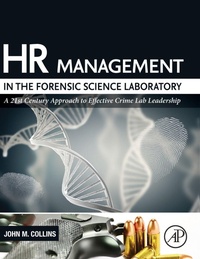
HR Management in the Forensic Science Laboratory
A 21st Century Approach to Effective Crime Lab Leadership
Published on 9. February 2018
Book
Hardback
530 pages
978-0-12-801237-6 (ISBN)
Description
HR Management in the Forensic Science Laboratory: A 21st Century Approach to Effective Crime Lab Leadership introduces the profession of forensic science to human resource management, and vice versa. The book includes principles of HR management that apply most readily, and most critically, to the practice of forensic science, such as laboratory operations, staffing and assignments, laboratory relations and high impact leadership. A companion website hosts workshop PowerPoint slides, a forensic HR newsletter and other important HR strategies to assist the reader.
More details
Language
English
Place of publication
San Diego
United States
Publishing group
Elsevier Science Publishing Co Inc
Target group
Professional and scholarly
Forensic lab directors and supervisors overseeing operations, HR Managers and analysts of forensic operations in public / private sectors. In addition, instructors and students in forensic mgmt. courses and new forensic professionals.
Product notice
Laminated cover
Dimensions
Height: 235 mm
Width: 191 mm
Thickness: 30 mm
Weight
1163 gr
ISBN-13
978-0-12-801237-6 (9780128012376)
Copyright in bibliographic data and cover images is held by Nielsen Book Services Limited or by the publishers or by their respective licensors: all rights reserved.
Schweitzer Classification
Other editions
Additional editions
John M. Collins
HR Management in the Forensic Science Laboratory
A 21st Century Approach to Effective Crime Lab Leadership
E-Book
02/2018
Academic Press
€71.95
Available for download
Person
John Collins is among the most active and respected forensic science professionals in the United States. A prolific writer and speaker on contemporary forensic science practices, John has been a pioneering advocate for the improvement of leadership and HR practices in forensic science organizations. His educational workshops are among the most highly attended of any forensic science instructor in practice today, and his writings have had an unprecedented impact on modern forensic science policy in the United States and overseas. John is a member of the forensic science faculty at Michigan State University, and he also works as a high-stakes leadership consultant and executive coach at Critical Victories (www.criticalvictories.com), a company he founded to help people, teams, and organizations function more effectively in high-stakes, high-pressure environments. John has a master's degree in Organizational Management and is formally recognized by the Society for Human Resource Management as a Senior Certified Professional. In 2013, John was honored by the American Society of Crime Laboratory Directors with the prestigious Briggs White Award in recognition for his expertise and outstanding contributions in the field of forensic science administration.
Content
PART I. INTRODUCTION1. Forensic Science and the Promise of HR2. The Story of Forensic Science3. Crime Scenes and Evidence Categories
PART II. LABORATORY OPERATIONS4. Evidence Triage and Intake5. Case Management and Customer Service6. Special Case Circumstances and Considerations7. Occupational Outlook8. Professional Standards and Governance9. Reporting of Conclusions and the Art of Consulting
PART III. JOB ANALYSIS AND STAFFING10. Core Competencies and Education11. Job Descriptions and Requirements12. Recruitment, Evaluation, and Selection13. Employee Onboarding and Training14. Organizational Structuring and Work Units15. Overtime, Flexibility, and Alternative Staffing
PART IV. ACCOMMODATIONS AND ENVIRONMENT16. Health and Safety17. Physical and Sensory Challenges18. Mental and Emotional Health
PART V. LABOR RELATIONS 19. Job Compensation and Classification20. Unions and Collective Bargaining21. Performance Review and Appraisal22. Progressive Discipline23. Malpractice and Misconduct24. Outside Employment (Moonlighting)
PART VI. HIGH-STAKES LEADERSHIP25. Ethics, Integrity, and Independence26. Accreditation27. Developing Future Leaders28. Strategic Positioning
PART II. LABORATORY OPERATIONS4. Evidence Triage and Intake5. Case Management and Customer Service6. Special Case Circumstances and Considerations7. Occupational Outlook8. Professional Standards and Governance9. Reporting of Conclusions and the Art of Consulting
PART III. JOB ANALYSIS AND STAFFING10. Core Competencies and Education11. Job Descriptions and Requirements12. Recruitment, Evaluation, and Selection13. Employee Onboarding and Training14. Organizational Structuring and Work Units15. Overtime, Flexibility, and Alternative Staffing
PART IV. ACCOMMODATIONS AND ENVIRONMENT16. Health and Safety17. Physical and Sensory Challenges18. Mental and Emotional Health
PART V. LABOR RELATIONS 19. Job Compensation and Classification20. Unions and Collective Bargaining21. Performance Review and Appraisal22. Progressive Discipline23. Malpractice and Misconduct24. Outside Employment (Moonlighting)
PART VI. HIGH-STAKES LEADERSHIP25. Ethics, Integrity, and Independence26. Accreditation27. Developing Future Leaders28. Strategic Positioning