

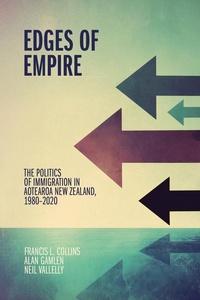
Edges of Empire
The Politics of Immigration in Aotearoa New Zealand, 1980-2020
Published on 11. September 2025
Book
Paperback/Softback
344 pages
978-1-77671-112-3 (ISBN)
Description
Since 1980, the peoples of Aotearoa New Zealand have fundamentally changed through new policies and new patterns of migration - from a largely Pakeha population with 10 per cent Maori in 1980 to today's megadiversity, with new residents from Asia, the Pacific and the rest of the world. Immigration has had a profound impact on New Zealand's society, economy, and place in the world.
Edges of Empire is an in-depth account of the social, political and economic context within which these transformations in policy and population took place. Drawing on interviews with fifteen former Ministers of Immigration, this book reveals the intricacies of politics and policy-making that have led to New Zealand's relatively open and economically driven approach towards migration.
Written by three leading social scientists, Edges of Empire provides an insightful account of who is included in Aotearoa New Zealand and under what conditions.
Edges of Empire is an in-depth account of the social, political and economic context within which these transformations in policy and population took place. Drawing on interviews with fifteen former Ministers of Immigration, this book reveals the intricacies of politics and policy-making that have led to New Zealand's relatively open and economically driven approach towards migration.
Written by three leading social scientists, Edges of Empire provides an insightful account of who is included in Aotearoa New Zealand and under what conditions.
Reviews / Votes
'Aotearoa New Zealand is a curiously neglected case in migration studies, despite the significance of immigration in the country's social, economic and political development. This book will make a significant contribution towards filling this gap.'- Antje Ellermann, Founder and Co-Director, Centre for Migration Studies, University of British Columbia
'This is an impressive review of international migration policy in Aotearoa New Zealand with particular reference to the forty years between 1981 and 2020. It makes a distinctive contribution by situating much of the discussion in the context of the perspectives and policy interventions of successive Ministers of Immigration since the mid-1970s. As someone with more than fifty years of research experience in the field, I found the narrative that the authors have developed is novel, very comprehensive, well argued and interesting to read.'
- Richard Bedford, QSO, Emeritus Professor, University of Waikato and AUT
'Edges of Empire is the first book-length study to chronicle the evolution of migration policy governance in Aotearoa New Zealand in the neo-liberal period, against the backdrop of treatymaking involving Maori and complex external relationships with peoples of the Pacific Islands. It boldly responds to the challenge to migration scholars to attend to the colonial in multiple sites and at different scales. The book is also unique in its use of interviews with successive ministers of migration to centre the analysis. In all these ways, Collins, Gamlen and Vallelly have produced a highly original and timely scholarly intervention.'
- Leah F. Vosko, FRSC, Distinguished Research Professor of Political Economy, York University
'Drawing on the personalised accounts of successive Ministers of Immigration, Edges of Empire offers a unique analysis of New Zealand's migration policies. At its core, the book outlines how the politics of markets, multiculturalism, and an enduring imperial agenda has shaped migration over the past forty years. It is also one of those rare accounts that threads the Crown's relationship with tangata whenua in unfolding immigration histories. Collins, Gamlen and Vallelly adeptly blend academic thoroughness and storytelling to deliver an immersive and thought-provoking critique of New Zealand's contemporary migration.'
-Rachel Simon-Kumar, Professor and Co-Director, Centre for Asian and Ethnic Minority Health Research and Evaluation, University of Auckland
More details
Language
English
Place of publication
Auckland
New Zealand
Product notice
Paperback (trade)
Unsewn / adhesive bound
Dimensions
Height: 224 mm
Width: 151 mm
Thickness: 19 mm
Weight
472 gr
ISBN-13
978-1-77671-112-3 (9781776711123)
Copyright in bibliographic data and cover images is held by Nielsen Book Services Limited or by the publishers or by their respective licensors: all rights reserved.
Schweitzer Classification
Persons
Francis L. Collins is a professor of sociology at Waipapa Taumata Rau, the University of Auckland and has previously held positions in geography and population studies at the National University of Singapore and Te Whare Wananga o Waikato, the University of Waikato. His research encompasses a focus on the regulation and experiences of temporary migration, racism and workplace exploitation; international student mobilities; and the relationship between migration and cities. Francis is the author of Global Asian City: Migration, Desire and the Politics of Encounter in 21st Century Seoul (Wiley, 2018). Co-edited volumes include Intersections of Inequality, Migration and Diversification (Palgrave, 2020), Aspiration, Desire and the Drivers of Migration (Routledge, 2020) and Handbook on Transnationalism (Edward Elgar, 2022).
Alan Gamlen is a social scientist specialising in migration, mobility and identity. He is a professor at The Australian National University, founding director of the ANU Migration Hub, and an ARC Future Fellow and College of Experts member. He has held appointments at Oxford, Stanford and the Max Planck Society, among others, and formerly served as founding editor-in-chief of the journal Migration Studies (Oxford University Press) and director of the Australian Population and Migration Research Centre. Gamlen is a member of the Tainui confederation of Maori tribes in Aotearoa New Zealand. His last book Human Geopolitics: States, Emigrants, and the Rise of Diaspora Institutions (Oxford University Press, 2019) won the ENMISA Distinguished Book Award.
Neil Vallelly is a lecturer in the sociology, gender studies and criminology programme at Otakou Whakaihu Waka, the University of Otago. He is the author of Futilitarianism: Neoliberalism and the Production of Uselessness (Goldsmiths Press, 2021), which has been translated into Italian, and his work has appeared in journals such as Angelaki, Poetics Today, Critical Times, Journal of Gender Studies and Theory & Event. Neil is the editor of the journal Counterfutures: Left Thought & Practice Aotearoa, a member of the executive committee for the Australasian Society for Continental Philosophy, and a recipient of a Rutherford Foundation Postdoctoral Fellowship (Royal Society Te Aparangi).
Alan Gamlen is a social scientist specialising in migration, mobility and identity. He is a professor at The Australian National University, founding director of the ANU Migration Hub, and an ARC Future Fellow and College of Experts member. He has held appointments at Oxford, Stanford and the Max Planck Society, among others, and formerly served as founding editor-in-chief of the journal Migration Studies (Oxford University Press) and director of the Australian Population and Migration Research Centre. Gamlen is a member of the Tainui confederation of Maori tribes in Aotearoa New Zealand. His last book Human Geopolitics: States, Emigrants, and the Rise of Diaspora Institutions (Oxford University Press, 2019) won the ENMISA Distinguished Book Award.
Neil Vallelly is a lecturer in the sociology, gender studies and criminology programme at Otakou Whakaihu Waka, the University of Otago. He is the author of Futilitarianism: Neoliberalism and the Production of Uselessness (Goldsmiths Press, 2021), which has been translated into Italian, and his work has appeared in journals such as Angelaki, Poetics Today, Critical Times, Journal of Gender Studies and Theory & Event. Neil is the editor of the journal Counterfutures: Left Thought & Practice Aotearoa, a member of the executive committee for the Australasian Society for Continental Philosophy, and a recipient of a Rutherford Foundation Postdoctoral Fellowship (Royal Society Te Aparangi).