

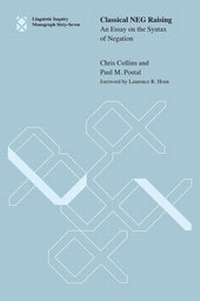
Classical NEG Raising: Volume 67
An Essay on the Syntax of Negation
Published on 16. May 2014
Book
Paperback/Softback
296 pages
978-0-262-52586-2 (ISBN)
Description
An extended argument for a syntactic view of NEG raising with consequences for the syntax of negation and negative polarity items.In this book, Chris Collins and Paul Postal consider examples such the one below on the interpretation where Nancy thinks that this course is not interesting:
Nancy doesn't think this course is interesting.They argue such examples instantiate a kind of syntactic raising that they term Classical NEG Raising. This involves the raising of a NEG (negation) from the embedded clause to the matrix clause. Collins and Postal develop three main arguments to support their claim. First, they show that Classical NEG Raising obeys island constraints. Second, they document that a syntactic raising analysis predicts both the grammaticality and particular properties of what they term Horn clauses (named for Laurence Horn, who discovered them). Finally, they argue that the properties of certain parenthetical structures strongly support the syntactic character of Classical NEG Raising. Collins and Postal also offer a detailed analysis of the main argument in the literature against a syntactic raising analysis (which they call the Composed Quantifier Argument). They show that the facts appealed to in this argument not only fail to conflict with their approach but actually support a syntactic view. In the course of their argument, Collins and Postal touch on a variety of related topics, including the syntax of negative polarity items, the status of sequential negation, and the scope of negative quantifiers.
Nancy doesn't think this course is interesting.They argue such examples instantiate a kind of syntactic raising that they term Classical NEG Raising. This involves the raising of a NEG (negation) from the embedded clause to the matrix clause. Collins and Postal develop three main arguments to support their claim. First, they show that Classical NEG Raising obeys island constraints. Second, they document that a syntactic raising analysis predicts both the grammaticality and particular properties of what they term Horn clauses (named for Laurence Horn, who discovered them). Finally, they argue that the properties of certain parenthetical structures strongly support the syntactic character of Classical NEG Raising. Collins and Postal also offer a detailed analysis of the main argument in the literature against a syntactic raising analysis (which they call the Composed Quantifier Argument). They show that the facts appealed to in this argument not only fail to conflict with their approach but actually support a syntactic view. In the course of their argument, Collins and Postal touch on a variety of related topics, including the syntax of negative polarity items, the status of sequential negation, and the scope of negative quantifiers.
More details
Series
Language
English
Place of publication
Cambridge, Mass.
United States
Publishing group
MIT Press Ltd
Target group
Professional and scholarly
Interest Age: From 18 years
Product notice
Paperback (trade)
Dimensions
Height: 229 mm
Width: 152 mm
Thickness: 14 mm
ISBN-13
978-0-262-52586-2 (9780262525862)
Copyright in bibliographic data and cover images is held by Nielsen Book Services Limited or by the publishers or by their respective licensors: all rights reserved.
Schweitzer Classification
Other editions
Additional editions
Book
05/2014
MIT Press
€9.89
Article exhausted; check different version
Persons
Chris Collins is Professor of Linguistics at New York University. Paul M. Postal is the author of many books, including On Raising and Edge-Based Clausal Syntax (both published by the MIT Press). Collins and Postal are coauthors of Imposters: A Study of Pronominal Agreement (MIT Press).