

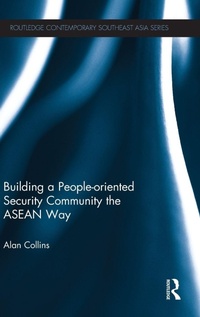
Building a People-Oriented Security Community the ASEAN way
1st Edition
Published on 22. August 2012
Book
Hardback
208 pages
978-0-415-60868-8 (ISBN)
Description
ASEAN has declared its intention to create a security community in Southeast Asia that is people-orientated. This book evaluates ASEAN's progress, and in doing so examines three matters of concern.
The book firstly looks at the importance of constitutive norms to the workings of security communities, by identifying ASEAN's constitutive norms and the extent to which they act as a help of hindrance in establishing a security community. It then moves on to how ASEAN has interpreted people-orientated as empowering civil society organisations to be community stakeholders. The book discusses the uncertainty between how ASEAN envisages their role, and the role they themselves expect to have. Civil society actors are seeking to influence what sort of community evolves and their ability to interact with the state elite is evaluated to determine what interpretation of people-oriented is likely to emerge. Thirdly, in order to make progress ASEAN has sought to achieve cooperation among its member states in functional areas. The book examines this interest in functional cooperation through case studies on human rights, HIV/AIDS and disaster management.
By discussing the notion of ASEAN being people-orientated, and how it engages with 'the people', the book provides important insights into what type of community ASEAN in building, as well as furthering our understanding on security communities more broadly.
The book firstly looks at the importance of constitutive norms to the workings of security communities, by identifying ASEAN's constitutive norms and the extent to which they act as a help of hindrance in establishing a security community. It then moves on to how ASEAN has interpreted people-orientated as empowering civil society organisations to be community stakeholders. The book discusses the uncertainty between how ASEAN envisages their role, and the role they themselves expect to have. Civil society actors are seeking to influence what sort of community evolves and their ability to interact with the state elite is evaluated to determine what interpretation of people-oriented is likely to emerge. Thirdly, in order to make progress ASEAN has sought to achieve cooperation among its member states in functional areas. The book examines this interest in functional cooperation through case studies on human rights, HIV/AIDS and disaster management.
By discussing the notion of ASEAN being people-orientated, and how it engages with 'the people', the book provides important insights into what type of community ASEAN in building, as well as furthering our understanding on security communities more broadly.
More details
Series
Language
English
Place of publication
London
United Kingdom
Publishing group
Taylor & Francis Ltd
Target group
College/higher education
Dimensions
Height: 240 mm
Width: 161 mm
Thickness: 16 mm
Weight
482 gr
ISBN-13
978-0-415-60868-8 (9780415608688)
Copyright in bibliographic data and cover images is held by Nielsen Book Services Limited or by the publishers or by their respective licensors: all rights reserved.
Schweitzer Classification
Other editions
Additional editions
Book
05/2017
1st Edition
Routledge
€71.60
Shipment within 10-20 days
E-Book
05/2013
1st Edition
Routledge
€64.49
Available for download
E-Book
05/2013
1st Edition
Routledge
€64.49
Available for download
Person
Alan Collins is a Senior Lecturer in the Department of Political and Cultural Studies at Swansea University, UK. His has written extensively on Southeast Asian security with a particular emphasis on non-traditional security, securitization and ASEAN.
Content
1. Introduction 2. Dependable expectations of peaceful change 3. ASEAN's Constitutive Norms 4. Norm Entrepreneurs, Community Plans of Action and the ASEAN Charter 5. Human Rights 6. HIV/AIDS 7. Disaster Management 8. Conclusion