

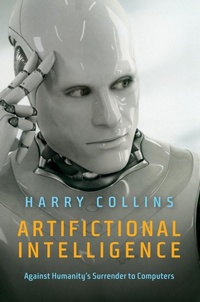
Artifictional Intelligence
Against Humanity's Surrender to Computers
1st Edition
Published on 7. September 2018
Book
Hardback
232 pages
978-1-5095-0411-4 (ISBN)
Description
Recent startling successes in machine intelligence using a technique called 'deep learning' seem to blur the line between human and machine as never before. Are computers on the cusp of becoming so intelligent that they will render humans obsolete? Harry Collins argues we are getting ahead of ourselves, caught up in images of a fantastical future dreamt up in fictional portrayals. The greater present danger is that we lose sight of the very real limitations of artificial intelligence and readily enslave ourselves to stupid computers: the 'Surrender'.
By dissecting the intricacies of language use and meaning, Collins shows how far we have to go before we cannot distinguish between the social understanding of humans and computers. When the stakes are so high, we need to set the bar higher: to rethink 'intelligence' and recognize its inherent social basis. Only if machine learning succeeds on this count can we congratulate ourselves on having produced artificial intelligence.
By dissecting the intricacies of language use and meaning, Collins shows how far we have to go before we cannot distinguish between the social understanding of humans and computers. When the stakes are so high, we need to set the bar higher: to rethink 'intelligence' and recognize its inherent social basis. Only if machine learning succeeds on this count can we congratulate ourselves on having produced artificial intelligence.
Reviews / Votes
"In an age when heady promises and dark warnings from advocates of a fast-approaching "Technological Singularity" regularly make front-page news, this book offers timely words of caution."J. Mark Bishop, Director of the Tungsten Centre for Intelligent Data Analytics, Goldsmiths, University of London
"By highlighting artificial intelligence's fundamental failures, Professor Collins provides an overdue correction to "the market-driven urge to advertise its successes". Authoritative and technically accurate, this book will be essential for students of AI, policy makers, business innovators and the broader public for many years."
Alan Blackwell, Computer Laboratory, University of Cambridge
"[Harry Collins examines] pervasive existential fears over artificial intelligence and its perceived threat in the 'deep learning' era. Collins probes this idea trenchantly and in considerable detail. Pointing to computers' inability to factor in social context, master natural language use well enough to pass a severe Turing test, or wield embodied cognition, he argues that the real danger we face is not a takeover by superior computers, but slavery to stupid ones."
Barbara Kiser, Nature
"[E]ven as a non-industry expert, Collins has still read deeply in this area, and consequently is posing some important, challenging questions. Having already experienced long periods of AI winters this book provides a robust challenge to those techno solutionist optimists who see AI-delivered solutions through overly rose-tinted glasses."
Simon Cocking, Irish Tech News
"If you are looking for a balanced debate on artificial intelligence, or are engaged in a critique of deep learning, concerned with the implications of singularity on society, intrigued by the notion of equivalence of human and machine intelligence, a critical observer of automation vs augmentation debate, perplexed by the ongoing interest in Turing test, or curious about what AI narratives attract AI research funding, then this book, by a critical scholar, a reflective narrator and a far-sighted teacher, Harry Collins, is for you."
Karamjit S. Gill, AI & Society
"Collins has provided a distinctive perspective to the conversation on AI."
Metascience
"[P]resents some interesting questions, most notably about how an embeddedness based on layers of data abstraction may or may not map onto embeddedness in social context. [...] Collins's frameworks often prove useful for questioning and analyzing what tends to be very messy data, and the book is sure to produce lively discussion among students and established scholars alike."
Sarah E. Sachs, Contemporary Sociology
More details
Other editions
Additional editions
E-Book
11/2018
1st Edition
Wiley
€19.99
Available for download
Book
09/2018
1st Edition
Polity Press
€27.50
Shipment within 15-20 days
Person
Harry Collins is a Fellow of the British Academy, and Distinguished Research Professor in the School of Social Sciences at Cardiff University
Content
Chapter 1. Computers in Social Life and the Danger of the 'Surrender'
Chapter 2. Expertise and Writing about AI: Some Reflections on the Project
Chapter 3. Language and 'Repair'
Chapter 4. Humans, Social Contexts and Bodies
Chapter 5. Six Levels of Artificial Intelligence
Chapter 6. Deep Learning: Precedent-Based, Pattern-Recognising Computers
Chapter 7. Kurzweil's Brain and the Sociology of Knowledge
Chapter 8. How Humans Learn What Computers Can't
Chapter 9. Two Models of Artificial Intelligence and the Way Forward
Chapter 10. The Editing Test and Other New Versions of the Turing Test
Appendix 1: How the Internet Works Today
Appendix 2: Little Dogs
Chapter 2. Expertise and Writing about AI: Some Reflections on the Project
Chapter 3. Language and 'Repair'
Chapter 4. Humans, Social Contexts and Bodies
Chapter 5. Six Levels of Artificial Intelligence
Chapter 6. Deep Learning: Precedent-Based, Pattern-Recognising Computers
Chapter 7. Kurzweil's Brain and the Sociology of Knowledge
Chapter 8. How Humans Learn What Computers Can't
Chapter 9. Two Models of Artificial Intelligence and the Way Forward
Chapter 10. The Editing Test and Other New Versions of the Turing Test
Appendix 1: How the Internet Works Today
Appendix 2: Little Dogs