

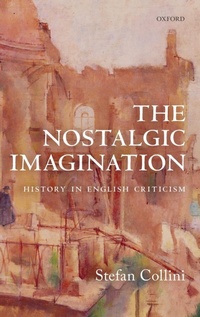
The Nostalgic Imagination
History in English Criticism
Published on 10. January 2019
Book
Hardback
258 pages
978-0-19-880017-0 (ISBN)
Description
This unusual book explores the historical assumptions at work in the style of literary criticism that came to dominate English studies in the twentieth century. Stefan Collini shows how the work of critics renowned for their close attention to 'the words on the page' was in practice bound up with claims about the nature and direction of historical change, the interpretation of the national past, and the scholarship of earlier historians. Among the major figures examined in detail are T.S. Eliot, F.R. Leavis, William Empson, and Raymond Williams, while there are also original discussions of such figures as Basil Willey, L.C. Knights, Q.D. Leavis, and Richard Hoggart. The Nostalgic Imagination argues that in the period between Eliot's The Sacred Wood and Williams's The Long Revolution, the writings of such critics came to occupy the cultural space left by academic history's retreat into specialized, archive-bound monographs. Their work challenged the assumptions of the Whig interpretation of English history, and entailed a revision of the traditional relations between 'literary history' and 'general history'. Combining close textual analysis with wide-ranging intellectual history, this volume both revises the standard story of the history of literary criticism and illuminates a central feature of the cultural history of twentieth-century Britain.
Reviews / Votes
The best book of literary criticism I read this year... * D.J. Taylor, The Times Literary Supplement, Books of the Year 2019 * The Nostalgic Imagination takes its place among Stefan Collini's works as an example par excellence of the rigour that, he teaches us, the critic must exert to remain even-handed: which is in itself the highest praise. * Jack Ingram, Times Literary Supplement * The Nostalgic Imagination reveals the surprising ways that even the most seemingly ahistorical works from this age of criticism not only depended upon conceptions of history, but also influentially conveyed those conceptions to a wider public. * Guy Ortolano, New York University, Ceercles * Stefan Collini's The Nostalgic Imagination... is the most dazzling piece of literary criticism I have read in ages an attempt to decode some of the historical assumptions that underlie the way in which early-twentieth-century critics such as Eliot, Leavis and Empson approached their subject, and written with a wit and intelligence that puts most current academic criticism to shame. * D J Taylor, The Tablet *More details
Language
English
Place of publication
Oxford
United Kingdom
Target group
Professional and scholarly
College/higher education
Dimensions
Height: 240 mm
Width: 161 mm
Thickness: 19 mm
Weight
555 gr
ISBN-13
978-0-19-880017-0 (9780198800170)
Copyright in bibliographic data and cover images is held by Nielsen Book Services Limited or by the publishers or by their respective licensors: all rights reserved.
Schweitzer Classification
Other editions
Additional editions
E-Book
01/2019
1st Edition
OUP eBook
€9.99
Available for download
E-Book
01/2019
1st Edition
OUP eBook
€9.99
Available for download
Person
Stefan Collini studied at Cambridge and Yale. He taught at the University of Sussex from 1974 to 1986, and thereafter at Cambridge where he became Professor of Intellectual History and English Literature in 2000. He is a frequent contributor to The London Review of Books, Times Literary Supplement, The Guardian, and The Nation, and an occasional broadcaster. He is a Fellow of the British Academy and of the Royal Historical Society.
Content
Introduction
1: Whig History and the Mind of England
2: Scrutinizing the Present Phase of Human History
3: Science and Capitalism as Background
4: Rationalism, Christianity, and Ambiguity
5: The History of the Reading Public
6: The Long Industrial Revolution
7: Literary history as cultural history
Postscript
1: Whig History and the Mind of England
2: Scrutinizing the Present Phase of Human History
3: Science and Capitalism as Background
4: Rationalism, Christianity, and Ambiguity
5: The History of the Reading Public
6: The Long Industrial Revolution
7: Literary history as cultural history
Postscript