

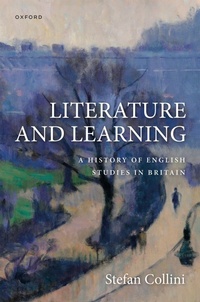
Literature and Learning
A History of English Studies in Britain
Published on 10. April 2025
Book
Hardback
656 pages
978-0-19-880018-7 (ISBN)
Description
The study and teaching of English literature is generally regarded as one of the central disciplines in the modern university, yet for much of its history it struggled to gain academic legitimacy and was frequently derided as 'a soft option'. Its early professors responded by emphasizing its scholarly character, foregrounding philology and literary history in ways that marked the syllabus far into the twentieth century.
Stefan Collini provides here the first full account of the discipline's development from its late-eighteenth-century beginnings up to the early 1960s. Paying special attention to institutional settings, he challenges numerous assumptions about the character of universities in the nineteenth and early twentieth centuries. From the detailed exploration of syllabuses, exam papers, and other institutional records, the impact of literary criticism is revealed to be later and more partial than is commonly assumed. Rather than seeing the early teaching of English literature as 'a substitute for religion' or 'a means to soften class conflict', Collini emphasizes the role of ideals of learnedness and scholarship, as well as of external factors such as opportunities for employment in the civil service and secondary school-teaching. There are full discussions of the parts played by such figures as John Churton Collins, A.C. Bradley, George Saintsbury, and Walter Raleigh, together with sceptical analyses of the decisive significance usually attributed to Matthew Arnold, T.S. Eliot, I.A. Richards, and F.R. Leavis. Separate chapters are devoted to neglected aspects of the story such as the role of Classics, the importance of the subject for women's higher education, and the connections with English teaching in schools.
Drawing on extensive use of institutional archives and records as well as the writings of contemporary participants, the book offers a vivid and wide-ranging history of English-as-discipline and its centrality across academic, literary, cultural, and educational life over the past two year hundred years, as well as a resounding testament to its continued importance and relevance today.
Stefan Collini provides here the first full account of the discipline's development from its late-eighteenth-century beginnings up to the early 1960s. Paying special attention to institutional settings, he challenges numerous assumptions about the character of universities in the nineteenth and early twentieth centuries. From the detailed exploration of syllabuses, exam papers, and other institutional records, the impact of literary criticism is revealed to be later and more partial than is commonly assumed. Rather than seeing the early teaching of English literature as 'a substitute for religion' or 'a means to soften class conflict', Collini emphasizes the role of ideals of learnedness and scholarship, as well as of external factors such as opportunities for employment in the civil service and secondary school-teaching. There are full discussions of the parts played by such figures as John Churton Collins, A.C. Bradley, George Saintsbury, and Walter Raleigh, together with sceptical analyses of the decisive significance usually attributed to Matthew Arnold, T.S. Eliot, I.A. Richards, and F.R. Leavis. Separate chapters are devoted to neglected aspects of the story such as the role of Classics, the importance of the subject for women's higher education, and the connections with English teaching in schools.
Drawing on extensive use of institutional archives and records as well as the writings of contemporary participants, the book offers a vivid and wide-ranging history of English-as-discipline and its centrality across academic, literary, cultural, and educational life over the past two year hundred years, as well as a resounding testament to its continued importance and relevance today.
Reviews / Votes
This "essay" provides a final rhetorical flourish to an extraordinary work of empirical scholarship and critical analysis. In 15 pages, it covers the various accounts of the history of the field and very fairly assesses the strengths and weaknesses of each text and emphasises what, in some cases, if anything, was added to our knowledge. What Collini has achieved is to add immensely to our knowledge of English Studies, to change and clarify our understanding in numerous ways and to set a new standard of rigorous scholarship for any subsequent account. * Andrew Goodwyn, Journal of the History of Education Society *More details
Language
English
Place of publication
Oxford
United Kingdom
Target group
Professional and scholarly
Dimensions
Height: 241 mm
Width: 169 mm
Thickness: 43 mm
Weight
1144 gr
ISBN-13
978-0-19-880018-7 (9780198800187)
Copyright in bibliographic data and cover images is held by Nielsen Book Services Limited or by the publishers or by their respective licensors: all rights reserved.
Schweitzer Classification
Person
Stefan Collini was educated at Cambridge and Yale. Following a Research Fellowship at St John's College, Cambridge, he was Lecturer, then Reader, in Intellectual History at the University of Sussex 1974-86; Lecturer, then Reader, then Professor of Intellectual History and English Literature at the University of Cambridge 1986-2014. He is a Fellow of the British Academy, and a frequent contributor to the London Review of Books, Times Literary Supplement, and Guardian.
Content
Introduction: Beauty and the Footnote
PART I: CULTURAL CONTEXTS
1: The Ascendancy of Literature
2: The Authority of Classics
3: The Imperium of History
PART II: INSTITUTIONAL STORIES
4: A Scottish Prologue
5: Nineteenth-Century Realities
6: London
7: Civic Traditions
8: Oxford
9: Cambridge
10: Colleges for Women
11: Schools
PART III: FOUNDING FIGURES
12: The Professorial Squad
13: Matthew Arnold and John Churton Collins
14: A. C. Bradley and George Saintsbury
15: Walter Raleigh and Arthur Quiller-Couch
16: John Bailey: Criticism as a Vocation
PART IV: PROFESSIONAL FORMS
17: Normal Scholarship
18: Local Varieties
19: The English Association
20: The Newbolt Report
PART V: MODERN TIMES
21: Insurgents
22: Normal Criticism
23: Cross-Currents
24: Meridian
25: Scenes from Departmental Life
26: Doubts
Appendix I: Existing Accounts: A Bibliographical Essay
Appendix II: Professors of English
Appendix III: Staff Numbers
Index
PART I: CULTURAL CONTEXTS
1: The Ascendancy of Literature
2: The Authority of Classics
3: The Imperium of History
PART II: INSTITUTIONAL STORIES
4: A Scottish Prologue
5: Nineteenth-Century Realities
6: London
7: Civic Traditions
8: Oxford
9: Cambridge
10: Colleges for Women
11: Schools
PART III: FOUNDING FIGURES
12: The Professorial Squad
13: Matthew Arnold and John Churton Collins
14: A. C. Bradley and George Saintsbury
15: Walter Raleigh and Arthur Quiller-Couch
16: John Bailey: Criticism as a Vocation
PART IV: PROFESSIONAL FORMS
17: Normal Scholarship
18: Local Varieties
19: The English Association
20: The Newbolt Report
PART V: MODERN TIMES
21: Insurgents
22: Normal Criticism
23: Cross-Currents
24: Meridian
25: Scenes from Departmental Life
26: Doubts
Appendix I: Existing Accounts: A Bibliographical Essay
Appendix II: Professors of English
Appendix III: Staff Numbers
Index