

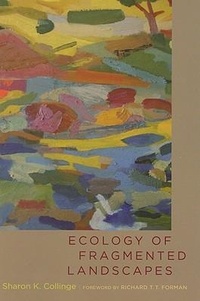
Ecology of Fragmented Landscapes
Published on 27. July 2009
Book
Hardback
360 pages
978-0-8018-9138-0 (ISBN)
Description
Ask airline passengers what they see as they gaze out the window, and they will describe a fragmented landscape: a patchwork of desert, woodlands, farmlands, and developed neighborhoods. Once-contiguous forests are now subdivided; tallgrass prairies that extended for thousands of miles are now crisscrossed by highways and byways. Whether the result of naturally occurring environmental changes or the product of seemingly unchecked human development, fractured lands significantly impact the planet's biological diversity. In Ecology of Fragmented Landscapes, Sharon K. Collinge defines fragmentation, explains its various causes, and suggests ways that we can put our lands back together. Researchers have been studying the ecological effects of dismantling nature for decades. In this book, Collinge evaluates this body of research, expertly synthesizing all that is known about the ecology of fragmented landscapes. Expanding on the traditional coverage of this topic, Collinge also discusses disease ecology, restoration, conservation, and planning. Not since Richard T. T. Forman's classic Land Mosaics has there been a more comprehensive examination of landscape fragmentation.
Ecology of Fragmented Landscapes is critical reading for ecologists, conservation biologists, and students alike.
Ecology of Fragmented Landscapes is critical reading for ecologists, conservation biologists, and students alike.
Reviews / Votes
This important and relevant work is well written and very extensively reference. Choice 2009 Its first-person style, relating often to the author's own experiences, is engaging and personable, and yet the book backs a scientific punch too... Its unassuming style and friendly approach belie it powerful insight and interpretation of a vast literature. -- Robert A. Davis Ecological Management and Restoration 2010 Ecology of Fragmented Landscapes is a fascinating, thorough, and positive book, packed with scientific and technical content-an excellent resource for teachers and students of landscape and restoration ecology or for scientifically oriented naturalists. -- Renate Sander-Regier The Canadian Field-Naturalist 2009More details
Language
English
Place of publication
Baltimore, MD
United States
Target group
Professional and scholarly
Product notice
sewn/stitched
Cloth over boards
With dust jacket
Illustrations
24 s/w Photographien bzw. Rasterbilder, 18 s/w Zeichnungen
18 Line drawings, black and white; 24 Halftones, black and white
Dimensions
Height: 237 mm
Width: 161 mm
Thickness: 29 mm
Weight
641 gr
ISBN-13
978-0-8018-9138-0 (9780801891380)
DOI
10.1353/book.3364
Copyright in bibliographic data and cover images is held by Nielsen Book Services Limited or by the publishers or by their respective licensors: all rights reserved.
Schweitzer Classification
Other editions
Additional editions
Sharon K. Collinge
Ecology of Fragmented Landscapes
E-Book
07/2009
Johns Hopkins University Press
€57.49
Available for download
Persons
Sharon K. Collinge is an associate professor of ecology and evolutionary biology as well as of environmental studies at the University of Colorado. She is the senior volume editor of Disease Ecology: Community Structure and Pathogen Dynamics.
Content
Foreword, by Richard T. T. Forman
Preface
1. Introduction
2. Conceptual Frameworks
3. Fragment Size and Isolation
4. Experimenting with Fragmentation
5. Fragment Context and Edge Effects
6. Animal and Plant Movement
7. Species Interactions
8. Parasites, Pathogens, and Disease Emergence
9. Modeling
10. Restoration
11. Ecological Planning
12. Some Final Thoughts
Literature Cited
Index
Preface
1. Introduction
2. Conceptual Frameworks
3. Fragment Size and Isolation
4. Experimenting with Fragmentation
5. Fragment Context and Edge Effects
6. Animal and Plant Movement
7. Species Interactions
8. Parasites, Pathogens, and Disease Emergence
9. Modeling
10. Restoration
11. Ecological Planning
12. Some Final Thoughts
Literature Cited
Index