

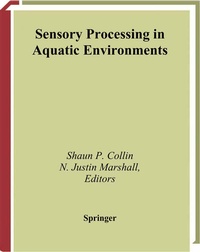
Sensory Processing in Aquatic Environments
Foreword by T. Bullock, Introducion by J. Atema, R.R. Fay, A.N. Popper and W.N. Tavolga
Published on 6. February 2003
Book
Hardback
XXI, 446 pages
978-0-387-95527-8 (ISBN)
Description
Research on sensory processing or the way animals see, hear, smell, taste, feel and electrically and magnetically sense their environment has advanced a great deal over the last fifteen years. This book discusses the most important themes that have emerged from recent research and provides a summary of likely future directions.
The book starts with two sections on the detection of sensory signals over long and short ranges by aquatic animals, covering the topics of navigation, communication, and finding food and other localized sources. The next section, the co-evolution of signal and sense, deals with how animals decide whether the source is prey, predator or mate by utilizing receptors that have evolved to take full advantage of the acoustical properties of the signal. Organisms living in the deep-sea environment have also received a lot of recent attention, so the next section deals with visual adaptations to limited light environments where sunlight is replaced by bioluminescence and the visual system has undergone changes to optimize light capture and sensitivity. The last section on central co-ordination of sensory systems covers how signals are processed and filtered for use by the animal.
This book will be essential reading for all researchers and graduate students interested in sensory systems.
The book starts with two sections on the detection of sensory signals over long and short ranges by aquatic animals, covering the topics of navigation, communication, and finding food and other localized sources. The next section, the co-evolution of signal and sense, deals with how animals decide whether the source is prey, predator or mate by utilizing receptors that have evolved to take full advantage of the acoustical properties of the signal. Organisms living in the deep-sea environment have also received a lot of recent attention, so the next section deals with visual adaptations to limited light environments where sunlight is replaced by bioluminescence and the visual system has undergone changes to optimize light capture and sensitivity. The last section on central co-ordination of sensory systems covers how signals are processed and filtered for use by the animal.
This book will be essential reading for all researchers and graduate students interested in sensory systems.
More details
Edition
2003 ed.
Language
English
Place of publication
New York
United States
Target group
College/higher education
Professional and scholarly
Research
Product notice
sewn/stitched
Cloth over boards
Illustrations
112 s/w Abbildungen, 8 farbige Abbildungen
XXI, 446 p. 120 illus., 8 illus. in color.
Dimensions
Height: 260 mm
Width: 183 mm
Thickness: 29 mm
Weight
1007 gr
ISBN-13
978-0-387-95527-8 (9780387955278)
DOI
10.1007/b97656
Schweitzer Classification
Other editions
Additional editions
Shaun P. Collin | N.Justin Marshall
Sensory Processing in Aquatic Environments
Book
05/2011
Springer
€213.99
Shipment within 15-20 days
Shaun P. Collin | N.Justin Marshall
Sensory Processing in Aquatic Environments
E-Book
04/2008
Springer
€213.99
Available for download
Persons
Content
Navigation and Communication.- Sound Detection Mechanisms and Capabilities of Teleost Fishes.- Trails in Open Waters: Sensory Cues in Salmon Migration.- Detection and Use of the Earth's Magnetic Field by Aquatic Vertebrates.- Finding Food and Other Localized Sources.- Physical Principles of Electric, Magnetic, and Near-Field Acoustic Orientation.- Active Electrolocation and Its Neural Processing in Mormyrid Electric Fishes.- Processing of Dipole and More Complex Hydrodynamic Stimuli Under Still- and Running-Water Conditions.- Information Processing by the Lateral Line System.- Retinal Sampling and the Visual Field in Fishes.- The Coevolution of Signal and Sense.- Underwater Sound Generation and Acoustic Reception in Fishes with Some Notes on Frogs.- The Design of Color Signals and Color Vision in Fishes.- Color Vision in Fishes and Its Neural Basis.- Chemically Mediated Strategies to Counter Predation.- Mechanisms of Ultraviolet Polarization Vision in Fishes.- Aspects of the Sensory Ecology of Cephalopods.- Recent Progress in Aquatic Vertebrate Olfaction.- Visual Adaptations to Limited Light Environments.- Eye Design and Vision in Deep-Sea Fishes.- Spectral Sensitivity Tuning in the Deep-Sea.- Visual Adaptations in Crustaceans: Chromatic, Developmental, and Temporal Aspects.- Central Coordination and Evolution of Sensory Inputs.- Sensory Systems and Brain Evolution Across the Bilateria: Commonalities and Constraints.- Electroreception: Extracting Behaviorally Important Signals from Noise.- In a Fish's Mind's Eye: The Visual Pallium of Teleosts.- Paddlefish and Platypus: Parallel Evolution of Passive Electroreception in a Rostral Bill Organ.