

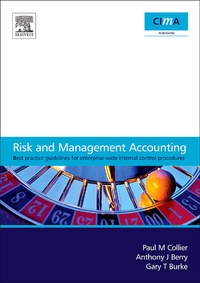
Risk and Management Accounting
Best Practice Guidelines for Enterprise-Wide Internal Control Procedures
Published on 11. August 2006
Book
Paperback/Softback
188 pages
978-0-7506-8040-0 (ISBN)
Description
This CIMA research report builds on a pilot study undertaken by the authors. A framework for risk management was developed as a result of the research. This research report describes the results of a major survey-based research study entitled 'Risk and Management Accounting: The development of best practice guidelines for enterprise-wide internal control procedures to identify and manage risk; the contribution of and the consequences for management accountants'.
More details
Language
English
Place of publication
Oxford
United Kingdom
Publishing group
Elsevier Science & Technology
Target group
Professional and scholarly
Management Accountants involved in risk management; Finance Directors involved in risk management; Finance professionals; Non-financial managers involved in risk management; Risk Managers; Business consultants and practitioners developing risk management techniques. CIMA Students
Illustrations
Illustrated; Illustrations
Dimensions
Height: 234 mm
Width: 165 mm
Weight
320 gr
ISBN-13
978-0-7506-8040-0 (9780750680400)
Copyright in bibliographic data and cover images is held by Nielsen Book Services Limited or by the publishers or by their respective licensors: all rights reserved.
Schweitzer Classification
Other editions
Additional editions
Paul M. M. Collier | Andrew Berry | Gary T. T. Burke
Risk and Management Accounting
Best Practice Guidelines for Enterprise-Wide Internal Control Procedures
E-Book
09/2006
Elsevier
€52.95
Available for download
Persons
Content
1. Introduction
2. Background
3. Survey design
4. Research results
5. Framework for risk management
6. Conclusions and implications
2. Background
3. Survey design
4. Research results
5. Framework for risk management
6. Conclusions and implications