

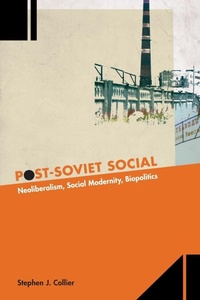
Post-Soviet Social
Neoliberalism, Social Modernity, Biopolitics
Published on 28. August 2011
Book
Paperback/Softback
312 pages
978-0-691-14831-1 (ISBN)
Description
The Soviet Union created a unique form of urban modernity, developing institutions of social provisioning for hundreds of millions of people in small and medium-sized industrial cities spread across a vast territory. After the collapse of socialism these institutions were profoundly shaken--casualties, in the eyes of many observers, of market-oriented reforms associated with neoliberalism and the Washington Consensus. In Post-Soviet Social, Stephen Collier examines reform in Russia beyond the Washington Consensus. He turns attention from the noisy battles over stabilization and privatization during the 1990s to subsequent reforms that grapple with the mundane details of pipes, wires, bureaucratic routines, and budgetary formulas that made up the Soviet social state. Drawing on Michel Foucault's lectures from the late 1970s, Post-Soviet Social uses the Russian case to examine neoliberalism as a central form of political rationality in contemporary societies.
The book's basic finding--that neoliberal reforms provide a justification for redistribution and social welfare, and may work to preserve the norms and forms of social modernity--lays the groundwork for a critical revision of conventional understandings of these topics.
The book's basic finding--that neoliberal reforms provide a justification for redistribution and social welfare, and may work to preserve the norms and forms of social modernity--lays the groundwork for a critical revision of conventional understandings of these topics.
Reviews / Votes
"[T]he overall arguments are clearly and exhaustively explicated, and Collier demonstrates a strong grasp of economics and economic history... [M]uch is provided that will interest a variety of scholars of political economy, as well as those with areal interests."--Samuel Schueth, Social Anthropology "Ambitious in its scope and level of detail, theoretically sophisticated and empirically rich, Collier's latest book makes an important contribution to Foucauldian scholarship. In particular, it helps us appreciate the significance and uniqueness of the Soviet biopolitical project, while suggesting a productive line of inquiry into the nexus between neoliberalism and social modernity. It also encourages us to critically interrogate neoliberal narratives in terms of their history and effects, to appreciate the flexibility of neoliberal reforms and to focus on specific practices in order to understand what makes them neoliberal."--Volha Piotukh, Foucault Studies "[B]y advocating the study of the actual ideas and policies, not merely the political manifestos, of economists and international financial institutions like the World Bank, as they change in interaction with material and social structures, Collier advances our understanding of socialism, postsocialism, and neoliberalism. This book would be useful in graduate courses on neoliberalism and postsocialism."--Johanna Bockman, Slavic Review "Undoubtedly, Collier's book is complex, yet highly rewarding, and this reviewer is certain that this book will transform not only our perception of how neoliberal reform actually worked in places like post-Soviet Russia, but also how we approach neoliberalism as an object of anthropological inquiry."--Valter Cvijic, Anthropological NotebooksMore details
Language
English
Place of publication
New Jersey
United States
Target group
College/higher education
Professional and scholarly
Product notice
Paperback (trade)
Illustrations
2 halftones. 5 line illus.
Dimensions
Height: 239 mm
Width: 156 mm
Thickness: 24 mm
Weight
462 gr
ISBN-13
978-0-691-14831-1 (9780691148311)
Copyright in bibliographic data and cover images is held by Nielsen Book Services Limited or by the publishers or by their respective licensors: all rights reserved.
Schweitzer Classification
Other editions
Additional editions
Book
08/2011
Princeton University Press
€71.80
Article exhausted; check different version

E-Book
08/2011
1st Edition
Princeton University Press
from
€34.39
Available for download
Person
Stephen J. Collier is an anthropologist and assistant professor in the Graduate Program in International Affairs at The New School. He is the coeditor of "Bio-security Interventions" and "Global Assemblages".
Content
List of Illustrations and Tables ix Preface: Formal and Substantive xi Acknowledgments xv Chapter One: Introduction: Post-Soviet, Post-Social? 1 Part I: Soviet Social Modernity 31 Chapter Two: The Birth of Soviet Biopolitics 39 Chapter Three: City-building 65 Chapter Four: City-building in Belaya Kalitva 84 Chapter Five: Consolidation, Stagnation, Breakup 108 Part II: Neoliberalism and Social Modernity 127 Chapter Six: Adjustment Problems 139 Chapter Seven: Budgets and Biopolitics: On Substantive Provisioningand Formal Rationalization 162 Chapter Eight: The Intransigence of Things 202 Epilogue: An Ineffective Controversy 245 Notes 253 References 279 Index 299