

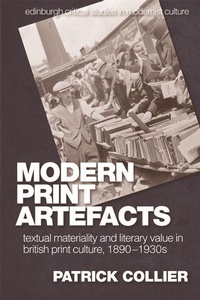
Modern Print Artefacts
Textual Materiality and Literary Value in British Print Culture, 1890-1930s
Published on 22. February 2018
Book
Paperback/Softback
288 pages
978-1-4744-3150-7 (ISBN)
Description
Demonstrates the ways in which print artefacts asserted and contested literary value in the modernist period
This study focuses on the close connections between literary value and the materiality of popular print artefacts in Britain from 1890-1930. The book demonstrates that the materiality of print objects-paper quality, typography, spatial layout, use of illustrations, etc.-became uniquely visible and significant in these years, as a result of a widely perceived crisis in literary valuation. In a set of case studies, it analyses the relations between literary value, meaning, and textual materiality in print artefacts such as newspapers, magazines, and book genres-artefacts that gave form to both literary works and the journalistic content (critical essays, book reviews, celebrity profiles, and advertising) through which conflicting conceptions of literature took shape. In the process, it corrects two available misperceptions about reading in the period: that books were the default mode of reading, and that experimental modernism was the sole literary aesthetic that could usefully represent modern life.
Key Features
Gives readers access to a sphere of literary production and reception that is virtually unexamined by existing scholarshipProvides a fresh view of literary production and the print marketplace by refusing to foreground literary modernism as a critical lens. Instead, it focuses on more widely read and accessible print artefacts, including the Illustrated London News in the 1890s; the London Mercury; John O'London's Weekly; and the poetry anthology as a book genreThe book constitutes a simultaneously historical and theoretical inquiry into the workings of literary value
This study focuses on the close connections between literary value and the materiality of popular print artefacts in Britain from 1890-1930. The book demonstrates that the materiality of print objects-paper quality, typography, spatial layout, use of illustrations, etc.-became uniquely visible and significant in these years, as a result of a widely perceived crisis in literary valuation. In a set of case studies, it analyses the relations between literary value, meaning, and textual materiality in print artefacts such as newspapers, magazines, and book genres-artefacts that gave form to both literary works and the journalistic content (critical essays, book reviews, celebrity profiles, and advertising) through which conflicting conceptions of literature took shape. In the process, it corrects two available misperceptions about reading in the period: that books were the default mode of reading, and that experimental modernism was the sole literary aesthetic that could usefully represent modern life.
Key Features
Gives readers access to a sphere of literary production and reception that is virtually unexamined by existing scholarshipProvides a fresh view of literary production and the print marketplace by refusing to foreground literary modernism as a critical lens. Instead, it focuses on more widely read and accessible print artefacts, including the Illustrated London News in the 1890s; the London Mercury; John O'London's Weekly; and the poetry anthology as a book genreThe book constitutes a simultaneously historical and theoretical inquiry into the workings of literary value
Reviews / Votes
His book is a testament to the ichness and promise of his own non-modernist angle; and his subject matter has the ethical advantage of modelling a 'democratisation' of critical judgement. -- Beci Carver * George Orwell Studies * [...] this book is full of fascinating finds that will be of lasting interest to those working in nineteenth- and twentieth-century literary and cultural studies. -- Nissa Ren Cannon, Boston University * Journal of European Periodical Studies, 4.2 (Winter 2019) * Always a fearless trailblazer, Collier argues eloquently for scholarly attention to the full range of early twentieth-century print culture. This carefully researched monograph is an exciting next step for a modernist studies that must leave behind its obsession with "modernism". -- Mark Morrisson, Penn State UniversityMore details
Series
Language
English
Place of publication
Edinburgh
United Kingdom
Target group
Professional and scholarly
Product notice
Paperback (trade)
Unsewn / adhesive bound
Illustrations
21 black and white illustrations, 7 colour illustrations
Dimensions
Height: 231 mm
Width: 155 mm
Thickness: 20 mm
Weight
386 gr
ISBN-13
978-1-4744-3150-7 (9781474431507)
Copyright in bibliographic data and cover images is held by Nielsen Book Services Limited or by the publishers or by their respective licensors: all rights reserved.
Schweitzer Classification
Person
Patrick Collier is Professor of Literature at Ball State University, where he teaches nineteenth- and twentieth-century British literature and film studies. He is the author of Modernism on Fleet Street (2006) and the co-editor of the Journal of Modern Periodical Studies and of the collections Transatlantic Print Culture 1880-1940 (2008) and Print Culture Histories Beyond the Metropolis (2016).
Content
Introduction; 1. Mapping Literary Value: Imperial/Modernist Forms in the Illustrated London News; 2. "Quite Ordinary Men and Women": John O'London's Weekly and the Meaning of Authorship; 3. Reactionary Materialism: Book Collecting, Connoisseurship, and the Reading Life in J.C. Squire's London Mercury; 4. Harold Monro, Poetry Anthologies, and the Rhetoric of Textual Materiality; Postscript: Against Modernist Studies; Bibliography.