

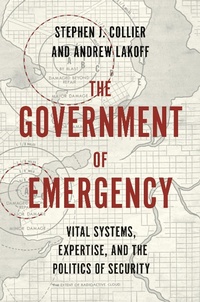
The Government of Emergency
Vital Systems, Expertise, and the Politics of Security
Published on 30. November 2021
Book
Paperback/Softback
480 pages
978-0-691-19928-3 (ISBN)
Description
The origins and development of the modern American emergency state
From pandemic disease, to the disasters associated with global warming, to cyberattacks, today we face an increasing array of catastrophic threats. It is striking that, despite the diversity of these threats, experts and officials approach them in common terms: as future events that threaten to disrupt the vital, vulnerable systems upon which modern life depends.
The Government of Emergency tells the story of how this now taken-for-granted way of understanding and managing emergencies arose. Amid the Great Depression, World War II, and the Cold War, an array of experts and officials working in obscure government offices developed a new understanding of the nation as a complex of vital, vulnerable systems. They invented technical and administrative devices to mitigate the nation's vulnerability, and organized a distinctive form of emergency government that would make it possible to prepare for and manage potentially catastrophic events.
Through these conceptual and technical inventions, Stephen Collier and Andrew Lakoff argue, vulnerability was defined as a particular kind of problem, one that continues to structure the approach of experts, officials, and policymakers to future emergencies.
From pandemic disease, to the disasters associated with global warming, to cyberattacks, today we face an increasing array of catastrophic threats. It is striking that, despite the diversity of these threats, experts and officials approach them in common terms: as future events that threaten to disrupt the vital, vulnerable systems upon which modern life depends.
The Government of Emergency tells the story of how this now taken-for-granted way of understanding and managing emergencies arose. Amid the Great Depression, World War II, and the Cold War, an array of experts and officials working in obscure government offices developed a new understanding of the nation as a complex of vital, vulnerable systems. They invented technical and administrative devices to mitigate the nation's vulnerability, and organized a distinctive form of emergency government that would make it possible to prepare for and manage potentially catastrophic events.
Through these conceptual and technical inventions, Stephen Collier and Andrew Lakoff argue, vulnerability was defined as a particular kind of problem, one that continues to structure the approach of experts, officials, and policymakers to future emergencies.
Reviews / Votes
"A scholarly tour de force. . . . For those seeking specialization in the anthropology of crises, disasters, and emergencies, this book is required reading."---Roberto E. Barrios, American Anthropologist "A monumental achievement."---Kathleen Tierney, American Journal of Sociology "The Government of Emergency is a thrilling intellectual history . . . [and] an important contribution to a growing line of scholarship that critically approaches the concept of 'disaster' itself."---Ryan Hagen, The British Journal of SociologyMore details
Series
Language
English
Place of publication
New Jersey
United States
Target group
College/higher education
Professional and scholarly
Product notice
Paperback (trade)
Illustrations
23 b/w illus. 2 tables.
Dimensions
Height: 229 mm
Width: 153 mm
Thickness: 29 mm
Weight
706 gr
ISBN-13
978-0-691-19928-3 (9780691199283)
Copyright in bibliographic data and cover images is held by Nielsen Book Services Limited or by the publishers or by their respective licensors: all rights reserved.
Schweitzer Classification
Other editions
Additional editions
Stephen J. Collier | Andrew Lakoff
The Government of Emergency
Vital Systems, Expertise, and the Politics of Security
E-Book
12/2021
1st Edition
Princeton University Press
€32.99
Available for download
Persons
Stephen J. Collier is professor of city and regional planning at the University of California, Berkeley. He is the author of Post-Soviet Social: Neoliberalism, Social Modernity, Biopolitics (Princeton). Andrew Lakoff is professor of sociology at the University of Southern California. He is the author of Unprepared: Global Health in a Time of Emergency.